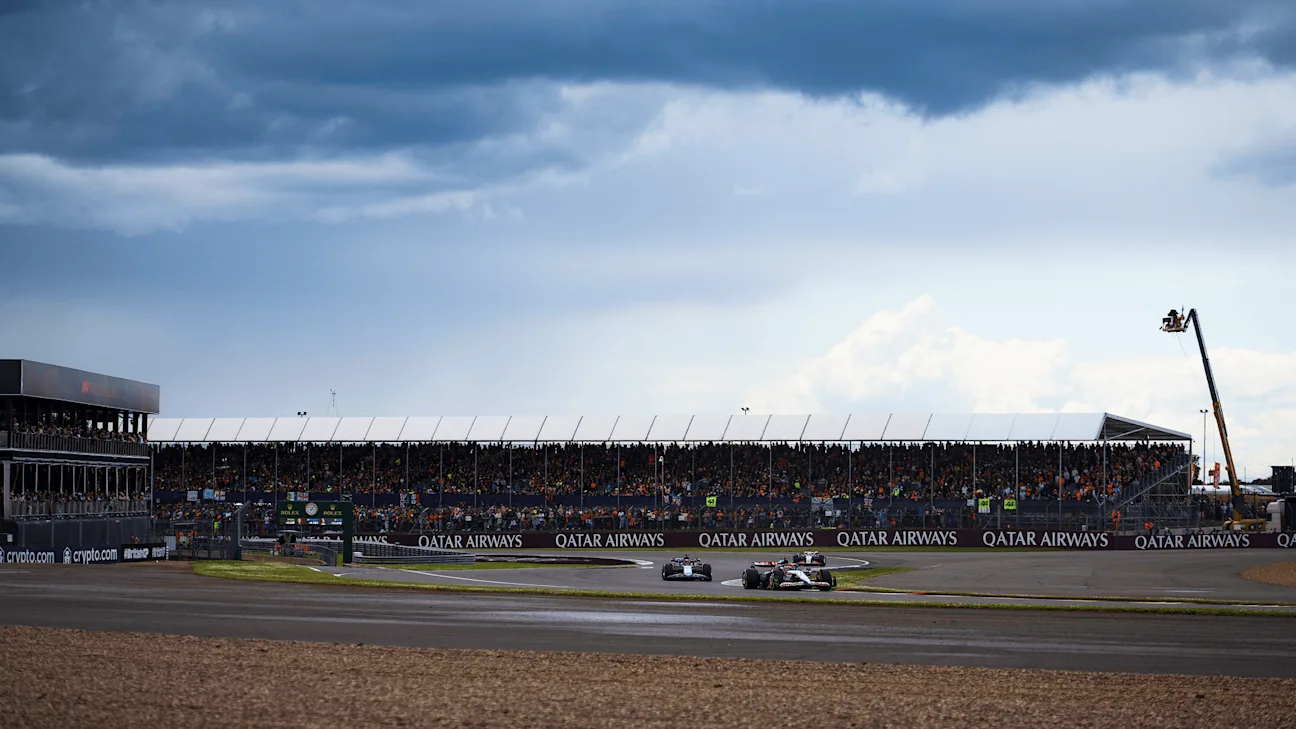
Silverstone is supposed to be one of Formula 1’s cleanest speed tests. That is why Max Verstappen’s warning about this weekend matters.
The British Grand Prix is next on F1’s official 2026 calendar, running from July 3-5 at Silverstone. After Red Bull’s stronger Austrian Grand Prix, the obvious storyline would be simple: Verstappen finished second, the upgrades looked real, and now the team gets a bigger stage to prove the car can chase Mercedes properly.
The more interesting story is less comfortable. Verstappen told reporters after Austria that Silverstone felt wrong in the simulator under the current 2026 power-unit formula, with too little battery available around the lap. The Guardian and Motorsport both picked up the same core issue: a fast, flowing circuit with long full-throttle sections and fewer heavy braking zones can expose the hybrid system’s energy limits in a way Austria did not.
That makes today’s Daily Dose of F1 more than a preview. It is the first big race-week test of whether F1’s energy-management debate is still an engineering footnote or a visible sporting problem.
Why this was the day’s strongest F1 story
This was the best non-duplicate story because it connects three things at once: a current driver warning, an official upcoming race, and a regulation debate that has already forced F1 and the FIA into future adjustments.
GearPulse recently covered the 2027-28 engine compromise, so another broad “F1 changed the rules” article would be a duplicate. This is different. Silverstone is now the live case study. The question is not whether the FIA has heard the drivers. It is whether the 2026 cars can make one of F1’s most famous high-speed circuits feel like Silverstone rather than an energy spreadsheet.
The trend signal was strong enough to clear the bar. The Guardian led with Verstappen’s British GP concern, Motorsport framed it around his simulator reaction, and official F1 material supplies the calendar, race-week context and Red Bull’s post-Austria performance evidence. The FIA source gives the regulatory backdrop: changes for 2027 and 2028 are already on the books, which tells you the complaint is not just paddock theatre.
The skipped alternatives were weaker. A Williams Silverstone livery piece had official imagery and home-race charm, but less competitive substance. Another Mercedes Austria follow-up would have overlapped yesterday’s GearPulse article. A Ferrari reality-check angle was valid after Austria, but it needed more fresh team-specific evidence to beat a live Silverstone performance question.
Why Silverstone is a brutal test for this formula
The Red Bull Ring helped Red Bull look more convincing because it has heavy braking zones where the car can recover energy cleanly. Silverstone asks a different question. It has long periods where the driver wants to keep the throttle pinned through high-speed corners and onto another straight, then expects the hybrid system to keep helping.
That is where 2026 F1 becomes awkward. If the car arrives at a long straight with too little electrical energy to deploy, the driver gets clipping or super-clipping: the sensation that the car is no longer pulling as expected before the braking zone arrives.
At a circuit like Silverstone, that is not a tiny technical detail. It can change how Copse, Maggots, Becketts, Chapel and the Hangar Straight feel as a sequence. The driver’s instinct is to carry speed and momentum. The power unit may force a more rationed lap.
GearPulse’s view: this is exactly the kind of problem that matters to fans even if they never say “energy deployment” out loud. People know what Silverstone should look like. If the cars visibly flatten before the end of the lap, the issue becomes emotional, not just technical.
Red Bull’s Austria step makes the warning sharper
The timing is important. Verstappen is not saying this after a hopeless weekend.
Formula 1’s official 2026 calendar records Austria as the previous round, with George Russell winning, Verstappen finishing second and Kimi Antonelli third. F1’s own post-race Red Bull coverage also framed Verstappen’s Austria drive as the team’s strongest of the season so far, with Laurent Mekies pointing to the progress Red Bull has made since the opening rounds.
That means Silverstone is not a write-off story. It is a translation story.
Austria suggested Red Bull’s package has moved closer. Silverstone may reveal whether that progress survives a circuit where energy recovery is less friendly. If Verstappen can still fight Mercedes there, Red Bull’s upgrade story becomes much more convincing. If the car looks muted down the long sections, Austria may prove to be more track-assisted than the podium suggested.
The comparison is useful:
| Question | Austria answer | Silverstone risk |
|---|---|---|
| Red Bull upgrade pace | Verstappen finished second and pressured the race story. | High-speed energy demand may hide some of the car’s gains. |
| Mercedes strength | Russell won, Antonelli made the podium. | Strong deployment could make Mercedes look even cleaner. |
| Ferrari recovery | Austria exposed race-day limits after strong Saturday signs. | Silverstone needs efficient aero and stable tyre phases, not only qualifying speed. |
| McLaren threat | Still present but not story-defining in Austria. | A balanced car could become a bigger race disruptor if others derate. |
The FIA’s future fix does not solve this weekend
The FIA has already ratified regulatory changes for 2027 and 2028, moving the formula back toward a greater internal-combustion share in stages. That context matters because it validates the direction of the criticism: drivers and teams have not been imagining the issue.
But it does not help anyone at Silverstone this weekend.
For 2026, the challenge remains the same: recover enough energy, deploy it at the right time, and avoid turning a famous high-speed lap into a sequence of compromises. The teams that have the best software maps, the most efficient aero package and the cleanest battery strategy will look smarter than teams with only raw peak speed.
That may make the British Grand Prix strategically fascinating. It may also make it less naturally dramatic if the cars cannot attack the lap in a way that matches the circuit’s reputation.
The caveat is important: no one outside the teams has the full simulation data. Verstappen’s comments are a strong signal, not a race result. Track temperature, wind direction, qualifying mode choices, tow effects and safety-car timing can all change how the weekend feels.
What to watch at the British Grand Prix
The first tell will be Friday’s speed trace, not the headline lap time. If cars are losing pull before braking zones at the end of the long runs, the fastest sector times may hide a stranger driving experience underneath.
The second tell will be Red Bull versus Mercedes. If Verstappen is close in the slow and medium-speed sections but gives away time through the high-speed full-throttle sequences, Silverstone will look like a regulation problem as much as a car-balance problem. If Mercedes stretches its legs, the Austrian win will start to look like part of a broader deployment advantage.
The third tell is whether drivers complain after the first meaningful sessions. F1 drivers often grumble about balance, tyres and traffic. When several of them converge on the same energy-management language, the story is usually real.
Here is the GearPulse probability board, as editorial analysis rather than betting advice:
| Silverstone read | Likelihood | Why |
|---|---|---|
| Energy management becomes a visible weekend talking point | 60-70% | Verstappen’s simulator warning fits the circuit layout and the season’s known hybrid complaints. |
| Mercedes starts as the cleaner competitive reference | 45-55% | Austria plus reported deployment strength make it the default benchmark. |
| Red Bull remains in the podium fight anyway | 40-50% | Verstappen’s Austria recovery and Red Bull’s upgrade progress are real, even if Silverstone is less friendly. |
| The race feels less compromised than the warning suggests | 25-35% | Teams may find better maps once track running, tow and tyre data replace simulator assumptions. |
Fun fact: Silverstone began life as a wartime airfield, which is part of why its old-school layout feels so broad and fast. Modern F1 energy management is now testing that heritage in a strange way: the problem is not whether the track is quick enough, but whether the car can keep feeding power through the lap.
Bottom line
Verstappen’s Silverstone warning is the right F1 story today because it makes the 2026 regulation debate immediate. This is not just a technical argument about future power-unit ratios. It is about whether a current car can make a current grand prix feel right.
If Silverstone produces natural, flat-out racing, the complaints will soften. If the cars spend the weekend visibly rationing battery through one of F1’s great high-speed sequences, the FIA’s 2027-28 correction will look less like overreaction and more like overdue repair.
GearPulse’s read: Red Bull’s Austria step is real, but Silverstone is the harsher exam. If Verstappen can keep Mercedes honest there, the upgrade story grows teeth. If he cannot, the British Grand Prix may become the clearest public evidence yet that 2026’s hybrid balance has asked too much of the show.
Support the site at buymeacoffee.com/gearpulse.site.