
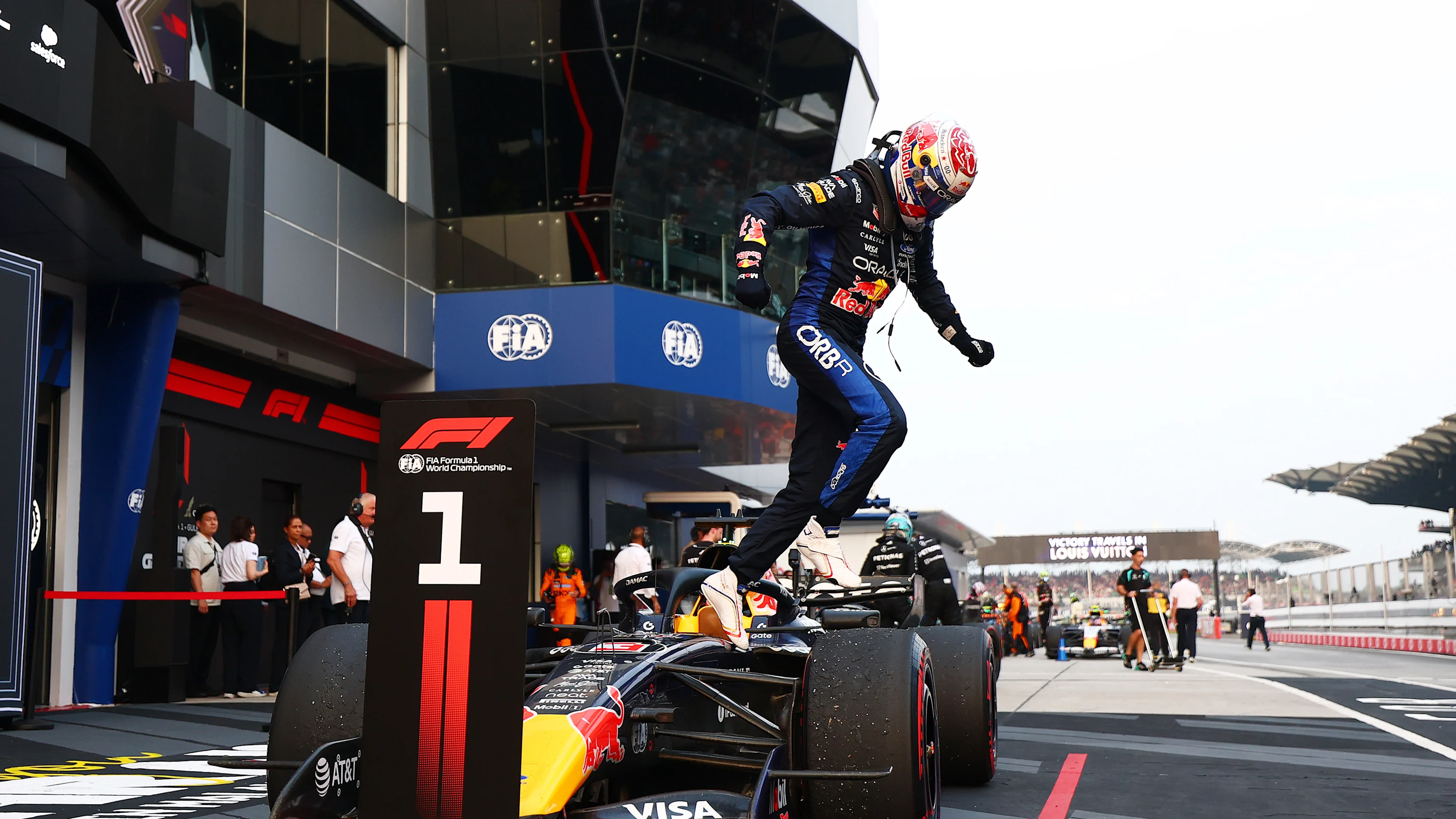
Max Verstappen won Formula 1’s improbable Bahrain Grand Prix in Malaysia, which is the headline. Kimi Antonelli’s second place is the championship consequence.
At a soaked Sepang, Red Bull’s pole sitter recovered from losing ground at the eventual start, passed both Mercedes cars and managed the late Safety Car to take the team’s first victory of 2026. Formula 1 records Antonelli 2.307 seconds behind and Lewis Hamilton 4.919 seconds back in third. George Russell’s retirement with five laps remaining means Antonelli’s lead has grown rather than merely survived a difficult Sunday.
That makes this more than a welcome win for a driver who had not stood on the top step since Abu Dhabi last year. Verstappen proved Red Bull could turn its stronger Sepang form into a race result; Antonelli turned a turbulent afternoon into the points outcome a title contender needs.
The result, stripped of the noise
The official classification shows 55 completed laps rather than the scheduled 56 after a race delayed by heavy rain, a suspended start procedure and two Safety Car interruptions. The top five read Verstappen, Antonelli, Hamilton, Charles Leclerc and Isack Hadjar.
| Finish | Driver | Team | Gap / result | Why it matters |
|---|---|---|---|---|
| 1 | Max Verstappen | Red Bull | 1:47:14.808 | Red Bull’s first win of 2026, converted from pole. |
| 2 | Kimi Antonelli | Mercedes | +2.307s | A controlled score when the race repeatedly changed character. |
| 3 | Lewis Hamilton | Ferrari | +4.919s | A recovery from an early slick-tyre gamble that initially went wrong. |
| Retired | George Russell | Mercedes | Late technical stoppage | The costly result for Antonelli’s closest championship rival. |
There is a useful separation to make here. Red Bull had the outright winner; Mercedes still had a car capable of putting both drivers at the front in the wet opening phase. Russell’s retirement was not a pace verdict. It was the kind of reliability loss that turns a close points day into a pivotal one, particularly when it hands a leading team-mate room to extend a championship advantage.
The early tyre call made the race
The weather did not merely add spectacle. It rearranged the technical assumptions that the pre-race Sepang tyre and energy preview identified as central to the weekend.
Heavy rain delayed the start, then a troubled formation-lap sequence delayed it further. Motorsport.com reports that several cars encountered throttle-related software trouble in the wet, while Formula 1 describes the initial start procedure being suspended after drivers struggled to maintain speed. Once racing finally began, the grid was split between intermediates and slicks.
Verstappen, Antonelli and Russell began on intermediates. Hamilton and Leclerc were among the high-profile drivers starting on slicks, a choice that sent the Ferraris backwards while the circuit was still too wet. When Valtteri Bottas’ lap-nine spin brought out the first Safety Car, the intermediate runners could switch to slicks in a much more favourable window. Verstappen then reclaimed the lead from the Mercedes pair as the track came to him.
That sequence is a reminder that strategy is not a binary choice between a brave call and a conservative one. It is an estimate of when the circuit will be usable, and of whether the car can survive the wrong phase long enough to reach the right one. Ferrari’s early call was punished, but its drivers retained enough pace and composure to turn a poor opening into third and fourth.
Red Bull’s win, Mercedes’ warning
Verstappen’s performance matters because it validates the wider speed profile that appeared in qualifying. Saturday’s pole suggested Red Bull had found range at Sepang, not simply one exceptional lap. Sunday supplied the harder test: changing grip, a tyre crossover, restarts and a lead to protect.
He passed Antonelli and Russell, built a lead, and did not give the race away when a late Safety Car removed much of that margin. That is a very complete kind of victory. It still does not prove that Red Bull has solved every circuit-specific problem for the rest of the season. Sepang’s mix of fast corners, long straights and tropical weather is a demanding but particular test. Singapore next weekend will ask a different question.
Mercedes should take a mixed reading from it. Antonelli’s second place under pressure was precisely the kind of result that makes a championship campaign resilient. Russell, who had been running third, lost the opportunity to contain the damage when his car stopped. Sky Sports reports that Antonelli’s title lead is now 84 points with seven rounds remaining; readers should treat that as the current post-race standing, not a guarantee about how the remaining calendar will unfold.
Hamilton showed what recovery pace is worth
Hamilton’s podium is easy to overlook because the winning story and the Russell retirement are so consequential. It was one of the day’s better drives.
Starting on a dry tyre cost Ferrari badly at first, but Hamilton held position enough for the improving surface and Safety Car timing to bring the race back within reach. Formula 1 reports that he passed Hadjar after the final restart, with Leclerc following to fourth. CNA independently describes the same swing from an early setback to a Ferrari third-four finish.
That recovery does not retroactively make the opening tyre decision correct. It does show that a strategically compromised race can still contain useful evidence: Ferrari had the pace and execution to salvage a major score once conditions matched the car. For a team searching for repeatable weekends, that is more valuable than a flattering but fragile qualifying position.
Bottom line
Verstappen earned the victory and Red Bull earned the validation. Both had to make their Sepang speed work when the weather turned the race into a sequence of fresh problems.
Antonelli, however, left Malaysia with the more durable prize. Second place in a difficult race is not glamorous until a rival’s retirement turns it into a meaningful championship cushion. The next races will decide whether Red Bull’s renewed breadth travels and whether Mercedes can convert its pace into two-car reliability. At Sepang, the winner was Verstappen; the title race moved toward Antonelli.
Support independent source-backed coverage at buymeacoffee.com/gearpulse.site.