
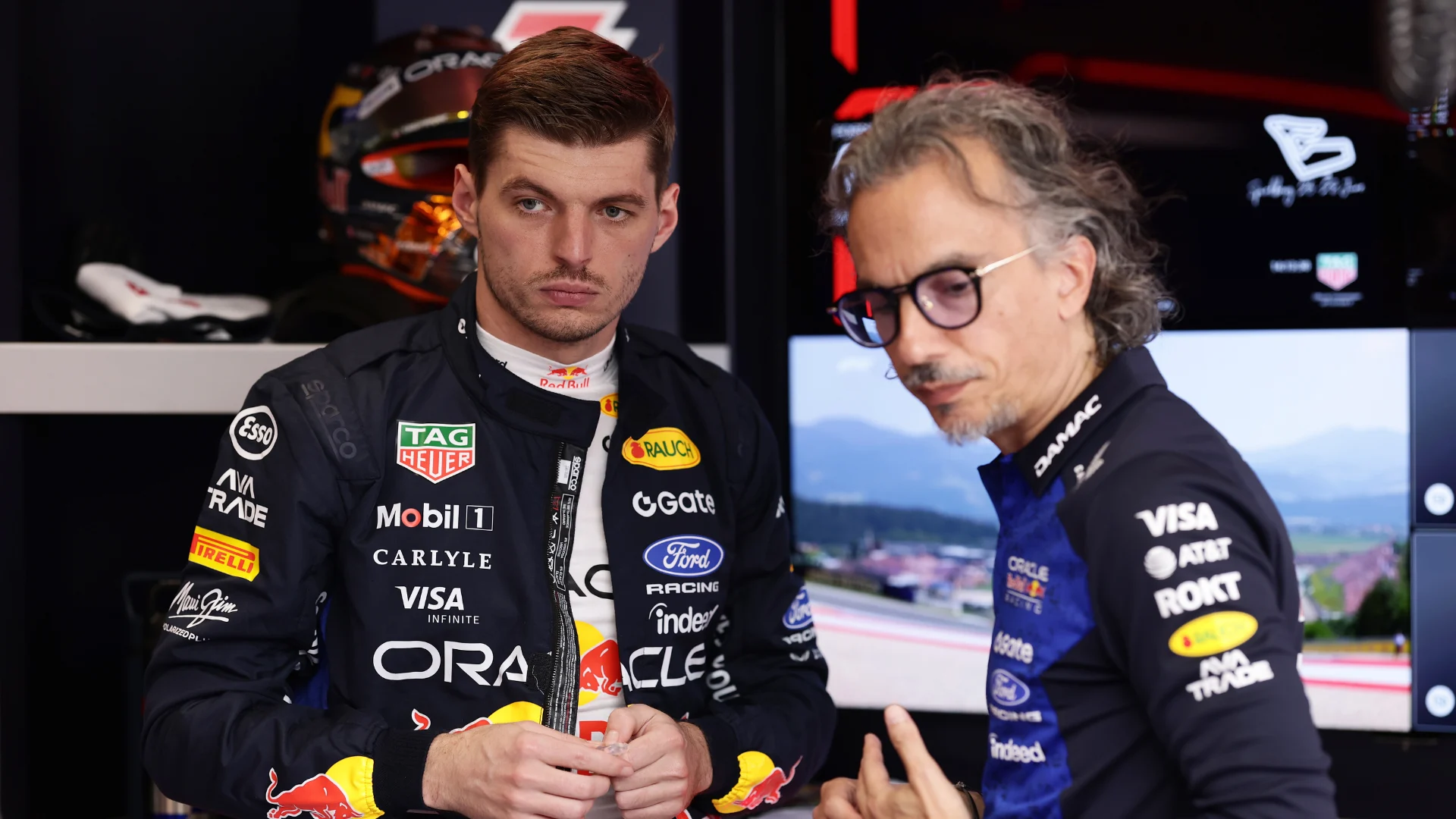
Max Verstappen’s Red Bull question is not really about a clause, a rival seat or a dramatic goodbye.
It is about trust.
Formula 1’s own latest analysis put Verstappen’s future back in focus after Silverstone, where a rear-wing problem pitched him out of a likely podium result. Red Bull’s race report confirms the core damage: Verstappen had climbed back into contention when an issue with the rear wing cost him downforce at Stowe and ended his race with just over four laps remaining.
That is why this is today’s Daily Dose of F1. GearPulse already covered the active-aero safety question on July 7. This is the next layer: how repeated car failures, a nine-race win drought, and the coming Spa decision turn Red Bull’s Verstappen relationship into a credibility test for Laurent Mekies’ team.
GearPulse’s view: Verstappen staying at Red Bull still looks more likely than a sudden exit. But “likely” is not the same as secure. The next week matters because Spa is exactly the place where Red Bull has to choose between peak performance and the driver’s confidence in the car.
Why this story rose today
The Verstappen future story usually needs heavy filtering. F1 is always full of contract smoke, and the fastest driver on the grid will always be linked with every ambitious team.
This time, the noise has substance because it is tied to hardware.
Formula 1’s July 10 piece says Verstappen’s future is being discussed again after Red Bull’s difficult Silverstone weekend, and notes the wider context: Red Bull has often been around the fourth-best car in 2026, Verstappen has gone nine races without a win, and there are believed to be performance-related clauses in his Red Bull deal. It also reports that Verstappen’s camp has sounded out options, including McLaren, while making the obvious but important caveat that such conversations are normal in F1.
RacingNews365 added same-day pickup on July 11 with Red Bull pushing back against the idea that Verstappen’s frustration has become unmanageable. That matters less as a denial than as a signal. When a team has to address the emotional state of its franchise driver, the story has already moved beyond a simple technical failure.
The reason it travels is obvious: Verstappen is not just another unhappy driver. He is the driver around whom modern Red Bull has been built.
The car is the contract
Contracts matter, but in F1 they rarely decide everything by themselves. Performance does.
Verstappen’s Red Bull contract runs to the end of 2028, yet Formula 1’s analysis points to performance-related escape possibilities depending on circumstances. That does not mean an exit is imminent. It does mean Red Bull cannot treat the paper deal as insulation if the RB22 keeps failing him in visible, high-speed moments.
The key phrase from Silverstone was not really about the future. It was Verstappen explaining the effect of the rear wing not closing fully: the car loses downforce and spins. Formula 1’s post-race report captured the emotional result too: Verstappen called the repeated problem painful and frustrating, and said he wanted to go home and not think about F1.
That is not a negotiation strategy. It is a driver describing the limit of his tolerance.
For Verstappen, trust is performance. He can live with a car that is not the fastest if he believes it will respond honestly. He has built much of his Red Bull career on taking liberties with cars that other drivers would find uncomfortable. What he cannot sensibly accept is uncertainty over whether the rear aero state will be there when he commits to a fast corner.
That is why the retention issue is more practical than theatrical. Red Bull does not need to give him a speech. It needs to give him a car he can commit to at Spa.
Spa makes the problem sharper
Formula 1’s official Belgian Grand Prix page confirms Spa-Francorchamps is next, on July 17-19. The circuit is 7.004km long, the longest on the current calendar, with long straights and fast corners that expose both drag and confidence.
That is exactly why Red Bull’s decision is so awkward.
Motorsport.com reported that Red Bull has “all options open” for Spa after investigating Verstappen’s rear-wing failure, including not using the rotating rear-wing concept there. The Race reported the same basic tension: Red Bull could park the trick wing after the Verstappen incidents.
On pure lap time, Spa is the sort of place where a strong low-drag rear-wing solution should be tempting. The Kemmel Straight rewards efficiency. The run through Eau Rouge, Raidillon, Pouhon and Blanchimont punishes doubt. In the 2026 active-aero era, that is not just a setup trade. It is a trust trade.
| Red Bull choice for Spa | What it says to Verstappen | Competitive cost |
|---|---|---|
| Keep the same rotating-wing specification | We believe the concept is now safe enough | Lowest short-term drag cost, highest trust risk |
| Revise the mechanism or limits | We still believe in the idea, but the failure mode matters | Medium risk if validation is rushed |
| Use a more conservative rear wing | Your confidence comes before cleverness this weekend | Possible straight-line and energy-deployment loss |
| Split experiments across practice | We need evidence before deciding | More data, but less settled preparation |
GearPulse’s probability read, as editorial analysis rather than betting advice: a modified or more conservative Spa approach feels more likely than Red Bull running the identical Silverstone-spec solution without visible changes. Put that at roughly 60-70%. The chance of a dramatic Verstappen exit before the end of 2026 still feels lower, around 20-30%, because the obvious rival seats are complicated and Red Bull remains the team most structured around him.
But those numbers can move. Another high-speed failure would change the conversation immediately.
Hadjar complicates the optics
Red Bull’s British GP was not a total collapse. Isack Hadjar finished fifth and gave the team 10 points. Red Bull’s own report says he recovered through a messy race after a slow stop and a front-wing change.
That is useful, but it also makes the Verstappen story more complicated.
Hadjar’s result shows the RB22 was not simply hopeless at Silverstone. There was enough pace and enough opportunism for a strong finish. Verstappen, meanwhile, had dragged himself into third before the failure. That supports the familiar Red Bull pattern: even in a compromised year, Verstappen can put the car somewhere it probably does not belong.
The danger for Red Bull is that this becomes emotionally inverted. If Verstappen keeps overdelivering and the car keeps letting him down, every “he can still score big points” weekend becomes proof of how much the team is wasting.
Hadjar matters for another reason. A strong team-mate should help Red Bull look less Verstappen-dependent. But if the team’s recovery story still turns on whether Verstappen believes the car, Red Bull is not yet structurally healthier. It is just getting better at damage limitation.
Why McLaren talk is not the whole answer
The McLaren link is irresistible because it sounds explosive: reigning champion team, elite driver, Red Bull uncertainty.
The practical barriers are large. Formula 1 notes McLaren has Lando Norris and Oscar Piastri under contract, Mercedes has locked in George Russell and Kimi Antonelli, and Ferrari is set with Charles Leclerc and Lewis Hamilton. F1 deals can be broken, but breaking them for Verstappen would require a team to accept cost, internal disruption and a major strategic bet.
That makes Red Bull’s position stronger than the headlines suggest. Verstappen may look around because any serious driver-management team would. Looking around is not the same as leaving.
The better question is not “which seat can he get?” It is “how long can Red Bull ask him to keep carrying imperfect cars while the team rebuilds around the 2026 rules?”
That is where Laurent Mekies’ challenge sits. Christian Horner-era Red Bull had a long institutional memory of turning pressure into performance. Mekies’ Red Bull has to prove the same thing without asking Verstappen to buy the idea on reputation alone.
The difference from July’s wing-safety story
There is an overlap here, so it is worth being clear.
The July 7 GearPulse article was about whether F1’s rotating rear-wing concepts had crossed into a safety and regulatory test. That question still stands. The FIA, Red Bull and Ferrari all have reasons to study the fail-safe behavior of these systems.
Today’s angle is different. It is about what the same technical problem does inside Red Bull’s driver relationship.
In championship terms, one DNF is expensive. In trust terms, a repeat high-speed aero problem is more expensive. It can change how early a driver commits to throttle, how much faith he has in the setup direction, and how willing he is to accept “we understand it now” after the next debrief.
That is why Red Bull’s best answer is not a denial of frustration. It is a clean Spa weekend with a car Verstappen can lean on.
Fun fact with a hard edge
Spa has a way of exposing whether a car is honest. Its modern layout is shorter than the old 14.9km road circuit, but at 7.004km it is still long enough that weather, drag, deployment and driver confidence can all swing a lap.
That matters because Red Bull’s 2026 weakness is not one-dimensional. The RB22 has needed straight-line efficiency, better balance, and now reliability in the active-aero hardware. Spa asks for all three at once.
The old Red Bull advantage was that Verstappen could turn a small car edge into a large result. The current worry is the reverse: a small doubt in the car could become a large restraint in the driver.
Bottom line
Red Bull’s Verstappen problem is not that he is definitely leaving. He probably is not, at least not immediately.
The problem is that the team has given him reasons to think about it.
After Silverstone, the contract story, the rear-wing story and the Spa story have merged. Red Bull can calm the first by solving the second before the third. That means no repeat failure, no vague explanations, and no car that asks Verstappen to trust a system the team has not fully proven.
If Spa is clean, the driver-market noise probably cools. If Spa is messy, every rival-team rumour will sound less like gossip and more like contingency planning.
For now, Red Bull’s task is brutally simple: make Verstappen believe the car again.