
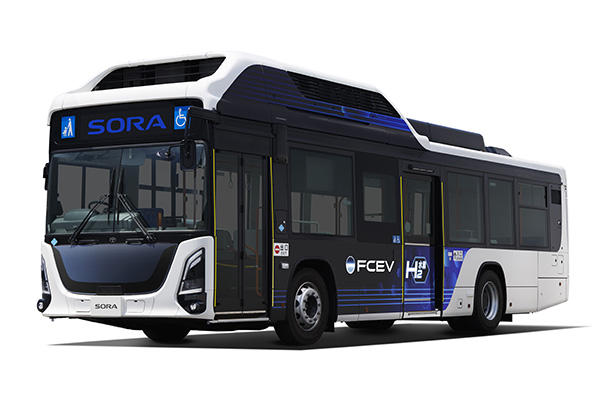
Hydrogen buses have a habit of arriving as tidy future-tense propositions: clean at the tailpipe, quick to refuel, and dependent on the stations that do not yet exist in enough places. Toyota’s newly launched Sora is more interesting because it makes a quieter argument. The bus is designed around the unglamorous parts of a route operator’s day: flat floors, passenger capacity, maintenance access and an emergency stop if a driver is incapacitated.
Launched in Japan on October 5, the second-generation Sora combines Toyota’s fuel-cell system with Isuzu’s battery-electric, full-flat route-bus platform. It is a commercial vehicle, not a consumer product, but it is a useful indicator of where the hydrogen case is strongest: high-utilisation fleets that cannot casually absorb long charging windows and can plan fuel supply around a depot.
A smaller hydrogen store, a longer stated route
Toyota says the new Sora exceeds 300 km on its own measurements. That is roughly 100 km more than the first-generation bus, even though total hydrogen-tank capacity is about 20% lower. The company credits a more efficient use of the fuel cell and a larger traction battery; the system’s roof-mounted packaging is also intended to make servicing easier.
Those are the figures that matter more than a launch-day promise of a “hydrogen society.” A transit authority must know whether one fuel stop fits an actual block of work, whether a vehicle can carry people without a compromised interior, and whether staff can maintain it without a bespoke ritual.
| New Sora urban model | Toyota’s stated specification |
|---|---|
| Range | More than 300 km, measured by Toyota; real-world distance varies with temperature, traffic, passenger load and air-conditioning |
| Passenger capacity | 70 total: 19 seated, 50 standing and one crew member |
| Fuel-cell stack | 113 kW polymer-electrolyte stack |
| Traction motor output | 220 kW total (two 110 kW motors) |
| Hydrogen storage | Three 70 MPa tanks, 471 L total volume |
| Vehicle dimensions | 10,545 mm long, 2,485 mm wide and 3,440 mm high |
The caveat under that range claim is important. It is not a certified, route-by-route guarantee, and Toyota explicitly says ambient temperature, traffic, occupancy and climate control change the result. A 300-km figure still tells an operator something useful, though: it puts the vehicle in a conversation about a full service day rather than a short demonstration loop.
The full-flat floor is the point people will actually notice
The fuel-cell hardware is packaged on the roof, leaving an uninterrupted low, flat passenger area from front to rear. That is the sort of decision that makes a technology legible outside an engineering meeting. It affects wheelchairs, buggies, older passengers and the time it takes for a crowded vehicle to empty at a stop.
Toyota also lists a one-touch wheelchair-securing system and an Emergency Driver Stop System linked to a driver-status monitor. If the system identifies a driver problem, Toyota says it can slow and stop the bus, then apply the parking brake. These are manufacturer-described functions rather than independent road-test findings, but they show the programme is being judged against daily accessibility and safety requirements, not simply emissions messaging.
Electrive and Sustainable Bus independently report that the bus uses Isuzu’s full-flat battery-electric platform under Toyota’s fuel-cell system. That hybrid of responsibilities is revealing. Fuel cells supply long-running energy, while the battery helps manage power demand; the passenger compartment gets to benefit from a platform conceived for a modern city bus in the first place.
Hydrogen has a narrower, more credible job to do
Sora does not settle the battery-versus-hydrogen debate, and it should not be read as a reason to put hydrogen everywhere. Battery buses can be compelling where charging is inexpensive and well scheduled. Hydrogen’s obstacle is still the fuel ecosystem: a bus is only as useful as the station, storage and delivery plan behind it.
That is why a route-bus launch is more persuasive than another concept car. Fleets have recurring duties and central operating bases, which give a refuelling network a defined first customer. Toyota says it has supplied more than 3,500 fuel-cell systems to over 100 customers worldwide since 2019, across buses, rail and stationary generation; that is company-provided context, not proof that every hydrogen deployment will pencil out.
GearPulse recently covered Toyota and Scania’s planned 40-truck hydrogen fleet. The two stories share the same discipline: hydrogen earns its place when a predictable fleet can make use of the infrastructure, rather than when the technology is asked to mimic the convenience of a private petrol car.
For riders, the Sora’s relevance is less about the chemistry above the roof than the bus at the kerb. If Toyota’s range and maintenance claims hold up in duty cycles, the practical win is a zero-tailpipe-emission route bus with a genuinely accessible layout—not a futuristic-looking vehicle that asks passengers to accept a compromised one. That is a far better standard for judging hydrogen transport, and Sora is at least aiming at it.