
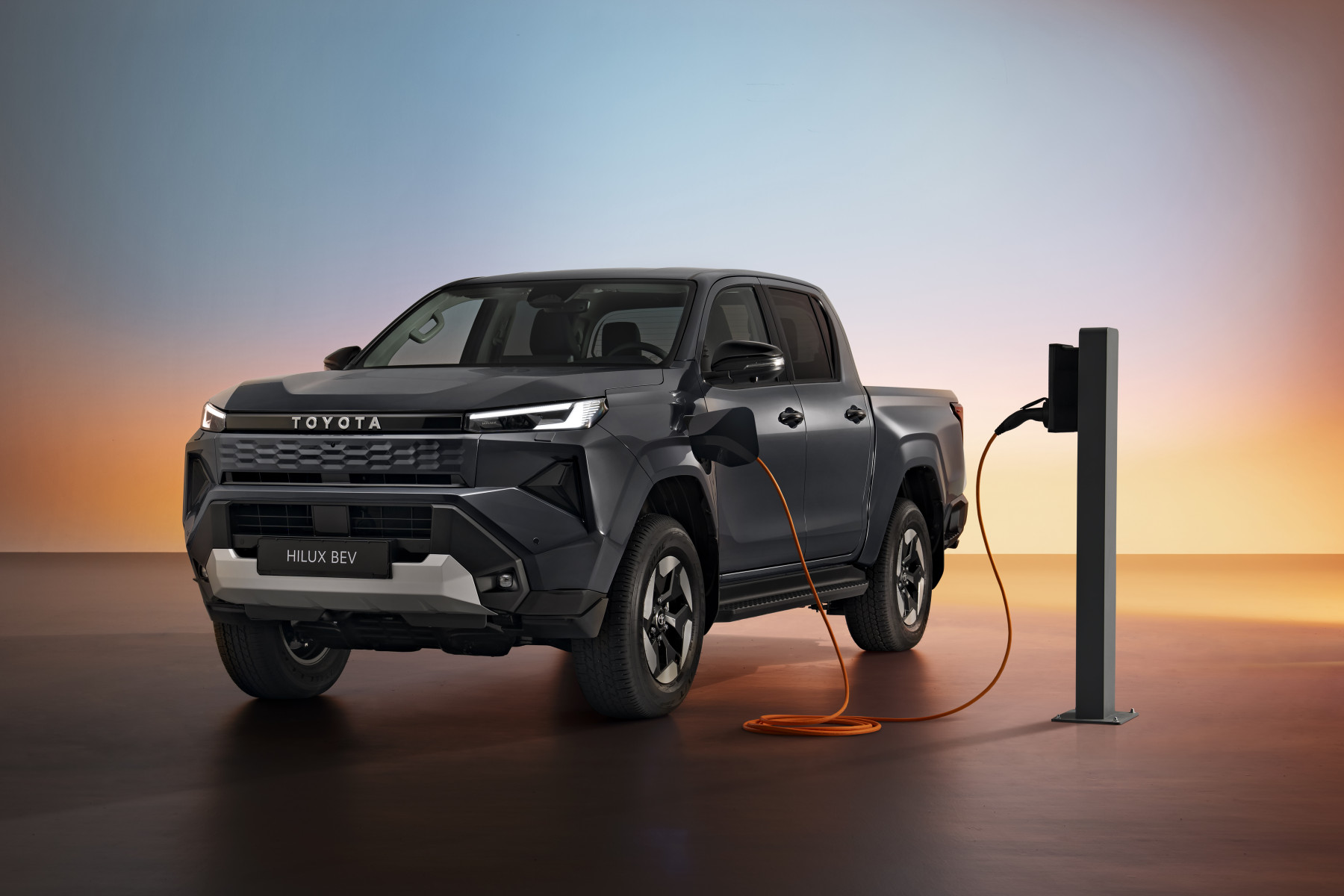
Toyota’s first electric pickup was never going to be judged only by range.
Electrek’s latest pricing report puts the Hilux BEV back in the practical part of the EV conversation: price, work use, towing, charging speed, and whether a battery pickup can do enough without trying to be a lifestyle flagship. Toyota’s official Hilux material frames the battery-electric version as part of the ninth-generation truck family, not as a separate halo machine.
That is the right lens. The Hilux name has always been about usefulness first.
The spec sheet tells a cautious story
The reported technical package is not outrageous. Electrek cites a dual-motor all-wheel-drive setup, a 59.2 kWh battery, a WLTP range of up to 160 miles, and a higher city-cycle figure. The tow rating cited in the report is around 3,700 pounds.
Those numbers will not scare the electric truck market in North America. But Hilux is not a North American full-size pickup. It is a global work truck, and the first BEV version looks designed around fleets, city duty, local deliveries, municipal work, and markets where diesel restrictions are tightening.
Where it makes sense
| Use case | Fit |
|---|---|
| Urban fleet work | Strong, if charging is predictable and routes are short. |
| Rural long-distance work | Less convincing until range and charging are clearer. |
| Towing-heavy use | Possible, but not the natural first mission. |
| Image-led EV buyers | Probably too utilitarian to be the exciting choice. |
Toyota’s real test
Toyota has been cautious with full EV pickups, and the Hilux BEV shows that caution clearly. It does not look like a truck built to win internet spec comparisons. It looks like a controlled launch for customers who already understand the Hilux and need a lower-emission tool.
That may be frustrating if you wanted Toyota to go directly after the most powerful electric trucks. It may also be smarter.
Bottom line
The electric Hilux matters because Toyota is finally putting a battery into one of its most durable workhorse nameplates.
The first version does not need to be spectacular. It needs to be credible, priced honestly, and useful enough for the fleets that can charge it every night. That is a smaller story than an EV moonshot, but it is probably the more important one.