
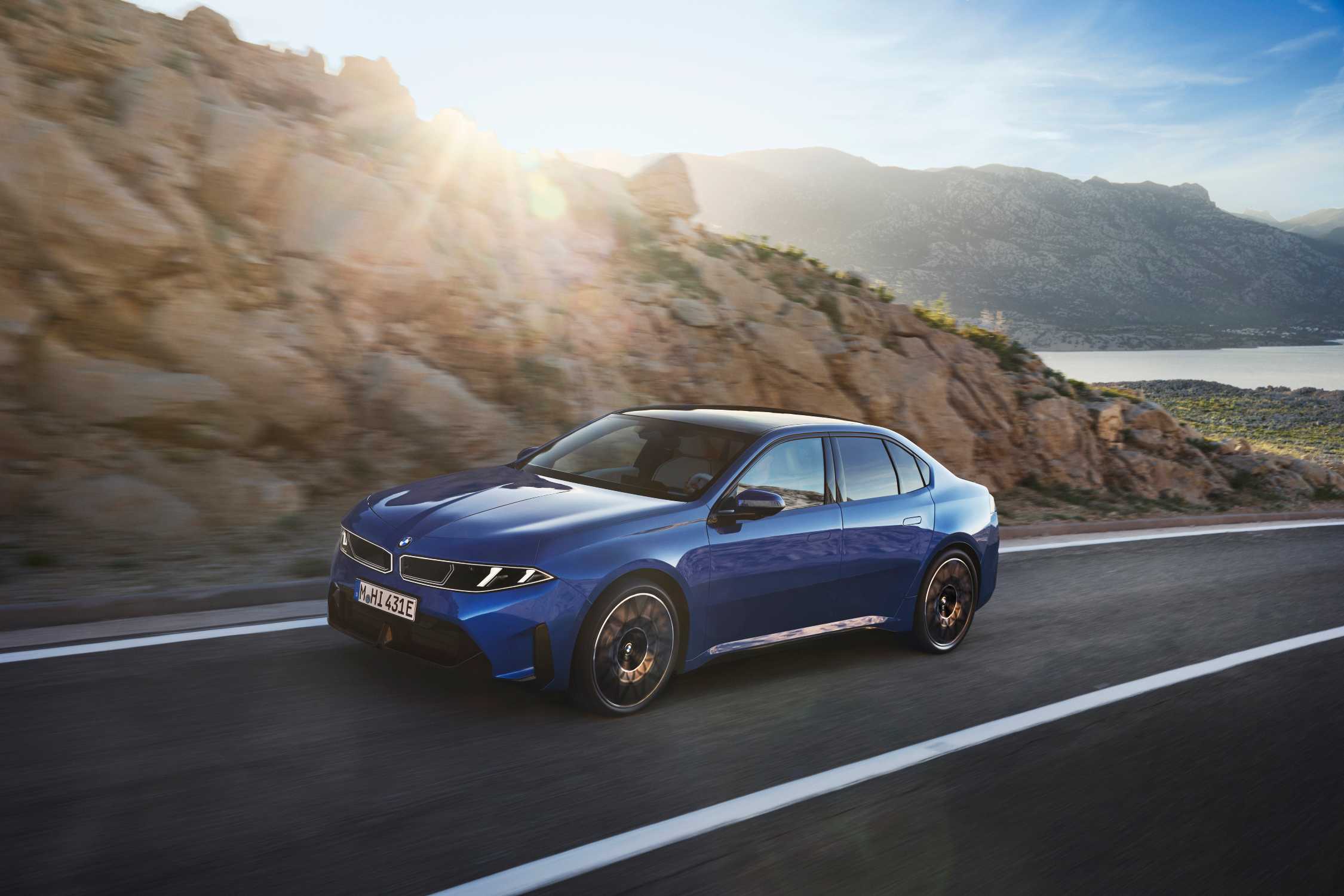
BMW has given the 3 Series its biggest reset since the nameplate appeared in 1975. The eighth-generation sedan (internal code G50) puts a battery-electric i3 and petrol-powered 3 Series models under one Neue Klasse design language, but they are not simply the same car with different propulsion. The i3 has a dedicated 800V electric architecture; the petrol cars retain a conventional longitudinal-engine layout with 48V mild-hybrid assistance.
First, a naming correction that matters. BMW did not unveil a 320i or M350i. The badges are BMW 320 and BMW M350 xDrive. BMW has dropped the traditional trailing “i” here, while the all-electric sedan takes the i3 name. In the United States, the four-cylinder launch car is instead called the 330 or 330 xDrive, with a different published output. Market names, equipment and figures vary, so this guide separates BMW’s global technical data from the announced UK and US lineups.
The full announced range at a glance
BMW has disclosed five core global derivatives: the entry-level 318, 320, M350 xDrive, i3 40 xDrive and i3 50 xDrive. The i3 M60 xDrive and a plug-in hybrid are confirmed for later, but BMW has not released their full technical specifications. All performance, consumption and range figures below are provisional WLTP/German-market figures unless marked otherwise.
| Model | Drivetrain | Output / torque | 0-100 km/h | Top speed | Efficiency / range | Status |
|---|---|---|---|---|---|---|
| BMW 318 | 2.0L turbo I4, 48V mild hybrid, RWD, 8-speed auto | 156 hp / 250 Nm | 9.5 sec | 215 km/h | 6.5-7.5 L/100 km; 148-169 g/km CO2 | Confirmed global launch model |
| BMW 320 | 2.0L turbo I4, 48V mild hybrid, RWD, 8-speed auto | 211 hp / 330 Nm | 7.4 sec | 240 km/h | 6.5-7.5 L/100 km; 148-169 g/km CO2 | Confirmed global/UK launch model |
| BMW M350 xDrive | 3.0L turbo I6, 48V mild hybrid, AWD, 8-speed sport auto | 443 hp / 580 Nm | 4.1 sec | 250 km/h | 7.5-8.2 L/100 km; 171-187 g/km CO2 | Confirmed global launch model |
| BMW i3 40 xDrive | Dual-motor EV, AWD | 374 hp / 520 Nm | 5.4 sec | 200 km/h | 14.3-17.9 kWh/100 km; up to 710 km WLTP | Confirmed electric launch model |
| BMW i3 50 xDrive | Dual-motor EV, AWD | 469 hp / 645 Nm | 4.7 sec | 200 km/h | 13.4-18.0 kWh/100 km; up to 912 km WLTP | Confirmed electric launch model |
| BMW i3 M60 xDrive | Dual-motor M Performance EV, AWD | Not yet disclosed | Not yet disclosed | Not yet disclosed | Not yet disclosed | Due in 2027 |
| 3 Series plug-in hybrid | Not yet disclosed | Not yet disclosed | Not yet disclosed | Not yet disclosed | Not yet disclosed | Confirmed for a later date |
The headline is breadth, not a single drivetrain: BMW is selling an entry petrol sedan, a six-cylinder M Performance sedan, two long-range AWD EVs, and will add both a PHEV and a faster electric M Performance model.
Petrol cars: 318, 320 and M350 xDrive
BMW 318: the confirmed entry point
The 318 is easy to miss because the broader announcement focuses on the 320 and M350, but BMW’s technical data confirms it as a launch derivative. It uses a 1,998cc four-cylinder petrol engine, a belt-driven 48V starter-generator, rear-wheel drive and an eight-speed Steptronic automatic. BMW quotes 156 hp, 250 Nm, 0-100 km/h in 9.5 seconds and a 215 km/h top speed.
In Germany, BMW says it starts at EUR49,900. It is not listed in BMW UK’s two-model petrol launch range and has not been announced for the US. That is a good example of why an international launch list should not be read as a promise for every local showroom.
BMW 320: the car formerly expected to be called 320i
The BMW 320 pairs the same 1,998cc turbo four with a 48V belt-driven starter-generator, rear-wheel drive and eight-speed Steptronic transmission. Output is 155 kW/211 hp and 330 Nm, which BMW says is 27 hp more than the prior-generation equivalent. The company quotes 7.4 seconds to 100 km/h, a 240 km/h top speed and 6.5-7.5 L/100 km WLTP.
It weighs 1,680 kg DIN, has a 59-litre fuel tank and 450 litres of boot space. The UK launch price is GBP44,975 on the road; BMW’s German list price is EUR54,900. The UK car’s standard equipment includes 18-inch wheels, a panoramic glass roof, heated electrically adjustable front seats, Driving Assistant Plus, Comfort Access, BMW Digital Premium, a rear camera and Econeer upholstery. Exact standard kit will differ elsewhere.
BMW M350 xDrive: the six-cylinder flagship, not an M3 replacement
The M350 xDrive replaces the M340i naming convention and is the petrol range-topper at launch. It is still an M Performance model rather than a full M3. Its 2,998cc straight-six produces 313 kW/426 hp on its own; a crankshaft-driven 48V motor integrated in the transmission contributes up to 13 kW/18 hp, for a quoted system maximum of 326 kW/443 hp and 580 Nm. BMW says the new turbochargers help create a 69 hp improvement versus its predecessor.
Standard hardware is substantial: xDrive all-wheel drive, eight-speed Steptronic Sport transmission, adaptive M suspension, variable sport steering, M Sport differential, M Sport brakes and 19-inch 1139 M wheels. It also gets extra front-end bracing, altered anti-roll-bar mounts, a rear spoiler and the expected four tailpipes. BMW quotes 0-100 km/h in 4.1 seconds, 250 km/h electronically limited, 1,860 kg DIN weight, 450 litres of luggage space and up to 1,800 kg braked towing.
The party trick is Drift Moment. Activated on the central display, it sends engine drive exclusively to the rear axle for controlled oversteer. BMW says it will arrive during 2027 and can be supplied to already-delivered M350s through a software update. It is reserved for M Performance models; do not read it as a permanent rear-drive conversion or as a feature available at the first deliveries.
BMW’s published German starting price is EUR80,900 and the UK price is GBP66,785. The US M350 xDrive has a lower quoted 437 hp and 428 lb-ft (580 Nm) figure, a USD65,900 MSRP before USD1,350 destination, and a claimed 3.9-second 0-60 mph time. Those regional figures are not interchangeable.
The electric 3 Series is the i3
The new i3 should not be confused with BMW’s discontinued small city EV. It is the first fully electric 3 Series and its own Neue Klasse sedan architecture is 5 mm shorter but 15 mm wider, 25 mm taller and 37 mm longer in wheelbase than the petrol car. Both launch i3s are dual-motor xDrive models: an electrically excited synchronous motor drives the rear axle most of the time, and a compact asynchronous motor supports the front axle when required.
The core electric upgrades are sixth-generation BMW eDrive, an 800V system, new cylindrical lithium-ion cells, cell-to-pack construction and a pack-to-open-body design that makes the battery a structural element. BMW also fits its Heart of Joy control computer, which integrates propulsion, braking, energy recuperation and steering functions with the BMW Dynamic Performance Control software stack.
| Electric specification | i3 40 xDrive | i3 50 xDrive |
|---|---|---|
| System output | 275 kW / 374 hp | 345 kW / 469 hp |
| System torque | 520 Nm | 645 Nm |
| Net battery capacity | 82.8 kWh | 108.7 kWh |
| Claimed WLTP range | 566-710 km (up to 441 mi) | 729-912 km (up to 567 mi) |
| 0-100 km/h | 5.4 sec | 4.7 sec |
| DC peak charge rate | 300 kW | 400 kW |
| 10-80% DC charge | 21 min | 21 min |
| Added WLTP range in 10 min | 251-337 km | 320-423 km |
| AC charging | 11 kW standard / 22 kW optional | 11 kW standard / 22 kW optional |
| 0-100% AC at 11 kW | 8 hr 15 min | 11 hr |
| 0-100% AC at 22 kW | 4 hr 15 min | 5 hr 30 min |
The i3 40 xDrive starts at EUR59,900 in Germany and GBP47,925 in the UK; the i3 50 xDrive starts at EUR65,900 and GBP53,425 respectively. BMW USA currently announces only the i3 50 xDrive, from USD61,500 before destination, for first-quarter 2027 launch.
Both EVs are electronically limited to 200 km/h. They measure 4,760 mm long, 1,865 mm wide and 1,480 mm high, with a 2,897 mm wheelbase. Each has 420 litres of rear cargo capacity plus a useful 31-litre under-bonnet compartment, so its total quoted storage is 451 litres. Both can tow up to 1,800 kg braked, carry 75 kg on the roof and have an 1,800 kg braked trailer rating in BMW’s German technical data.
Bidirectional capability is unusually complete on paper: vehicle-to-home and vehicle-to-grid are rated at 11 kW DC; vehicle-to-load is an optional 3.7 kW AC function. BMW says the Multifunction Charger and V2L adapter are expected from the fourth quarter of 2026. Availability, grid approvals and compatible hardware are market-dependent, so potential buyers should treat that as a feature to confirm with a local dealer rather than a universal launch entitlement.
i3 M60 xDrive: confirmed, but still not fully specified
BMW says the i3 M60 xDrive M Performance model is coming in 2027. It will use Gen6 M eDrive, two motors and steering-wheel shift paddles to adjust M eDrive response. BMW has shown M-specific lighting graphics and available 21-inch aerodynamic wheels, but it has not released output, battery, acceleration, range, price or charging data. Any precise performance numbers circulating before BMW publishes them are not official specifications.
One design language, two bodies beneath it
The exterior makes a deliberate effort to look like one 3 Series family. Every version has the Neue Klasse 2.5-box silhouette, short overhangs, a set-back glasshouse, flared arches, flush door handles and a front graphic that joins the kidney grille and twin headlights. Iconic Glow illumination is optional; M Performance cars gain M Yellow lighting graphics, a rear spoiler and four exhaust outlets in the M350’s case.
Petrol models are 4,765 mm long, 1,850 mm wide, 1,455 mm tall and ride on a 2,860 mm wheelbase. Their drag coefficients are 0.26 for the 318/320 and 0.28 for the M350. The i3’s 0.21 drag coefficient is a major part of its exceptional paper range, alongside the larger battery option.
Wheel sizes run from 18 to 20 inches on petrol models, while i3 models start at 19 inches and can reach 21 inches. The i3 offers nine wheel/aero-wheel designs in total. BMW says up to 11 paint finishes will be offered at launch, including M Le Castellet Blue metallic, with more BMW Individual colours promised during 2027.
Cabin, infotainment and assistance systems
The cabin is defined by BMW Panoramic iDrive and Operating System X. It combines the full-width Panoramic Vision projection at the base of the windscreen, an optional BMW 3D head-up display, a 17.9-inch driver-angled central screen, a new multifunction steering wheel and BMW’s touch, haptic and voice controls. Operating System X is based on the Android Open Source Project and supports over-the-air updates. BMW Digital Premium can add entertainment, security and expanded navigation services; BMW says Alexa+ integration will roll out gradually, beginning in Germany and the US.
Standard seats are electrically adjustable with memory and Travel & Comfort mounting. Four interior themes are offered: Econeer fabric, Veganza, M Veganza/M PerformTex and BMW Individual Merino leather. The i3’s optional multifunction seats can include massage; combustion models can instead be specified with seat ventilation. The rear backrest folds 40:20:40 in every version.
BMW calls the assistance package an SAE Level 2 system, not autonomous driving. Driving Assistant Plus handles speed, following distance and lane keeping; BMW Symbiotic Drive is designed to let the driver accelerate, steer or brake without immediately cancelling assistance. On approved motorways in 21 countries, Motorway Assistant supports hands-free driving up to 130 km/h/81 mph while still requiring attention. BMW says navigation-guided partially automated urban driving functions will follow in 2027.
Launch timing, production and regional availability
BMW i3 production began at Plant Munich in August 2026, where the first 3 Series was built in 1975. Petrol 3 Series production is due to begin at Dingolfing in November 2026. BMW says UK i3 deliveries begin in autumn 2026 and petrol deliveries in January 2027. The US expects the i3 50 xDrive, 330, 330 xDrive and M350 xDrive in the first quarter of 2027.
That US lineup needs a footnote. BMW USA lists a 255 hp, 295 lb-ft 2.0-litre 330 and 330 xDrive rather than Europe’s 211 hp rear-drive 320; it does not list the 318 or i3 40 xDrive at launch. BMW also quotes a US M350 output of 437 hp rather than the 443 hp published globally. Treat BMW’s regional press sites and local configurators as the final word for ordering.
What has not been announced
BMW has not announced a Touring/wagon, diesel, full M3, rear-wheel-drive i3, pricing for every market, or final specifications for the i3 M60 xDrive and PHEV. It has also not released independent range or charging tests. The WLTP numbers are excellent but laboratory comparison figures; weather, wheel choice, speed, battery condition, route and auxiliary loads will change real-world results.
Bottom line
The G50 3 Series is a more serious technology split than its shared styling suggests. The 318 and 320 keep the traditional rear-drive petrol-sedan formula alive; the M350 preserves BMW’s six-cylinder M Performance rung with much more power; and the i3 is a clean-sheet 800V EV with 441-567 miles of quoted WLTP range and 300-400 kW DC charging.
The crucial buyer advice is simple: use the exact regional spec sheet. “320i,” “M350i” and “electric 3 Series” are useful search terms, but BMW’s actual launch names and equipment differ by market. The confirmed cars are the 318, 320, M350 xDrive, i3 40 xDrive and i3 50 xDrive, with an i3 M60 xDrive and PHEV still ahead.
Support the site at buymeacoffee.com/gearpulse.site.