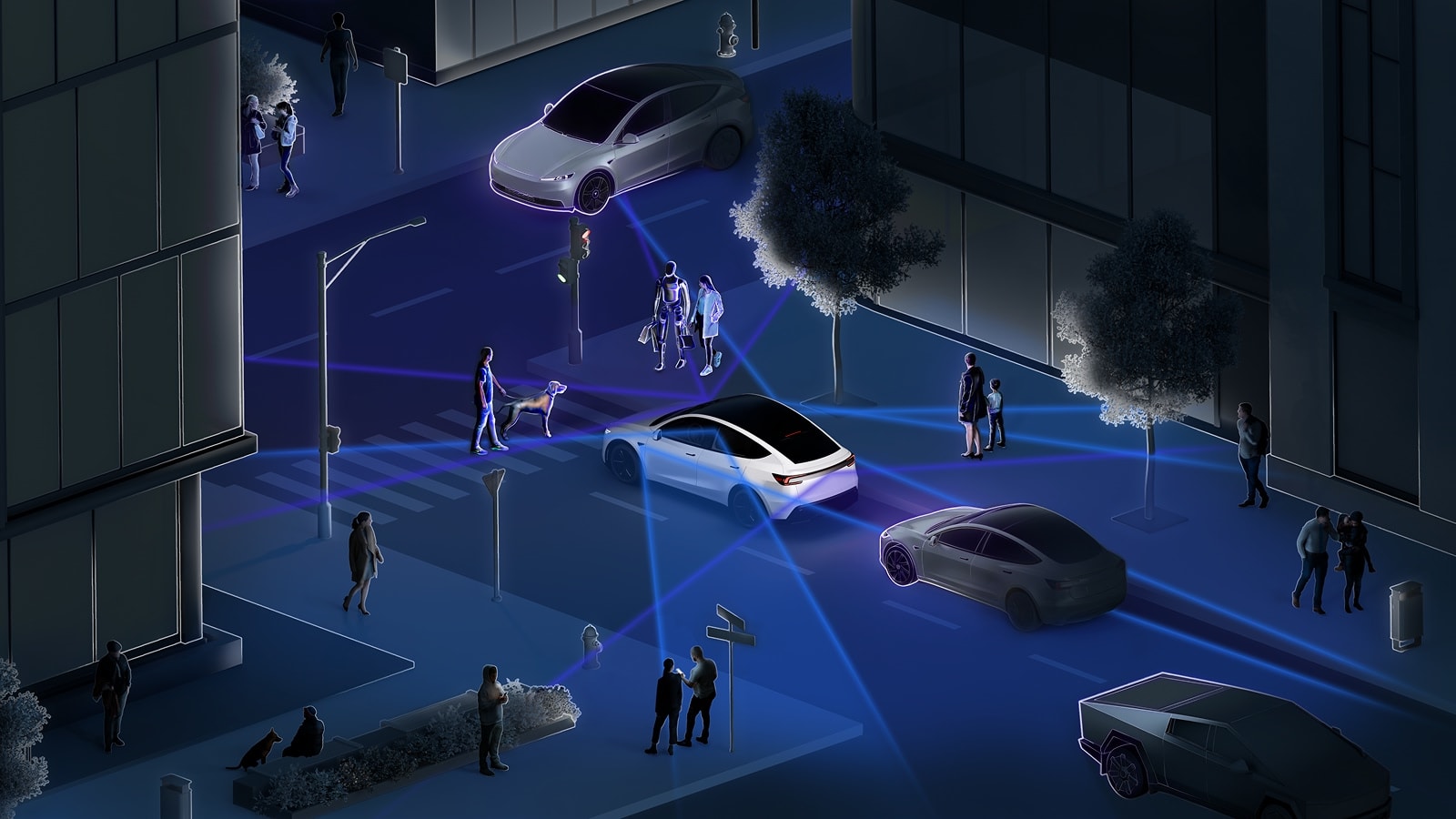
Tesla’s Full Self-Driving story keeps trying to move faster than its own product name.
The customer-facing product is still called Full Self-Driving (Supervised). Tesla’s support page says the system can drive the vehicle under the driver’s supervision and handle lane changes, route following, turns, and navigation around traffic. The same page also says those features do not make the vehicle fully autonomous or replace the driver.
That is not a small legal footnote. It is the whole story.
TechCrunch’s latest mobility roundup pulled together the tension around Tesla’s automated-driving system: more scrutiny after a fatal Texas crash, an existing NHTSA investigation into FSD performance in reduced visibility, and Tesla continuing to position FSD as the key revenue-generating proof point for its AI future. Electrek added the other half of the pressure: Elon Musk has again said unsupervised FSD could become widespread in the U.S. by year-end.
The practical question is not whether Tesla can show impressive drives. It can. The question is whether the current supervised system, the safety data, the investigations, and the timeline promises all point in the same direction.
Right now, they do not.
What Tesla officially says FSD can do
Tesla’s public FSD materials are more careful than the name sounds. The support page describes a driver-assistance system that can perform a wide range of driving tasks, but only under supervision. The owner manual is even blunter: drivers must pay attention and be prepared to take immediate action.
That makes the product easier to understand if you separate the marketing name from the operating duty.
| FSD point | What Tesla says now | Reader takeaway |
|---|---|---|
| Product name | Full Self-Driving (Supervised) | The parenthetical matters |
| Driver role | The driver remains responsible | It is not a hands-off, sleep-in-the-car system |
| Capability | Route following, lane changes, turns, and other maneuvers | Advanced assistance, not proven general autonomy |
| Official safety data | Tesla reports collision rates using its own telemetry and definitions | Useful, but not the same as independent certification |
| Unsupervised future | Promised repeatedly by Elon Musk in various timelines | Treat timing claims as provisional until Tesla and regulators demonstrate it |
Tesla’s safety report is important because it lays out definitions. The company explains how it classifies collision events, how it counts FSD engagement near a collision, and how it compares FSD (Supervised) against manually driven Tesla vehicles with and without active safety features.
That transparency is useful. It also creates questions.
Safety data is not the same as permission
Tesla’s safety report can support a case that FSD (Supervised) is improving. It does not, by itself, prove that FSD is ready to become an unsupervised consumer autonomy product everywhere.
There are several reasons.
First, Tesla’s data is fleet telemetry under Tesla’s definitions. That does not make it worthless. It does mean readers should separate company-reported safety rates from independent regulatory approval, third-party test results, and crash-by-crash causation.
Second, driving environments are uneven. A system can perform very well on many roads and still struggle with rare but serious edge cases. NHTSA’s preliminary evaluation into Tesla FSD specifically focused on crashes in reduced roadway visibility, including conditions such as glare, fog, or airborne dust. That is exactly the sort of edge case that separates impressive automation from dependable autonomy.
Third, customer behavior matters. A supervised system relies on humans staying ready even when the car performs well for long stretches. That is a difficult human-factors problem because the better automation gets, the easier it is for drivers to overtrust it.
The current scrutiny is not just noise
TechCrunch reported that NHTSA and NTSB have opened investigations into a fatal Texas crash where the driver reportedly said an automated driving-assistance system was active, while Tesla’s AI software chief publicly disputed that framing by pointing to accelerator override behavior. That distinction may prove important, but it also shows why independent investigation matters.
TechCrunch also noted a separate lawsuit settlement tied to a fatal 2023 crash involving FSD (Supervised), connected to the broader reduced-visibility investigation. None of that automatically proves FSD caused a specific crash. It does show that Tesla’s move from supervised assistance toward broader autonomy is happening under active scrutiny.
That scrutiny is especially relevant because Tesla does not sell FSD as a quiet driver-assistance feature. It is central to the company’s AI story, robotaxi story, valuation story, and software-margin story.
The promise gap keeps widening
Electrek’s coverage of Musk’s latest timeline claim is useful because it puts the promise in context. Musk reportedly said unsupervised FSD would be widespread in the U.S. by the end of the year, while Electrek pointed back through years of missed autonomy timelines.
That history matters for readers, even if Tesla’s software is genuinely improving. Repeated missed timelines change how a new timeline should be weighed.
| Claim area | Why it is hard to evaluate |
|---|---|
| ”Widespread” availability | Could mean geography, fleet scale, customer cars, robotaxis, or limited service areas |
| ”Unsupervised” use | Requires a different safety, liability, and regulatory posture than FSD Supervised |
| Safety comparison | Depends on definitions, road mix, driver mix, disengagement behavior, and reporting rules |
| Real-world readiness | Needs proof across weather, visibility, construction, unusual road users, and messy intersections |
Tesla may eventually make the jump. But the honest consumer article today has to say the jump has not happened for ordinary customers.
What Tesla owners should do now
If you already use FSD (Supervised), the practical advice is boring because it has to be: treat it as supervised driver assistance. Watch the road. Keep control authority in your head, not just your hands. Be especially skeptical in construction zones, poor visibility, unusual intersections, school zones, emergency scenes, and places where local driving behavior is chaotic.
If you are shopping a Tesla because of future autonomy, buy the car you can use today. Do not make the purchase pencil out based on a promised unsupervised capability arriving on a specific schedule.
That is not anti-Tesla. It is the only reasonable way to evaluate a feature whose current official documentation still makes the human driver responsible.
Bottom line
Tesla has the most visible consumer driver-assistance story in the EV market, and its official safety report gives supporters more data to discuss. But the defining word is still “Supervised.”
Until Tesla can show unsupervised readiness with independent scrutiny, clear operating limits, and regulatory confidence, FSD should be treated as a powerful assistance system rather than a finished autonomy product.