
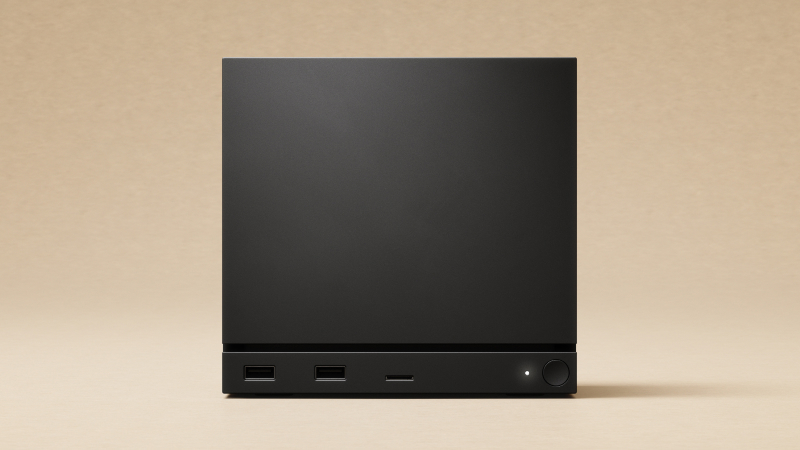
The new Steam Machine is no longer a rumor, a Linux hobby box, or a nostalgic punchline from Valve’s first living-room PC attempt. It is a real 2026 product with official hardware pages, reservation coverage, review units, benchmark videos, and a price that changes the entire conversation.
Valve’s pitch is elegant: a small cube that brings PC gaming to the TV with SteamOS, a console-like interface, Proton compatibility, a custom AMD platform, and a living-room design that does not look like a mid-tower gaming PC lying on its side. The catch is also simple: the Steam Machine is priced like a proper PC.
What Valve is selling
Valve describes the Steam Machine as powerful PC gaming made easy in a small package. The official page positions it as a big-screen Steam box with a semi-custom AMD desktop-class CPU and discrete GPU, a 4K/60 fps target with FSR, SteamOS, and the same broad Steam library logic that made the Steam Deck work.
The core spec picture is:
| Spec | Steam Machine 2026 |
|---|---|
| CPU | Semi-custom AMD Zen 4, 6 cores / 12 threads |
| GPU | Semi-custom AMD RDNA 3, 28 compute units, 8GB GDDR6 |
| System memory | 16GB DDR5 |
| Storage | 512GB or 2TB NVMe SSD, with microSD expansion |
| OS | SteamOS |
| Video output | HDMI 2.0 and DisplayPort 1.4 |
| Wireless | Wi-Fi 6E and Bluetooth 5.3 |
| Wired networking | Gigabit Ethernet |
| Target | 4K gaming at 60 fps with FSR |
That is not a PlayStation-style fixed-function console. It is a small SteamOS PC with a carefully controlled hardware target. That distinction matters because it explains both the appeal and the frustration.
Price and availability
The price is the part everyone is arguing about. Rock Paper Shotgun’s Steam-syndicated coverage says the 512GB Steam Machine starts at GBP 879 / USD 1049 / EUR 1039, while the 2TB model is GBP 1149 / USD 1349 / EUR 1359. Bundling a Steam Controller pushes the higher configuration to GBP 1208 / USD 1428 / EUR 1428.
That is not cheap-console territory. It is not even Steam Deck OLED territory. It is compact gaming PC territory.
Availability is also not a normal walk-in launch. Recent coverage describes a reservation system, limited supply, and component-price pressure around RAM and storage. Valve reportedly points to the same ugly market reality everyone building PCs now recognizes: memory and storage did not get cheaper on schedule, and AI infrastructure demand has distorted component pricing.
The benchmark reality
Reviews make the Steam Machine sound like a lovely object and a complicated recommendation. PC Gamer praises the idea, design, quietness, and living-room integration, but its verdict is blunt about value. In demanding games, the machine often needs reduced settings and upscaling to stay comfortable. Gamers Nexus’ YouTube review focuses heavily on CPU and GPU benchmarks, thermals, noise, SteamOS behavior, and the price problem. That is exactly the right lens because this product lives or dies on whether convenience can justify the hardware delta.
The short version:
| Area | What early reviews suggest |
|---|---|
| Industrial design | Strong, compact, living-room friendly |
| Noise and thermals | Better than many small PCs |
| SteamOS experience | Good if you live inside Steam, still PC-like at the edges |
| Performance | Fine for many games, not magic for new AAA titles |
| Value | Hard sell versus a discounted console or a self-built PC |
This is the problem with calling it a console. A console buyer compares it to a PS5 Pro or Xbox plus Game Pass. A PC buyer compares it to a tower, a mini PC, or a discounted GPU build. The Steam Machine is trying to win on integration, not raw frames per dollar.
The good argument for it
There is a real buyer for this. If your Steam library is already your main gaming library, you want a box under the TV, you do not want Windows update drama in the living room, and you value a quiet, compact, repairable-ish system with Valve software support, the Steam Machine is appealing.
The Steam Deck proved that Valve can make hardware better by owning the whole experience around it. Game mode, suspend/resume, controller mapping, per-game profiles, Proton improvements, and Deck Verified labels all reduced the friction of PC gaming. The Steam Machine extends that idea to the TV.
It also gives developers another stable-ish PC target. Not as stable as a console, but more coherent than the chaotic Windows desktop market.
The bad argument against it
The price is brutal. At USD 1049 before the controller, buyers are allowed to ask why they should not buy or build a stronger gaming PC. At USD 1349 or more, they are allowed to ask very loudly.
There is also the anti-cheat and compatibility issue. SteamOS and Proton are much better than they used to be, but some multiplayer games still treat Linux as a problem. Valve can keep improving this, but buyers should not assume every Windows game will behave perfectly.
And then there is performance marketing. “4K/60 with FSR” is not the same as native 4K/60. It can still be a good living-room experience, but demanding games will need compromises.
Should you buy it?
If you want the best performance for the money, probably not. A conventional gaming PC is more flexible and can be faster for the same spend, especially if you already know how to shop parts. If you want a conventional console, this is too expensive and too PC-like.
If you want a Steam-first living-room computer that behaves more gracefully than a Windows box on a TV, the Steam Machine becomes interesting. It is for people who want PC gaming convenience, not PC gaming tinkering.
Bottom line
Valve has built the Steam Machine that should have existed years ago: small, clean, SteamOS-native, technically credible, and designed around the way people actually use Steam now. Unfortunately, it arrives in a hostile component market with a price that makes every benchmark feel personal.
My read: the Steam Machine is good hardware with a bad-value shadow. I like the idea a lot. I would not call it a mainstream console killer. I would call it the most polished niche living-room PC anyone has made yet.