
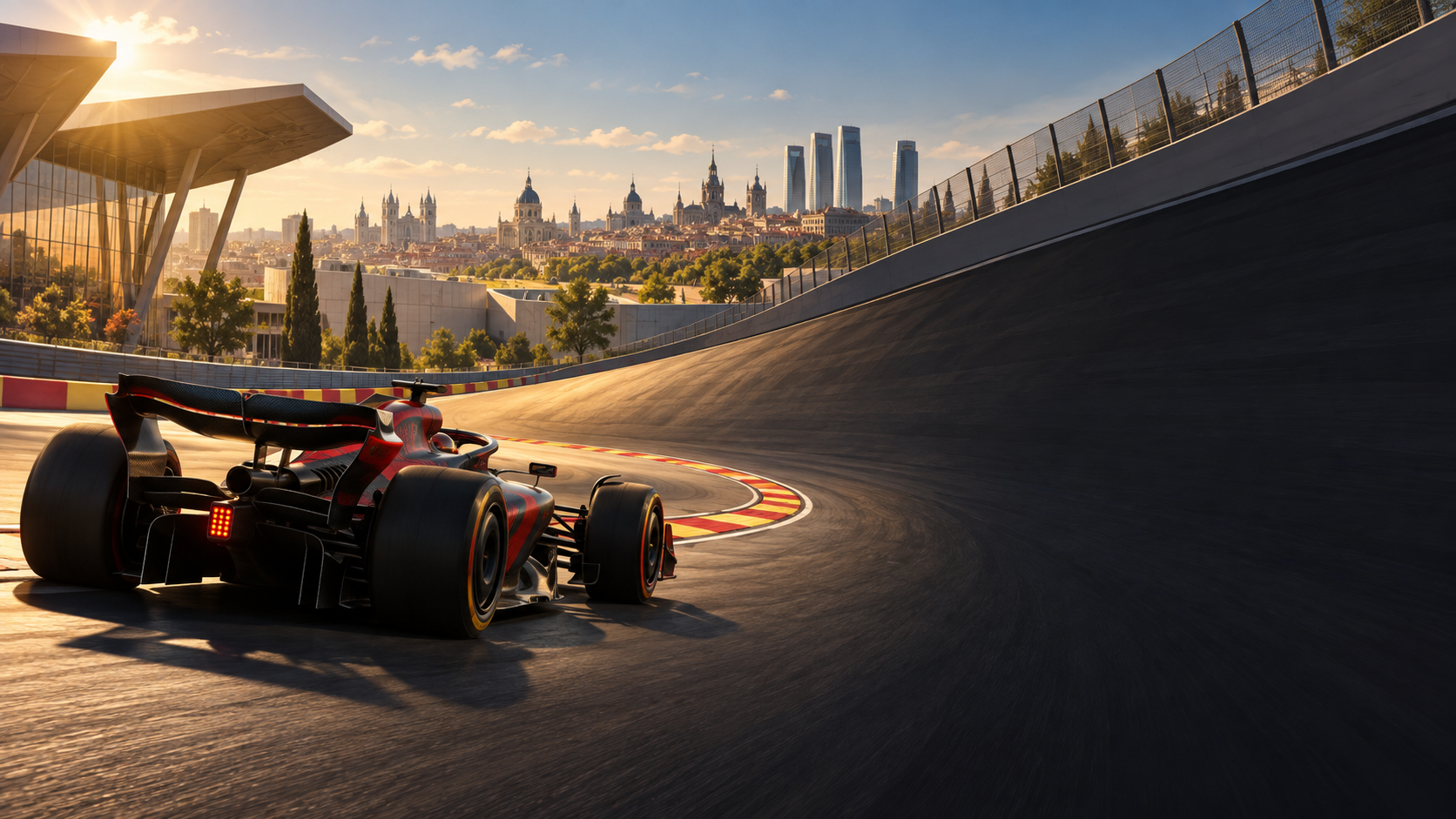
Spanish Grand Prix Qualifying is scheduled to begin at 14:00 UTC on Saturday, September 12 — 16:00 CEST in Madrid. Formula 1’s official timetable places the one-hour session at the new Madring, a 5.414 km, 22-corner circuit that will host a 57-lap Grand Prix on Sunday.
This is an event-start preview, not a live report. GearPulse is not trackside, has no live timing or telemetry access, and makes no claim about the session’s outcome. The useful question as qualifying begins is simpler: which car can give its driver a platform they can trust from the first braking phase to the final corner?
One lap has to work everywhere
Madring is a new Formula 1 reference. Formula 1 last raced in Madrid at Jarama in 1981; this is not a familiar layout with a deep setup archive. The new venue combines permanent and public-road sections, and its defining feature is La Monumental, the long, steeply banked Turn 12. Formula 1 and Pirelli identify high vertical loading there, while the new surface starts the weekend with less historical grip data than an established circuit.
That makes qualifying a test of repeatability rather than a contest to chase one impressive speed trace. A very low-drag car can be compelling on the straights, but it must also arrive stable at the braking zones and let the driver carry confidence through the banking and technical sections.
| Madring fact | Qualifying consequence |
|---|---|
| 5.414 km and 22 corners | The car needs a usable balance across fast, medium- and low-speed phases. |
| Smooth, new asphalt | Tyre preparation and mechanical grip can change quickly as the surface evolves. |
| Long banked Turn 12 | Vertical and lateral load reward a settled platform more than a nervous peak. |
| 57-lap, 308.399 km Grand Prix | Saturday’s setup cannot ignore the cooling and tyre stability needed for Sunday. |
For GearPulse readers, that is the engineering comparison worth keeping in view: ultimate efficiency versus the confidence to exploit it. A package that is fractionally slower in a straight-line state can be the more useful qualifying car if the driver can brake later, rotate once and commit to the next section without compensating twice.
Straight Mode changes the old DRS shorthand
This is not a conventional DRS-era qualifying lap. The FIA’s 2026 rules use moveable front and rear wings: Straight Mode reduces drag in designated sections, while Corner Mode restores downforce. At Madring, Formula 1 has identified two Straight Mode zones — the start/finish straight and the run between Turns 3 and 4.
The distinction is practical. Straight Mode is not merely a top-speed button; teams must manage the transition back to a braking and cornering platform. The best low-drag phase is of little value if it makes the rear of the car uncertain at corner entry or compromises the tyre surface before the lap’s demanding middle section.
That makes the active-aero trade-off more visible than it was under the old DRS language. One team can prioritise peak velocity, another may prefer a larger stability margin, and a third may seek the most consistent energy and aero-state handoff. Qualifying rewards the answer that produces one complete lap.
Heat makes tyre preparation part of the setup
Pirelli’s allocation is C2 hard, C3 medium and C4 soft. The soft is the natural qualifying tyre, but a fresh circuit and high ambient temperature create a narrow preparation window. Formula 1’s pre-session forecast calls for a dry Saturday, with temperatures rising from about 16C in the morning to 31C during the day and track temperatures peaking around 50-51C. Motorsport.com’s independent weekend guide also points to a hot, dry Saturday.
That forecast is not a claim about conditions once the session is running. It does, however, explain why brake temperatures, out-lap discipline and the rear axle are all part of the same problem. A tyre that starts too cool can cost confidence at the first serious braking zone; one pushed beyond its useful window can make the final part of the lap less precise.
Race strategy is necessarily provisional at a circuit with no prior Formula 1 Grand Prix distance to study. The 57-lap race, hot forecast, smooth surface and heavy banking load pull the calculation in different directions. Rather than inventing a one- or two-stop verdict, the more useful qualifying context is whether a setup can build temperature cleanly while preserving enough cooling and tyre life for the rest of the weekend.
Home focus, shared technical problem
Carlos Sainz and Fernando Alonso naturally draw a home-race spotlight, but this is a level starting point in a more important sense: every driver is learning a brand-new Formula 1 circuit. The quickest adaptation may come from committing early to braking references and banking lines, yet engineers still need feedback that separates a driver adjustment from a car characteristic.
The same applies across McLaren, Mercedes, Ferrari, Red Bull and the rest of the grid. No team gets to import a previous Madring setup. Independent coverage from Motorsport.com and Autosport has emphasised the new circuit’s evolving surface, heat and walls; those are reasons to value a driver-friendly car, not reasons to pretend an outcome is already known.
What to watch without chasing the timing screen
Look for stability at the end of the two Straight Mode sections. A car that arrives calmly at the next braking phase gives its driver more usable margin than one built only around a terminal-speed figure.
Look for a clean approach to the banking. The relevant clue is not a dramatic slide but whether the platform lets a driver carry commitment without spending the next corners correcting it.
And listen for language around tyres, brake confidence and cooling. At a hot, new 22-corner venue, those details explain the package better than a single sector comparison.
The confirmed frame is clear: qualifying starts at 14:00 UTC, at 16:00 local time, on a 5.414 km, 22-corner circuit, with C2-C3-C4 tyres, two designated Straight Mode zones and a hot, dry forecast. Madring’s first Formula 1 qualifying session is a high-pressure one-lap exercise, but the decisive advantage will be the car that makes its complicated technology feel simple to drive.