
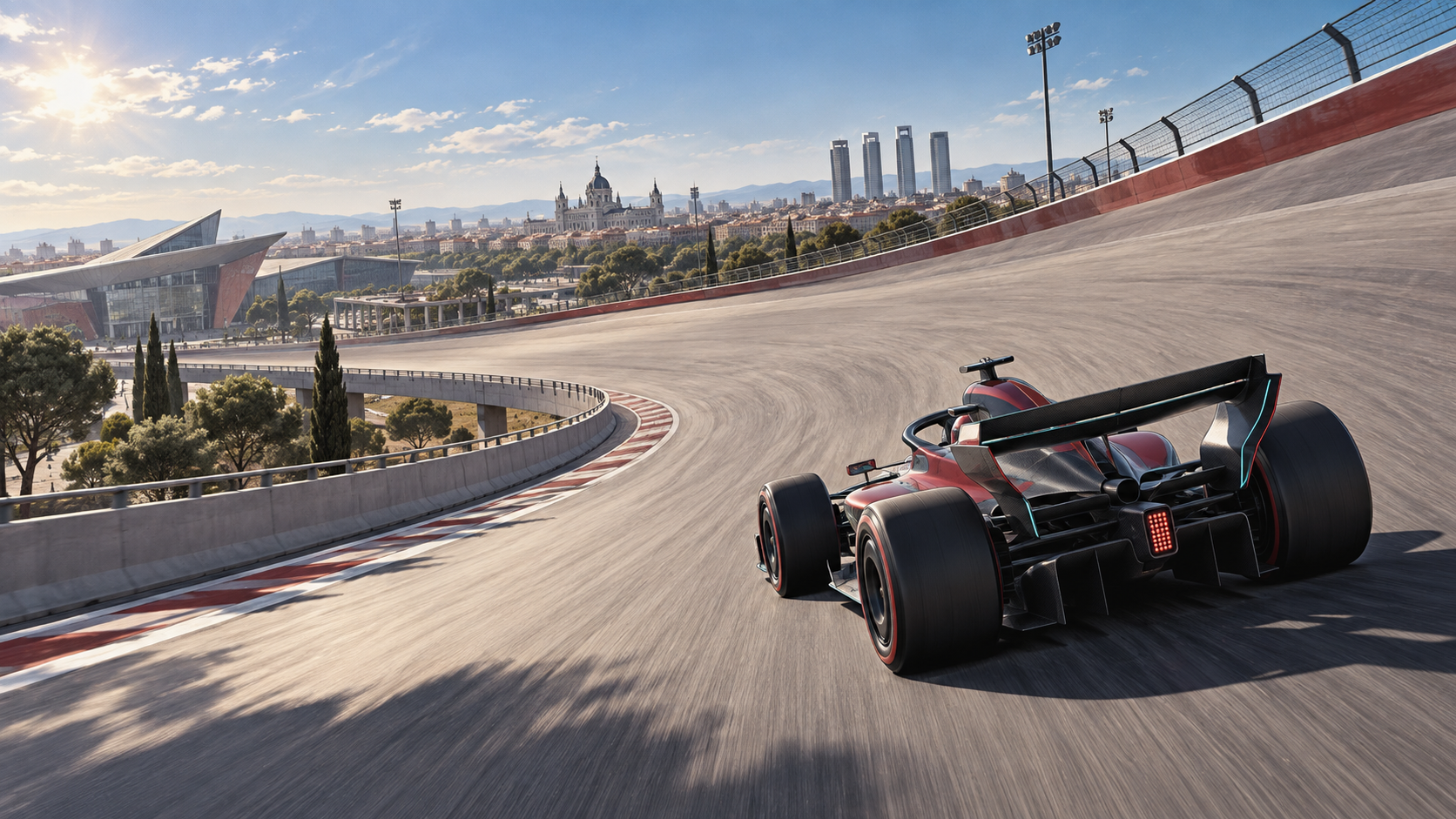
Spanish Grand Prix Practice 3 begins at 10:30 UTC on Saturday, September 12 — 12:30 CEST in Madrid. Formula 1’s official schedule gives teams one 60-minute session before qualifying at 14:00 UTC. It is the first Formula 1 weekend at Madring, so the useful question is not who looks dramatic on one lap; it is whether the car can give its driver the same answer twice.
This is a pre-session context preview. GearPulse is not at the circuit, does not have live timing or team telemetry, and does not report the session’s outcome.
A new track turns FP3 into a decision session
Madring is 5.414km long with 22 corners; Sunday’s Grand Prix is scheduled for 57 laps and 308.399km. Formula 1 describes the venue as a hybrid of public roads and permanent sections, with cars expected to reach roughly 340kph on its straights. Madrid last hosted a World Championship round at Jarama in 1981, which makes this a new F1 reference rather than a return to a familiar Spanish layout.
That changes the normal FP3 job. On an established circuit, the final hour often trims an already-known balance. Here, engineers are still testing the relationship between ride height, braking stability, tyre warm-up and confidence around a fast sequence with limited margin. The focal point is La Monumental, the long banked Turn 12: Pirelli’s pre-event assessment places its vertical loading at the highest level of the season.
| Madring fixed fact | What it asks of the car |
|---|---|
| 5.414km, 22 corners | A setup must work across fast, medium and low-speed corners rather than excel in one sector. |
| 57-lap race | The qualifying platform cannot ignore tyre temperature and cooling over a full Sunday distance. |
| 200m from pole to Turn 1 braking | Starts and launch behaviour will matter, but FP3 is about establishing braking references. |
| Smooth, low-grip new surface | Mechanical grip and clean tyre preparation may be more valuable than an aggressive one-lap compromise. |
It is Straight Mode now, not DRS
The 2026 rules replace the old DRS vocabulary with active-aero modes. At Madring, Formula 1 identifies two designated Straight Mode zones: the start/finish straight and the run between Turns 3 and 4. That is a genuine setup consideration, not a label change. The rear wing opens as before, but the front wing also moves under the new rules, so stability on the way into the next braking phase matters as much as the top-speed number itself.
For GearPulse readers, the compelling engineering comparison is between peak efficiency and confidence. A low-drag approach can make the straight-mode sections attractive; a more secure aerodynamic platform may repay the driver through the banked corner, the lower-speed final sector and each high-commitment braking zone. FP3 is where teams decide which compromise has fewer weaknesses.
Tyres, strategy and heat are connected
Pirelli has brought C2 as the hard, C3 as the medium and C4 as the soft. Its research began before the circuit was completed, then incorporated track-surface measurements, simulation and tyre-load modelling — an unusually explicit reminder that there is no old Grand Prix database for this layout.
The official forecast calls for a dry Saturday, 16C to 31C air temperatures, track temperatures around 50-51C and no expected rain. Motorsport.com’s independent Saturday preview also expects a hot, sunny, dry day. Those conditions make FP3 more representative for qualifying, but they also narrow the margin for tyre preparation: a tyre can be ready for a first push lap without remaining calm through the final technical corners.
The race strategy is necessarily provisional. There is no previous F1 race here from which to borrow a stop-loss figure, while smooth new asphalt, high lateral loading and heat pull in different directions. The useful pre-session test is therefore not a guessed one-stop or two-stop prediction. It is whether a car can build temperature without graining, preserve braking confidence and repeat a useful lap after several hard corners. That evidence will inform both Saturday setup and Sunday’s stint-length calculations.
The human context is learning speed
Every driver is building a real-world reference at Madring, but the pressure is not evenly distributed. Carlos Sainz and Fernando Alonso carry the home-race focus; their value in FP3 is not a sentimental storyline, but whether they can make the unfamiliar layout legible early enough to guide their teams’ setup choices.
For the established front-running groups — McLaren, Mercedes, Ferrari and Red Bull — the same question applies in a different form: can their simulation model survive contact with a warm, evolving circuit? Independent reporting from Motorsport.com and Autosport both characterises the challenge around the new venue in terms of track evolution, walls, temperature and confidence. That is the right frame for the final practice hour, without turning it into a result forecast.
The compelling driver comparison is not an invented hierarchy. It is the contrast between a driver who attacks the banking with a settled rear platform and one who must leave margin for a surface or braking phase that still feels unfamiliar. On a 22-corner lap, a small hesitation can travel through the next sequence and become a larger compromise by the end of it.
What to look for before qualifying
Watch for three kinds of evidence, not a timing-screen verdict:
- Repeatability: A car that delivers the same rotation and traction across multiple push laps is more valuable than one isolated peak.
- Straight Mode to braking: The two active-aero zones matter only if the platform remains stable when the driver returns to a braking zone or turns into a linked corner.
- Thermal discipline: In 31C ambient conditions and a 50C-plus track, tyre temperature, brake cooling and energy management can turn a promising qualifying setup into a fragile one.
Bottom line
Madrid FP3 is the last controlled hour before qualifying locks the weekend into a more visible contest. The verified frame is clear: Practice 3 at 10:30 UTC, a 5.414km/22-corner circuit, 57 race laps, C2-C3-C4 tyres, two Straight Mode zones rather than DRS, and a hot, dry forecast.
The new-track advantage will not belong automatically to the car with the highest theoretical peak. It belongs to the team that turns its model into a driver-friendly platform through banking, heat, active aero and a circuit that still has almost no F1 history to explain its behaviour.