
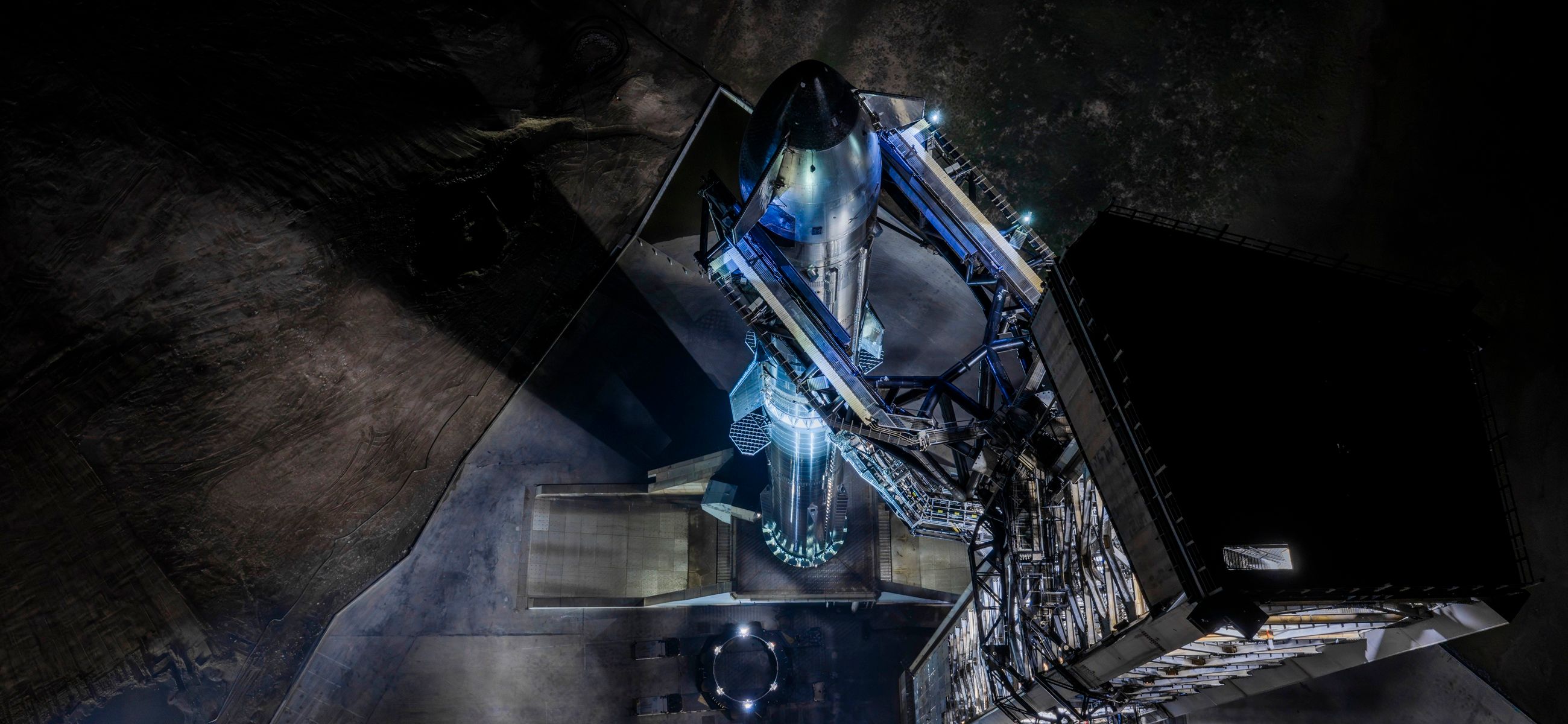
Starship Flight 13 did not explode. It did not arc into the sky. It did not put the first Starlink V3 satellites through their planned suborbital test.
It sat there, thundered briefly, shut itself down and made SpaceX look very human.
That is not a glamorous outcome. It is also not the wrong kind of failure.
The July 16 attempt at Starbase reached Super Heavy ignition before the vehicle automatically aborted. AP, Ars Technica and Spaceflight Now reported that not all 33 booster engines started as expected, with Spaceflight Now reading four non-ignitions from the webcast telemetry and AP reporting a full automatic shutdown seconds before liftoff. Space.com reported that two Raptors were expected to be removed and replaced before another attempt.
GearPulse’s view: this is relevant because Starship does not need more spectacle. It needs repeatability. The vehicle’s future depends less on whether a single test looks heroic and more on whether SpaceX can make every abort, relight, heat-shield experiment and launch recycle boring enough to trust.
What Flight 13 was supposed to test
SpaceX’s official Flight 13 page described an ambitious test even before the abort. The booster was meant to launch, ascend, separate, perform a boostback burn and execute a landing burn toward an offshore point. The ship was meant to deploy 20 Starlink V3 satellites on a suborbital trajectory, relight a Raptor engine in space, reenter and splash down in the Indian Ocean.
The mission also carried a heat-shield inspection twist. SpaceX said six of the 20 Starlink V3 satellites had cameras intended to inspect Starship’s heat shield and send imagery back to operators. The vehicle also included modified tiles, different attachment mechanisms and load-sensing tiles to gather data under higher dynamic pressure.
| Flight 13 objective | Why it mattered |
|---|---|
| 33-engine Super Heavy launch | Proves the booster can reliably start under operational conditions. |
| Hot staging and boostback | Tests the rhythm needed for future reuse. |
| Starlink V3 deployment demo | Connects Starship directly to SpaceX’s next network-capacity bet. |
| In-space Raptor relight | Needed for more complex mission profiles. |
| Heat-shield inspection | Helps answer whether rapid reuse can become real. |
| Controlled splashdowns | Keeps the test program moving toward disciplined recovery behavior. |
None of that happened on July 16. The vehicle did the one thing it had to do once the engine-start sequence was not healthy: it stayed on the pad.
The abort is embarrassing, but useful
There are two lazy reactions to a Starship abort.
One is to hand-wave it away as “just testing,” as if public failures do not matter. They do. Starship is tied to Starlink economics, SpaceX’s launch-cost ambitions and NASA’s Artemis lunar architecture. NASA’s Human Landing System program depends on commercial landers, including SpaceX’s Starship-based lander. A vehicle this central does not get infinite social credit for drama.
The other lazy reaction is to treat every scrub as proof that the architecture is doomed. That is also wrong. A pad abort after ignition is exactly the kind of protection a launch system is supposed to have when its start conditions are outside limits. The rocket did not launch with a sick booster. That is a better result than forcing a doomed flight for optics.
The harder read is more useful: Starship is still a development vehicle, and development is now colliding with expectations for operational cadence.
The Flight 12 shadow
Flight 13 already carried baggage from Flight 12. The FAA said on July 13 that the required Flight 12 mishap investigation had closed and Flight 13 could proceed once remaining safety and licensing requirements were met. SpaceX’s own Flight 13 materials said the new test included hardware and software changes after Flight 12, including modifications to improve Super Heavy relight reliability and updates to engine alarms and abort behavior.
That detail makes the July 16 abort feel especially pointed. Engine reliability was not background noise; it was one of the advertised things being worked on.
It does not mean SpaceX failed to learn from Flight 12. It means the learning loop is still open. The public sees the dramatic end of that loop. Engineers see sensors, thresholds, ignition timing, startup transients, hardware swaps and the question every test program has to answer: did the system fail in a way that gives us better data and preserves the vehicle?
Why readers should care
Starship is easy to file under space spectacle. It is more than that.
If it works, it changes how SpaceX deploys its own network, how large payloads get to orbit, how lunar logistics are planned and how quickly launch infrastructure has to operate. If it remains inconsistent, every dependent promise becomes harder: Starlink V3 capacity, rapid reuse, orbital refueling, lunar landers and the commercial case for extremely large payloads.
That is why an abort can be worth attention even without a fireball or a triumphant launch. It shows the distance between one-off demonstrations and a transportation system.
Bottom line
Flight 13 was ugly television and useful engineering.
The best thing SpaceX can do now is not sell the abort as a win. It is to make the next attempt cleaner, explain the fix plainly and keep turning Starship from a thrilling prototype into a reliable machine. For a rocket this ambitious, the real milestone will be the day a scrub feels routine and a successful launch feels almost uneventful.