
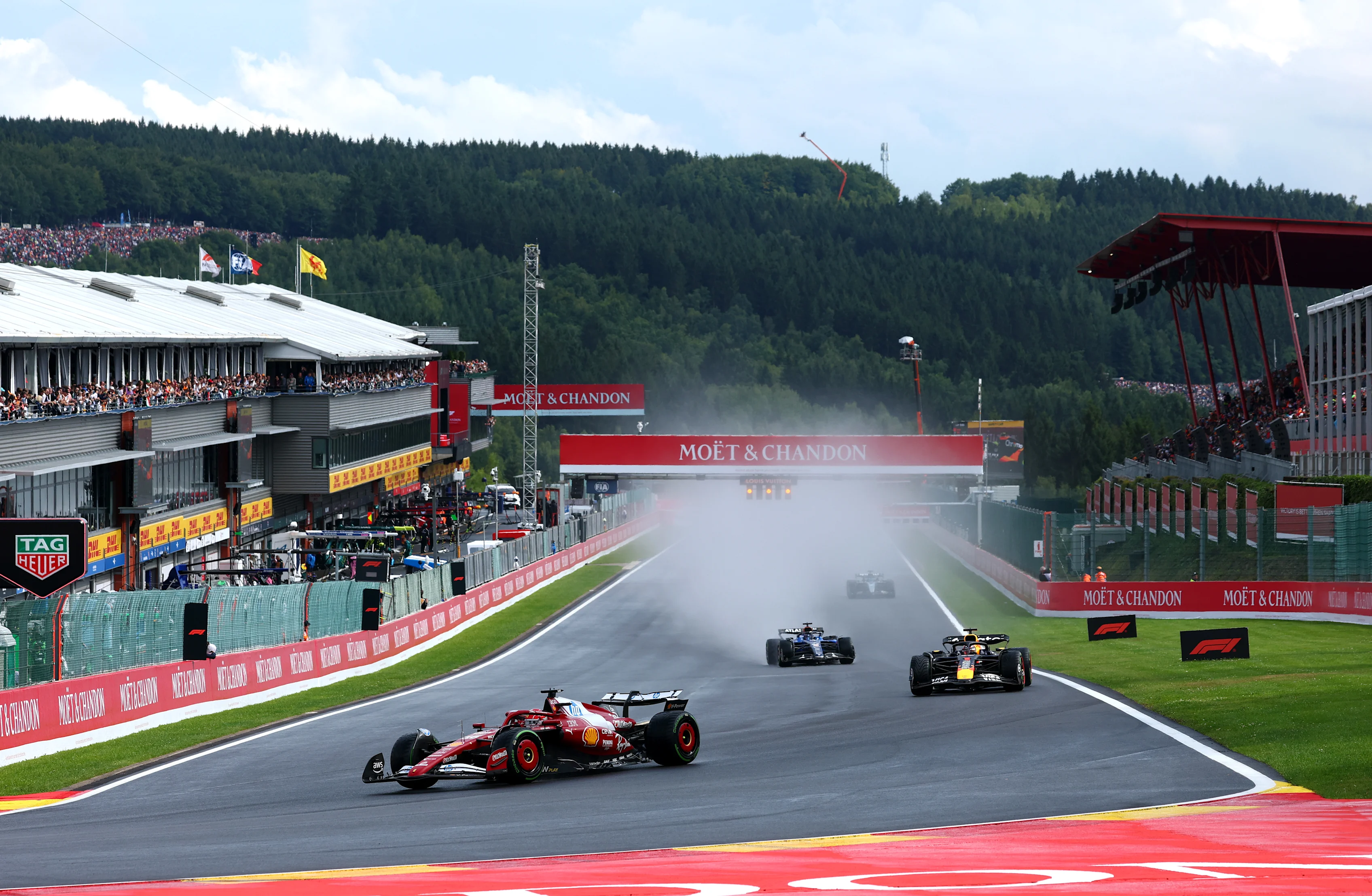
Spa-Francorchamps is never just a circuit on the calendar. It is a weather system, a power-unit exam and a driver-confidence test stretched over 7.004 kilometres.
That is why the Belgian Grand Prix is the right Daily Dose of F1 story today.
Formula 1’s official race-week guide says the 2026 season heads to Belgium with warm conditions and a high chance of precipitation across the sessions. Its Race Week preview makes the more important point: the grid has still not had a collective wet session with these 2026 cars. Some teams have wet-tyre or shakedown mileage. The field as a whole has not yet had to solve spray, tyre warm-up, active aero, battery deployment and traffic at the same time in proper race-week conditions.
Add Motorsport.com’s driver-led warning that Spa could be one of the worst deployment tracks of the year, Pirelli’s note that Spa is second only to Silverstone and Suzuka for tyre stress, and Sky’s framing of Belgium as the start of the final double-header before the summer break, and this stops being a routine preview.
GearPulse’s view: Spa is where the 2026 rule reset may become legible to everyone, not only engineers. If it rains, the cars will not just be slower. They will expose how much of this generation’s performance depends on energy maps, tyre preparation and driver trust.
Why this story rose today
The headline reason is simple: Formula 1 published fresh Belgian GP race-week material today, July 13, and both official and media coverage now point to weather risk.
The deeper reason is timing. The British Grand Prix has already told us the 2026 cars can look awkward when energy deployment runs thin on fast, flowing tracks. Spa asks a similar question on a longer lap, with bigger elevation change, heavier commitment through Eau Rouge/Raidillon, and the possibility that one section of the circuit is wet while another is still drying.
That is a better story than another round of driver-market speculation. Red Bull and Verstappen remain noisy. Aston Martin’s upgrades and Jak Crawford’s FP1 run are real items. Ferrari’s push against Mercedes is growing. But the most interesting thread today is bigger than one team: Belgium may be the first weekend where the 2026 cars have to prove they can handle the messy version of Formula 1.
The trend signal is there too. Formula 1 has the weather and Race Week angles on its homepage, Sky is leading with the title battle and rain risk, Motorsport has the deployment warning, and SB Nation is carrying the same mix of title race, development and weather themes for a broader audience.
The wet-weather unknown is the real hook
Wet races are not rare in F1 history. Wet races with a new rules generation are different.
The 2026 cars are lighter, narrower and more dependent on a complicated relationship between power unit, energy recovery, active aero and software decisions. In dry running, teams can at least lean on repeatable data. In wet running, grip comes and goes corner by corner, and Spa’s length makes that even harder to read.
Formula 1’s official Race Week preview notes that some teams have wet experience from shakedown or Pirelli testing, but the majority have not run the 2026 chassis and tyres collectively in rain. That matters because a grand prix weekend is not a controlled test. Drivers have traffic. Teams have limited setup windows. Race control has visibility decisions. Engineers have to choose how much downforce, how much tyre temperature risk, and how much battery deployment to spend when the track is changing faster than the model.
The first clue will be Friday practice. If rain arrives early, do not treat the timesheet like a normal hierarchy. Watch who can get the intermediate tyre working without sliding the rear axle, who can keep battery deployment predictable out of La Source, and who looks calm when the car compresses through the climb toward Raidillon.
That is where driver confidence becomes data.
Spa doubles down on the battery problem
Spa was already a difficult 2026 test before the forecast turned messy.
Motorsport.com reported that drivers are braced for more deployment pain after Silverstone, with Fernando Alonso, Max Verstappen and Oliver Bearman all pointing toward Spa as a track where battery use can become awkward. The basic problem is easy to understand: if a driver spends too much electrical energy from La Source up the Kemmel Straight, there may not be enough left to attack later parts of the lap. Save too much, and the car gives away time where overtaking and lap time are built.
That becomes even more delicate in the wet. Wheelspin wastes energy. Lift-and-coast can cost tyre temperature. A driver may want smoother deployment to avoid snapping the rear, while the stopwatch still rewards commitment through the long flat-out sections.
Here is the tension:
| Spa variable | Why it matters in 2026 |
|---|---|
| 7.004 km lap | More time for battery strategy to go wrong before the lap resets. |
| Eau Rouge/Raidillon and Kemmel | The first sector can tempt drivers to spend deployment early. |
| Long middle sector | A weak energy plan can leave the car exposed for a large chunk of lap. |
| Changeable Ardennes weather | One sector can be wetter than another, confusing tyre and aero decisions. |
| C2/C3/C4 tyres | Pirelli has gone middle-range, but Spa’s load still punishes mistakes. |
This is why Belgium is more revealing than a normal high-speed race. It does not only ask which car has the most downforce or the cleanest power unit. It asks which team understands the whole operating window.
Mercedes and Ferrari face different pressure
The official F1 guide frames the championship picture clearly: Kimi Antonelli still leads, but George Russell is only 25 points behind after Antonelli’s Silverstone retirement, and Lewis Hamilton remains close enough that Ferrari cannot be treated as background noise.
That makes Spa dangerous for Mercedes. Pace is not the whole problem now. Reliability and risk management are. A wet weekend at Spa could compress the field, increase Safety Car probability, and make one wrong call far more expensive than it would be on a dry, predictable track.
Ferrari’s opportunity is different. Charles Leclerc’s Silverstone win and Hamilton’s recent podium form have made the Mercedes-Ferrari fight feel live again. Spa gives Ferrari a chance to show whether that was circuit-specific momentum or a more durable title push. The catch is that Ferrari cannot rely on emotion, history or a single-lap burst here. Wet Spa requires clean operations and a car that gives both drivers trust through high-speed direction changes.
Red Bull is the wild card. Verstappen has the skill set for Spa, but the recent Red Bull story has been about trust: rear-wing problems, crashes and questions about the car’s safety margin. If the forecast brings rain, that trust question becomes sharper. A driver can manage a difficult car in the dry. In spray, through compression and elevation, the tolerance shrinks.
What the midfield can steal
Wet Spa is where midfield teams can look bolder than they really are.
That does not mean random results are guaranteed. Modern F1 strategy tools are too good for pure chaos to rule every wet race. But variable weather does reward teams that commit at the right moment and drivers who can create tyre temperature without overdriving.
Audi, Williams, Aston Martin, Haas, Racing Bulls and Alpine should all see opportunity in this. A normal dry Spa race tends to reward efficient cars and strong power delivery. A damp or mixed weekend can hand points to the team that gets through Q1/Q2 at exactly the right time or pits one lap before the obvious window.
The biggest midfield watch is Aston Martin. Jak Crawford’s Belgian FP1 run is useful development mileage, but if the session is wet it may become less about headline lap time and more about how the team correlates simulator work against real 2026 wet behaviour. For a team waiting on a bigger upgrade step, that kind of information can be more valuable than a tidy dry run.
GearPulse probability board
This is editorial analysis, not betting advice.
| Belgian GP read | Likelihood | Why |
|---|---|---|
| At least one meaningful wet or mixed F1 session | 60-70% | F1 and Sky both flag precipitation risk across the weekend, and Spa’s local weather is famously uneven. |
| Energy deployment becomes a major talking point again | 65-75% | Motorsport’s driver evidence lines up with Spa’s long lap and limited heavy-braking recharge points. |
| Mercedes remains the default title benchmark | 45-55% | Antonelli and Russell still hold the championship shape, but reliability has reopened the fight. |
| Ferrari leaves Belgium looking like a sustained threat | 35-45% | Recent form is real, but Spa will test operations and mixed-condition adaptability. |
| A midfield team scores above its dry-weather pace | 40-50% | Wet Spa often creates timing windows, but the 2026 field still needs clean execution. |
The caveat is important: weather forecasts are not results. Spa can threaten rain all week and still produce a dry race. The better way to frame the weekend is not “rain will decide it.” It is “rain risk changes how every team has to prepare.”
Fun facts with a point
Spa’s current 7.004 km layout is the longest lap on the Formula 1 calendar. The original road circuit was more than twice as long, using public roads through the Ardennes region. That heritage explains why the modern circuit still feels unlike most permanent tracks: forest, elevation, blind commitment and weather that can make one sector look like a different venue.
Formula 1’s race hub also notes that Belgium was part of the first world championship season in 1950. So the 2026 edition has a neat symmetry: one of F1’s oldest venues may be the place where the newest rules finally meet old-fashioned rain.
Pirelli’s compound choice adds another layer. Belgium gets the C2, C3 and C4, the middle of the range. That is not as conservative as Silverstone’s hardest allocation, but Pirelli still ranks Spa among the highest tyre-stress venues. If rain interrupts dry running, teams may enter qualifying and the race with a weaker understanding of how those slicks behave on a green or cooling track.
What to watch
Do not only watch the fastest lap in FP1. Watch the first driver who can repeat a lap cleanly.
Wet Spa rewards consistency before heroics. The car that looks planted through one lap and nervous the next is not solved. The driver who can keep the intermediate tyre alive without overheating it may matter more than the driver who briefly tops a session in the best conditions.
Watch the battery traces if broadcasts show them. A car that clips early on the Kemmel Straight or feels flat later in the lap is telling you something. Watch radio messages about deployment and tyre temperature. Watch whether teams split setup choices between drivers, because that will reveal how uncertain the simulations are.
And watch Mercedes versus Ferrari in mixed conditions. If Mercedes is still clean while Ferrari needs more laps to switch the tyres on, the title race remains tilted toward Brackley. If Ferrari is immediately comfortable, Silverstone may start to look like the beginning of a bigger fight rather than a one-weekend release.
Bottom line
Spa is today’s most interesting F1 story because it combines everything the 2026 season has been hinting at: new cars, battery compromise, title pressure, tyre learning and a weather wildcard.
A dry Belgian Grand Prix would still be a serious deployment test. A wet or mixed one could become the first full public exam of how this rules generation behaves when the clean simulation world disappears.
GearPulse’s read: if Spa stays calm, Mercedes and Ferrari get a high-speed title benchmark. If the rain arrives, Belgium becomes something more useful: the weekend that tells us which teams actually understand their 2026 cars when Formula 1 stops being tidy.
Support the site at buymeacoffee.com/gearpulse.site.