
Spa-Francorchamps did not merely give Formula 1 another dramatic result. It gave the 2026 rules their clearest public complaint.
Yes, Kimi Antonelli won. Yes, George Russell’s title position took a heavy hit. GearPulse covered that Mercedes boost problem yesterday because the team itself admitted both cars suffered an opening-lap issue and Russell’s race ended before it had settled.
Today’s story is wider. The Guardian’s post-race analysis landed on July 20 with the sharper diagnosis: drivers are growing tired of a formula where energy-deployment algorithms can make identical-looking laps feel different, turn classic corners into lift-and-coast exercises, and create sudden closing-speed mismatches on the longest straights.
That is why this is today’s Daily Dose of F1. Spa took a problem that had been discussed by engineers and turned it into driver language. Antonelli, Charles Leclerc and Max Verstappen all addressed the deployment weirdness in the FIA’s post-race press conference. Formula 1 and the FIA race reports show the opening-lap consequences. Mercedes’ own report confirms the boost issue in its garage. Motorsport.com warned before the weekend that Spa was going to hurt. ESPN’s post-race lessons and Sky’s Russell coverage reinforced the same theme: the 2026 cars are quick enough to race, but not yet transparent enough for drivers to trust every outcome.
GearPulse’s view: F1 does not need to panic. It does need to admit that “the software decided” is a bad answer when the driver is the one arriving at Les Combes with five cars closing at different rates.
Why this story rose today
The trend signal is unusually clean for a technical rules story. It has a fresh same-day Guardian analysis, official FIA press-conference quotes, official FIA and Formula 1 race reports, Mercedes primary-team context, and specialist coverage from Motorsport.com and Sky around Russell’s unexplained pace and deployment deficit.
It also avoids duplicating yesterday’s article. The July 19 GearPulse piece was about Antonelli’s win, Russell’s DNF and Mercedes’ title-control problem. This one is about the design of the sport: how much agency drivers still feel they have when the battery map, harvesting model and deployment algorithm become as important as braking later or carrying more minimum speed.
Spa was the perfect stress test because it exaggerates every weakness. The lap is 7.004 km. La Source, Eau Rouge, Raidillon and the Kemmel Straight tempt teams to spend energy early. The middle sector needs commitment and downforce. The run to Les Combes becomes dangerous if one car has deployment and the next one suddenly does not.
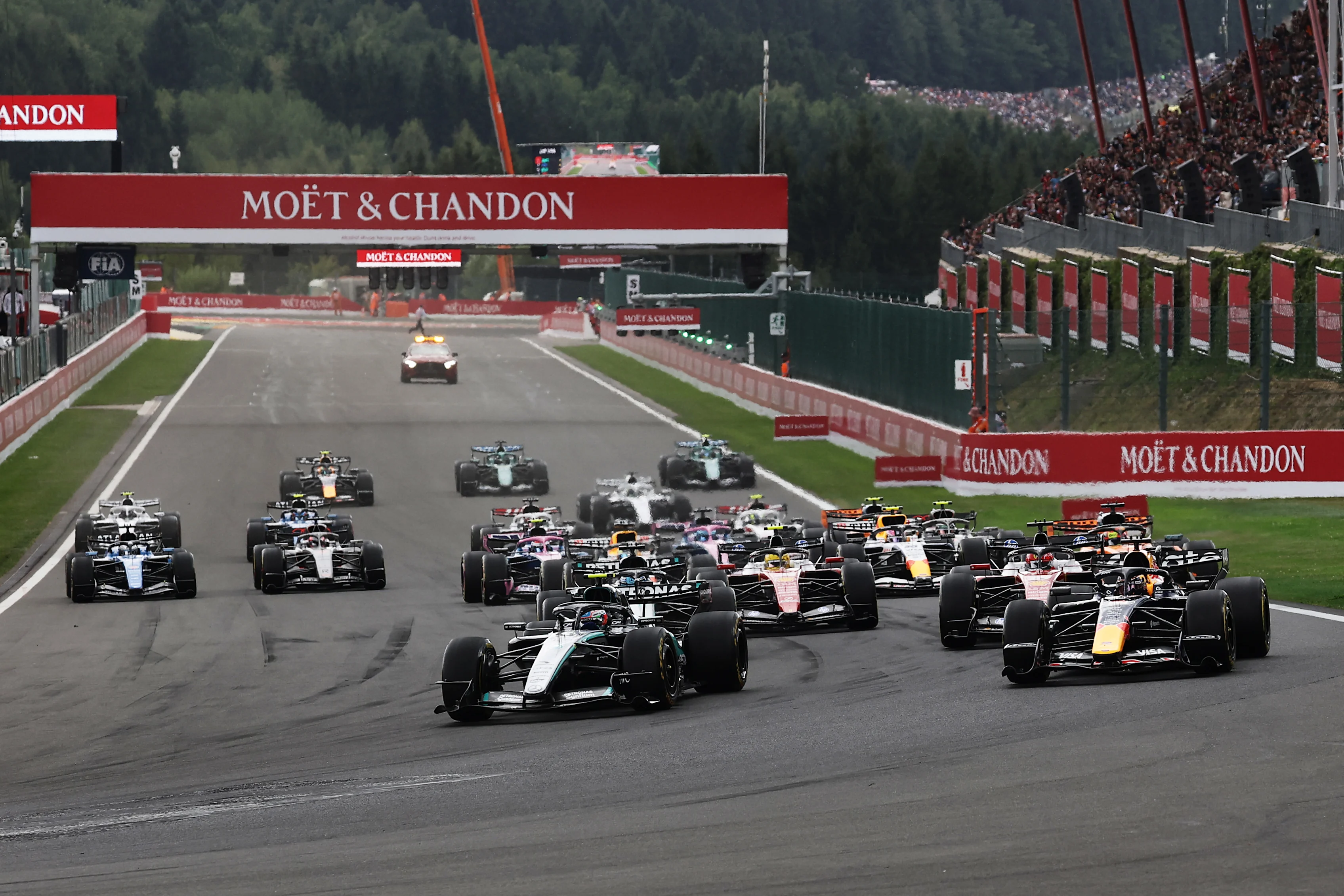
The FIA race report captured the oddity at the front. Verstappen jumped Antonelli, then spent too much energy and was passed back before Les Combes. Behind them, Leclerc surged forward as Russell lost momentum. The official Formula 1 report describes Russell dropping behind both Ferraris before the Hamilton contact ended his afternoon.
That is not just racing theatre. It is the 2026 rules becoming visible.
The problem is not that the cars are hybrid
F1 has lived with hybrid complexity for years. The new issue is the ratio and the opacity.
The 2026 regulations were sold around lighter cars, active aero, sustainable fuels and a much larger electrical share of the power unit. Formula 1’s regulation explainer says the new power units split performance more evenly between the internal-combustion side and the electric side, while also adding a manual override system intended to improve overtaking.
On paper, that is a sensible future-facing direction. It keeps F1 relevant to manufacturers, gives the sport a stronger sustainability story and creates a technical battlefield that is not only about burning fuel harder.
But Spa showed the downside of making energy deployment so central. If the driver understands why the car is fast or slow, the challenge becomes part of the craft. If the car behaves differently for reasons that feel hidden in the background, the driver starts to feel managed by the model.
That is the distinction that matters. Tyre management can be frustrating, but a driver can feel the rubber, see the temperature trend and adapt. Energy deployment is less tactile. The driver may make a slightly different input, the software may choose a different state, and the lap can unravel before the cockpit has a clean explanation.
The FIA already knows this is sensitive. Formula 1 reported in March that the FIA, teams and power-unit manufacturers agreed a qualifying energy-management tweak before Suzuka after feedback from drivers and teams. That change was described as a targeted refinement, not an emergency. Spa suggests the refinement process is not finished.
What the drivers actually told us
The FIA post-race transcript is more useful than the radio anger because it gets past the immediate heat.
Antonelli acknowledged that the system can behave in ways drivers do not fully understand, especially on tracks that are heavy on energy demand. He also made the fair caveat: these systems are complex and teams are still trying to make them easier and more consistent.
Leclerc’s point was more revealing for the broader grid. He said a driver can do similar laps and still get different straight-line outcomes because so much changes in the background. That is the kind of complaint that lands differently from “my car was slow.” It says the driver is not always sure which lever produced the performance.
Verstappen gave the plainest version after the opening lap. He knew he had spent too much deployment early, looked at his battery state after Eau Rouge and expected Antonelli to come back at him. Then he saw Leclerc arriving quickly behind as well. His point was not that the racing was boring. It was that the differences were dramatic enough to shape where everyone could safely place a car.
The Guardian added Oscar Piastri’s frustration from the same wider conversation, and it matters because Piastri is usually a measured voice. When calm drivers start describing qualifying and racing as being distorted by invisible deployment behaviour, F1 should listen before the complaint hardens into a season-long verdict.
Russell made the invisible problem visible
Russell is the reason this story crossed from technical annoyance to mainstream talking point.
Before the race, Sky Sports F1 covered his argument that driving style was not the whole explanation for the deficit to Antonelli. After the race, Mercedes’ own report and Formula 1’s Russell reaction coverage made clear that the opening-lap boost issue left him exposed at exactly the wrong point of Spa.
The blunt version is this: Russell should have been fighting Antonelli, Verstappen and Leclerc. Instead, he was suddenly part of a Ferrari traffic jam into Les Combes. Hamilton received the penalty for the contact, but Mercedes’ bigger concern was why Russell was vulnerable in the first place.
That is why the issue is larger than one crash. F1 can live with driver error. It can live with power-unit failures. It struggles when a title contender is knocked into a different race because the car’s energy state is not repeatable enough for the team or driver to anticipate.
The opening lap also showed why this can become a safety argument. A car without expected deployment is not merely slower. It changes closing speeds. At Spa, on the run from La Source to Les Combes, that means cars are approaching each other while drivers are still sorting out battery state, wing mode, tyre temperature and first-lap positioning. The field is not spread out yet. The margin for surprise is small.
Spa did what Silverstone only hinted at
GearPulse covered Silverstone’s energy questions earlier this season, and Spa was always likely to be worse. Motorsport.com’s pre-weekend warning from drivers made the logic clear: Spa’s long lap and limited harvesting opportunities were going to expose the 2026 deployment tradeoff.
The fun fact is that Spa’s old-school grandeur now clashes with the newest part of F1. Pouhon used to be a test of high-speed nerve. In 2026, the Guardian’s analysis noted that drivers were complaining the middle sector could feel power-starved, with corners becoming less of a challenge because the car was not arriving with the expected energy profile.
That is a strange result for a rules package sold partly on making cars more agile and driver-focused. F1 wanted lighter, more raceable machinery. At Spa, some drivers felt the car’s intelligence was getting between them and the lap.
The caveat is important: the race was not dull. Antonelli had to repass Leclerc. Verstappen was in the fight early. Norris and Hadjar recovered from penalties. Ferrari looked threatening. If F1 judges only the spectacle, Spa gave it plenty.
But drivers do not judge a car only by whether the broadcast had overtakes. They judge whether they can understand, trust and repeat its behaviour. That is where the 2026 rules still have work to do.
GearPulse probability board
This is editorial analysis, not betting advice.
| Post-Spa question | Likelihood | Why |
|---|---|---|
| FIA and teams discuss another energy-management refinement this season | 60-70% | The March Suzuka tweak set the precedent, and Spa produced broader driver complaints. |
| Hungary hides the problem rather than solves it | 55-65% | The Hungaroring has shorter straights and a different energy profile, so it may reduce symptoms without proving the fix. |
| Monza revives the backlash | 65-75% | Long straights and low drag will put deployment, override and closing-speed differences back under the spotlight. |
| Mercedes’ Russell-side issue is fully understood before the summer break | 40-50% | Mercedes has strong data, but its own language still points to investigation rather than a clean answer. |
| Drivers keep pushing this publicly | 70-80% | The complaint now includes race winners, title contenders and usually careful voices. |
The most likely short-term path is not a dramatic rule rewrite. F1 rarely changes a technical generation in one swing unless safety forces it. The more plausible route is calibration: revised harvesting limits, clearer operating windows, better driver tools, and track-specific parameters that stop classic circuits from becoming software lotteries.
The Hungarian test is subtler
Budapest comes quickly, on July 24-26, and it will not ask the same question as Spa.
The Hungaroring is slower, tighter and more traction-led. It will not put cars on the Kemmel Straight with the same dramatic battery-spend choice. That makes it a useful contrast. If drivers are calmer in Hungary, it does not mean the problem has gone away. It may simply mean the circuit is less exposed.
For Mercedes, Hungary is a Russell diagnostic. If his car behaves normally and he is back beside Antonelli, Spa looks like a specific high-energy failure. If the weirdness follows him into a very different track profile, the title problem becomes deeper.
For Ferrari, Hungary is a reality check after Leclerc’s Silverstone win and Spa second place. A tight circuit should reduce some of the long-straight deployment drama and reveal whether the Ferrari is actually more repeatable, or whether Spa flattered it because the energy picture scrambled the front.
For Red Bull and McLaren, the question is trust. Verstappen can still make marginal cars look alive, but he has been publicly sceptical about the 2026 energy game. McLaren had Norris on a recovery mission after his penalty and Piastri voicing frustration about deployment behaviour. Both teams need a weekend where performance feels less dependent on invisible decisions.
Bottom line
Spa made F1’s 2026 energy debate impossible to park in the engineering office.
The sport can point to a close race, a young winner, Ferrari pressure, Red Bull resistance and recovery drives through the pack. That is all real. But the drivers are telling F1 something just as real: when deployment algorithms become too central and too opaque, the show may still work while the craft feels compromised.
GearPulse’s read is that the 2026 rules are not broken. They are unfinished in public. Spa was the warning label. Hungary may calm the noise, but Monza, Baku and every long-straight circuit still to come will ask the same question again.
If F1 wants this generation to be remembered as smart, sustainable and raceable, the drivers need to feel like they are racing the car, not negotiating with a black box.