
Industrial robots are very good at repeating a job that engineers have already nailed down. The bill arrives when the job changes.
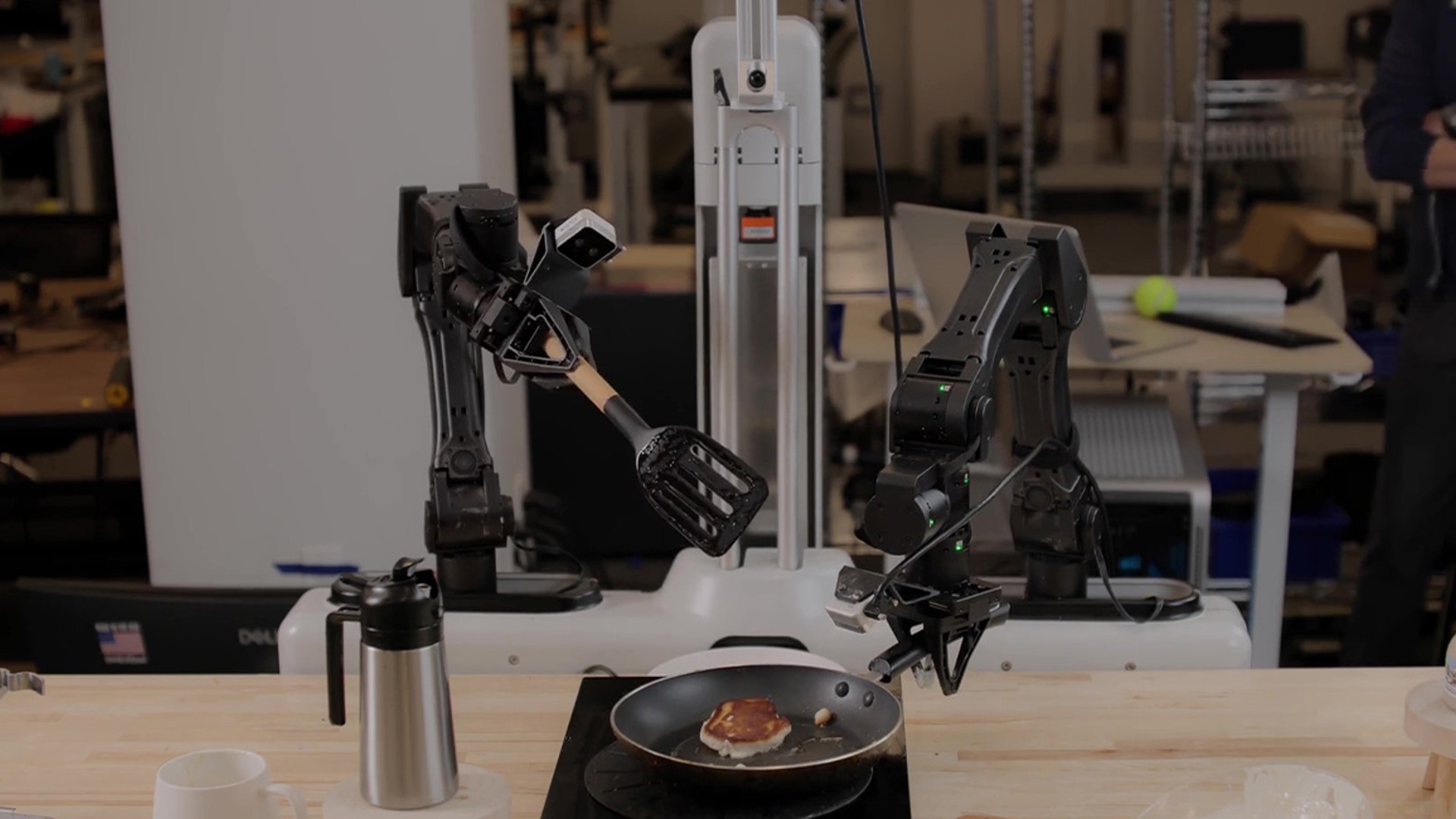
Skild AI’s new S1 model attacks that setup cost with a compelling proposition: record a person doing an unfamiliar task, give the robot that video as context, and let it attempt the work without task-specific fine-tuning or weight updates. Skild says S1 can handle new tasks lasting up to 10 minutes, including plant potting, pour-over coffee, pancake preparation and kit assembly.
GearPulse’s view: the useful breakthrough is not that a robot can watch a video. It is that the video is being treated as a job instruction rather than another dataset that must first be labeled, collected at scale and folded into a training run. That is potentially valuable on a factory floor where products, tooling and layouts keep moving. But it is not a blank cheque for autonomous work: Skild’s most quoted result is a step-based internal measure that includes human recovery interventions. A complete, unattended job is a much harder standard.
The shift is from retraining to prompting
Skild describes S1 as an in-context learner. In conventional robot-learning workflows, a new task usually means collecting demonstrations in the target environment and post-training a policy for that task. S1 instead takes a video demonstration as part of its input context, infers the goal and sequence, then maps that intent onto the robot and scene in front of it.
The distinction sounds academic, but it changes the operating question. Instead of asking, “Do we have enough new data to train this robot?”, an operator can start with, “Can this robot understand and execute this demonstrated job well enough to be useful?”
| S1 claim | What it could change | What it does not prove yet |
|---|---|---|
| One video can specify a new task | Faster first trials when a line or product changes | Consistent production performance across shifts and sites |
| No task-specific weight update | Less waiting for a new training cycle | No need for safety validation or acceptance testing |
| Tasks up to 10 minutes | A move beyond simple pick-and-place clips | Reliable completion of every step without intervention |
| One shared model across tasks | A chance to reuse capability instead of building narrow policies | That every robot body and tool will behave equally well |
This is why the story matters beyond the usual humanoid-robot spectacle. Factories, warehouses and inspection lines often have an automation gap between a fixed machine that is cheap but brittle and a flexible cell that is costly to program. Reducing the time needed to try a new workflow could make automation more practical in the messy middle.
The result needs to be read at the right resolution
Skild says its testing on new, multi-step tasks reached about 66% success per step for S1 when prompted with a demonstration, compared with 9% for a language-prompted comparison system. It also estimates that one video can be comparable to roughly 380 teleoperated demonstrations, or 50 to 100 hours of manual data collection.
Those figures are interesting, but they are company results, not a factory service-level agreement. Independent reporting from The Rundown notes two crucial details: the 66% figure is cumulative across steps, and the evaluation includes human recovery interventions. That does not invalidate the work; recovery is a sensible capability to study in robotics. It does mean readers should not translate “66% per step” into “two-thirds of complete jobs run unattended.”
The math makes the caveat intuitive. On a hypothetical 20-step workflow, even a 95% independent success rate at every step would not guarantee a clean end-to-end run. Real work also introduces lighting changes, worn grippers, shifted parts, sensor noise, people in the cell and the little timing errors that polished demonstrations tend to hide.
| Before a deployment claim is convincing | Why it matters |
|---|---|
| End-to-end completion rate | Customers buy finished jobs, not isolated successful moves. |
| Intervention and recovery rate | A robot that needs frequent rescues changes staffing economics. |
| Performance across sites and shifts | Industrial environments drift even when the nominal task stays the same. |
| Safety and failure behavior | Graceful stopping can matter more than another percentage point of speed. |
That is the test I would want to see next: not another clever prompt, but a detailed account of how many full cycles S1 completes, where people step in and how it fails when the task or scene departs from the demonstration.
NVIDIA adds deployment context, not independent validation
NVIDIA says Skild trained S1 with its AI infrastructure and uses NVIDIA Cosmos, Omniverse, Isaac Sim and Isaac Lab across data preparation, simulation and reinforcement learning. It also says Skild, NVIDIA and Foxconn are deploying Skild’s technology on dual-arm manipulators for high-precision Blackwell-system assembly.
That is meaningful evidence that the work has a path toward industrial use, and it connects naturally to GearPulse’s recent look at NVIDIA’s Jetson T2000 and T3000 robotics modules. The hardware and simulation stack are becoming more capable. Still, NVIDIA is a Skild infrastructure collaborator here, so its report should be read as deployment context—not a neutral replication of S1’s research claims.
The broader pattern is encouraging. Physical AI needs better ways to use video, simulation and experience without treating every new layout as a bespoke software project. It also needs more evidence than a launch reel. Those two ideas are not in conflict; the first makes the second more urgent.
Bottom line
S1 offers a more practical vision of robot learning: show the machine the work, then evaluate whether it can do it. If that reliably trims the data-collection and retraining loop, it could become a useful tool for operations teams dealing with frequent change.
For now, the strongest conclusion is narrower. Skild has presented a credible technical direction and a meaningful internal result, not proof that a factory can replace its commissioning process with a phone video. The next evidence that matters is duller and more valuable: whole-job success, intervention rates and performance outside the controlled demo.
That is where robotics earns trust—one completed shift at a time.
Support independent GearPulse articles at buymeacoffee.com/gearpulse.site.