
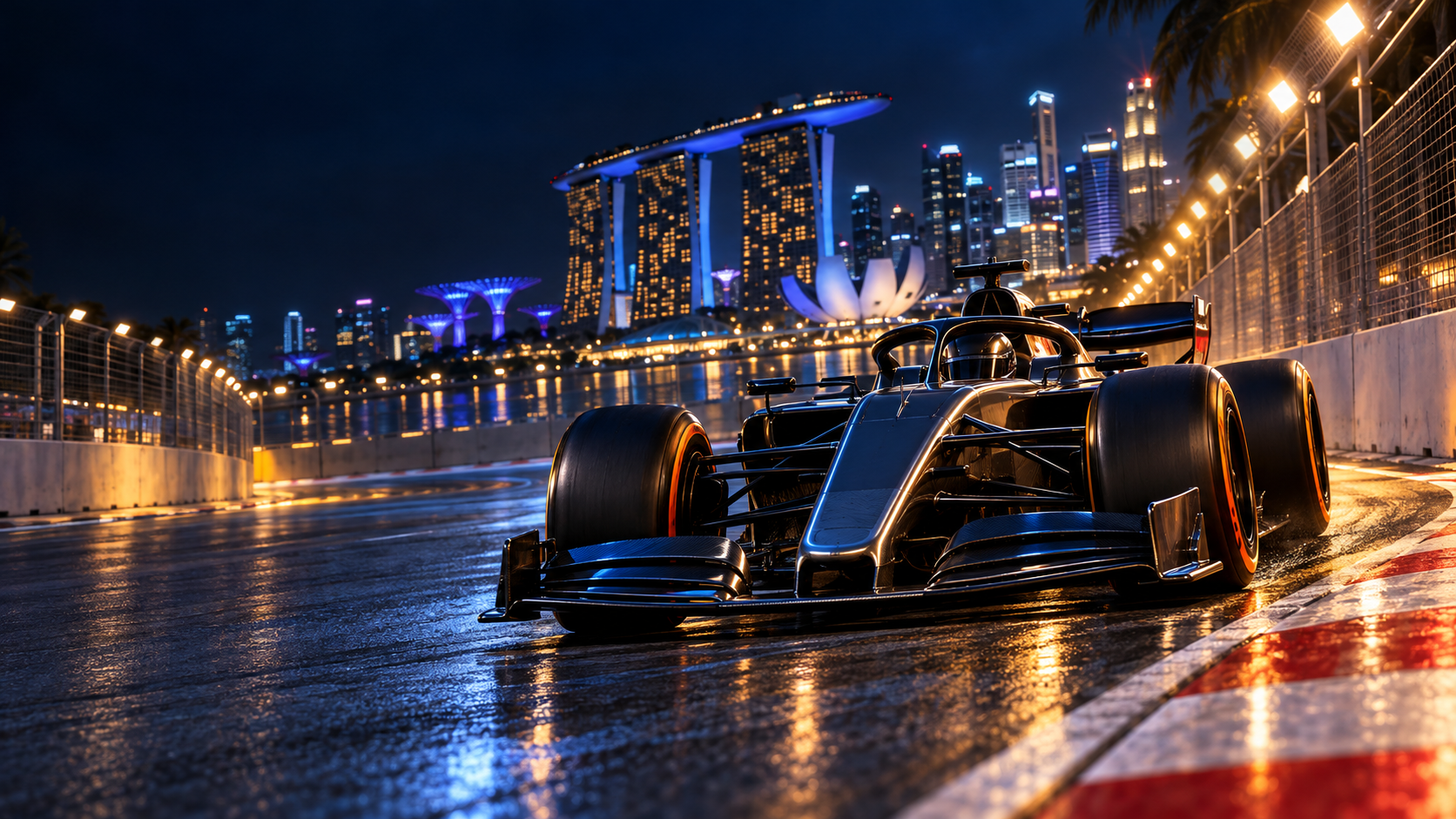
Singapore Sprint Qualifying starts at 20:30 local time (12:30 UTC) on Friday and runs for 44 minutes. It is the first competitive session of Marina Bay’s first Sprint weekend, after just one practice hour. The format makes this less a conventional qualifying build than a compact engineering decision: a team must choose its balance direction before it has properly seen the night-time circuit.
This is a start-of-session preview, not a live report. GearPulse is not trackside and does not have live telemetry. Nothing here uses session timing or reveals a qualifying, Sprint or race result.
The afternoon-to-night reset is the real problem
Formula 1 lists the Marina Bay Street Circuit at 4.927 km, with 19 corners. Sunday’s Grand Prix is scheduled for 62 laps and 305.337 km; Saturday’s Sprint is 21 laps or 60 minutes. Singapore first appeared on the F1 calendar in 2008, but it has not previously carried this Sprint-weekend sequence.
That historical first is more than a schedule footnote. The sole practice session runs in the afternoon, while Sprint Qualifying, Grand Prix qualifying and the Grand Prix are under the lights. Motorsport.com’s pre-weekend analysis notes that recent Singapore events have seen Friday-evening track temperatures several degrees cooler than Friday afternoon. A setup that behaves naturally in practice can therefore arrive at Sprint Qualifying with a changed tyre and grip window.
For GearPulse readers, that is why this is a useful systems story rather than just a 44-minute sports appointment. Cars do not carry a single, fixed level of performance: cooling, tyre warm-up, energy use, ride height and driver confidence have to work together as the environment changes.
| Marina Bay variable | Why it matters for Sprint Qualifying |
|---|---|
| Night-time temperature shift | It can change tyre preparation versus the only afternoon practice reference. |
| Close barriers and 19 corners | A small balance correction is more expensive when commitment is needed repeatedly. |
| Short session | A poor out-lap or an awkward setup direction leaves very little recovery time. |
| First Singapore Sprint | Teams have no previous Marina Bay Sprint notebook to copy wholesale. |
Traction, not a legacy DRS shortcut
The 2026 cars do not use the old DRS-zone framework. Active aerodynamics changes the wing state between corner and straight running, while Overtake Mode has its own activation rules. That makes an old map of Marina Bay’s DRS zones a poor guide to this weekend’s one-lap order.
The enduring circuit challenge is still clear. Pirelli describes a street layout with barriers close to the racing line, limited overtaking opportunities, 19 corners and many braking-and-traction phases. The 2023 third-sector revision made the lap faster and smoother in places, but it did not make the car’s rear stability optional. A driver who has to hesitate on rotation or protect a loose rear loses more than a tenth in one obvious corner; the compromise follows them through the sequence.
The practical comparison is with a fast permanent circuit. There, a car can sometimes use a long loaded corner to settle itself. At Marina Bay, frequent direction changes, braking phases and walls make each platform movement visible. The strongest sign before any result is known is a car that gives its driver a predictable front axle without making traction fragile on exit.
Tyres, weather and the long-weekend compromise
Pirelli has brought C3 hard, C4 medium and C5 soft tyres, the same allocation used at Singapore a year ago. That is a relatively soft range, but it should not be mistaken for a simple soft-tyre shootout. Street circuits are evolving surfaces, and the heat and humidity surrounding Marina Bay make temperature control part of the setup rather than a background detail.
The current Friday forecast reported by Motorsport.com and Sky Sports points to hot, humid conditions with a material rain risk around the weekend. That is a forecast, not a claim that the session will be wet. The more useful conclusion is operational: teams need a dry-lap plan that can be executed promptly, plus enough flexibility not to be trapped by changing surface temperature or a disrupted run sequence.
For the Sprint itself, the tyre choice and 21-lap distance make preservation relevant even though Sprint Qualifying is only about the grid for Saturday’s short race. A very aggressive single-lap balance can be attractive under the lights; it is less attractive if it leaves the car sliding and makes the following day’s tyre behaviour harder to understand.
What the teams need from their driver pairings
The breadth of the 2026 field matters here more than any imagined hierarchy. Established pairings at McLaren, Mercedes, Ferrari, Red Bull and Aston Martin can split run-plan work, while newer projects such as Audi and Cadillac have the same compressed timing problem with less accumulated reference at this venue. That does not predict a result. It explains why two cars delivering comparable feedback is valuable in a Sprint format.
Pirelli calls Marina Bay one of the season’s most physically demanding events, while Motorsport.com highlights the circuit’s heat, humidity, low-speed corners and walls. The driver contribution is therefore not limited to a single peak lap. Clear feedback on braking stability, traction and tyre warm-up can prevent a team chasing a setup change that only solves one corner.
There is also a calendar context. Singapore closes a triple-header, according to Pirelli and Motorsport.com. The useful question is whether a team can turn that accumulated travel and component-management pressure into a clean first competitive night, not whether it can manufacture a headline from an incomplete data set.
The first clues worth watching
At the start of Sprint Qualifying, watch how calmly drivers prepare the tyres before their first committed lap, whether the car rotates without a second steering input and whether traction looks repeatable out of the slower corners. Those are more revealing than treating a single straight-line number as a verdict.
Singapore’s 62-lap Grand Prix is still the weekend’s longest strategic problem. But Friday night defines the first short one. With a 4.927-km street circuit, 19 corners, a soft tyre allocation and only one afternoon practice reference, the team that has made its night setup feel ordinary has already achieved something unusual.