
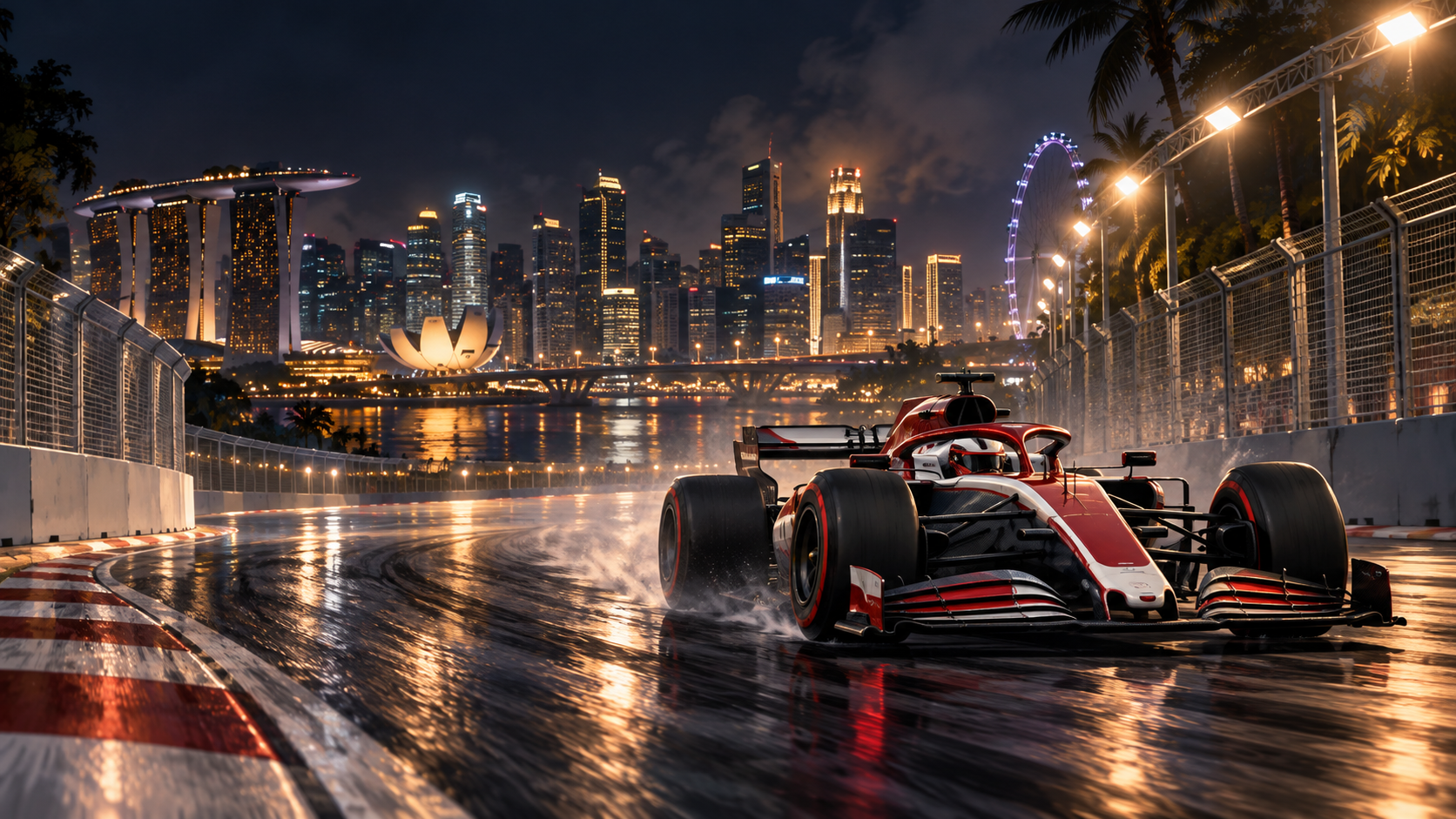
The 2026 Singapore Grand Prix is scheduled to start at 12:00 UTC on Sunday, October 11 — 20:00 in Singapore — and run for 62 laps. Formula 1’s official race hub gives Marina Bay a 4.927 km lap and a 305.337 km race distance.
This is a start-of-race preview, not a live report. GearPulse is not trackside and does not have live timing or telemetry. Nothing here discloses or implies the outcome of any completed competitive session, the Grand Prix grid, a pole sitter, a winner, a podium, a fastest lap, a classification-revealing penalty or a championship outcome.
A street race where the stint matters as much as the launch
Marina Bay’s low average speed can make the Grand Prix feel like a long sequence of traction tests rather than a single top-speed contest. Formula 1 notes that the 2023 revision cut the corner count from 23 to 19, but the circuit remains bumpy, wall-lined and physically severe in Singapore’s humidity. The old 23-corner version is gone; the core problem has not: each exit asks the rear tyres to put energy down cleanly, and every braking phase comes with less runoff than a permanent circuit.
| Race variable | Why it matters at Marina Bay |
|---|---|
| Rear-tyre temperature | Slow exits repeatedly load the rear axle; sliding early in a stint can make the later laps expensive. |
| Braking repeatability | Bumps and close barriers turn a small lock-up or unstable entry into lost confidence for several corners. |
| Track position | Sky Sports identifies the Turn 7 approach and the run toward Turn 16 as key passing opportunities, but overtaking remains difficult. |
| Weather interruption | A storm can change grip, tyre choices and pit timing faster than a conventional degradation model can. |
That makes the most credible pre-race strategy less dramatic than a one-word prediction. A team that can preserve rear grip may be able to extend an opening stint and protect track position. A team that sees temperature rising or grip falling may prefer to stop earlier for clean air. Neither route is inherently superior; traffic, a safety-car interruption and the exact state of the track will decide which option is usable.
No DRS-zone shortcut in the 2026 rules
This is not a legacy-DRS race. The FIA says the 2026 cars use movable front and rear wings: Straight Mode reduces drag at designated straight-line points, while Corner Mode restores the higher-downforce configuration. The separate electrical Overtake Mode is intended to assist a following car.
For GearPulse readers, the useful comparison is between a low-drag tool and a whole-lap system. At a power-sensitive circuit, straight-line efficiency can be the headline. At Marina Bay, it has to survive the next braking zone and traction phase. The car that transitions calmly between aero states, electrical deployment and heavy braking has a more practical race advantage than one that merely looks quick in a short burst.
The night setting also matters. Floodlights make the race visually distinctive, but the engineering effect is the gradual movement from hot, humid daytime conditions to a cooler surface after dark. That can alter tyre warm-up, brake temperatures and the balance a driver trusts on turn-in. It is why an answer that works at the start may need to be managed rather than repeated unchanged all evening.
Weather is a strategic branch, not a forecast certainty
Sky Sports’ weekend guide forecasts thunderstorms for Sunday, with temperatures between 28C and 33C across the week. Its circuit guide also flags the combination of low-speed corners, traction demand and high track temperature as particularly hard on tyres. Motorsport.com’s pre-weekend circuit guide independently describes Marina Bay as a high-heat, high-humidity street track where traction and endurance are central.
Those published forecasts do not tell us the conditions at the green light, and they should not be treated as a prediction of a wet race. They do explain why pit-wall flexibility is unusually valuable. A dry race could reward a long opening stint and controlled tyre use; a shower could reset the grip picture and raise the value of being ready with the right tyre at the right moment. The sensible race plan is a range of choices, not a promise.
Driver and team context: precision has to be repeatable
Marina Bay does not select one type of driver, but it makes different strengths visible. Lando Norris and Oscar Piastri are a useful contrast in how a team can search for a repeatable high-traction platform; Charles Leclerc and Lewis Hamilton bring different styles of extracting a lap from a narrow street-circuit window; and Max Verstappen’s ability to place a car precisely is relevant whenever confidence near a barrier becomes a race-long resource. Those are pre-race traits, not a ranking or a claim about how any driver has performed this weekend.
The same applies to the teams. Mercedes, Ferrari, McLaren and Red Bull must all balance a responsive front end against rear stability, then make that balance work while the energy system and tyre state change. Further back, a team with a calmer car may gain more from a clean, low-error race than one chasing an aggressive setup that cannot be sustained. In a 62-lap street race, repeatability is performance.
The historical reminder
Formula 1 first raced at Marina Bay in 2008, when Singapore hosted the championship’s first night race. The venue’s 2023 layout change shortened and simplified part of the lap, yet the modern 19-corner circuit still carries the defining Singapore trade-off: drivers need commitment, but teams cannot afford to spend the tyres, brakes or energy store too early.
That is why the race-start question is richer than who gets the best initial getaway. Watch whether the cars can follow without obvious tyre distress, whether the rear axle remains composed through repeated traction zones, and whether teams leave themselves an answer if the weather changes. At Marina Bay, the fastest-looking option is only useful if it still works when the race reaches its most demanding laps.