
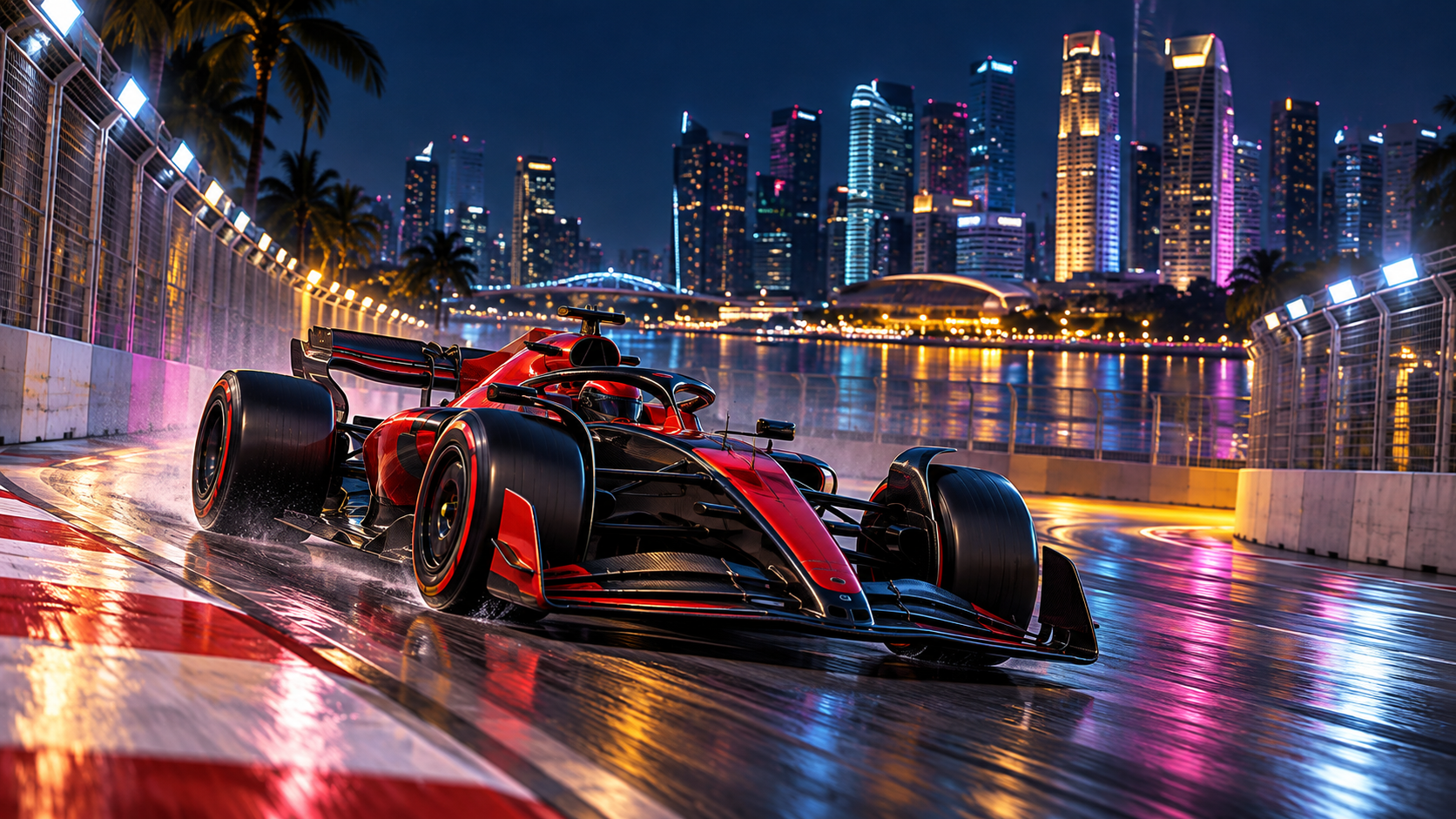
Singapore Grand Prix Qualifying is scheduled to begin at 13:30 UTC on Saturday, October 10 — 21:30 Singapore time — at the Marina Bay Street Circuit. Formula 1’s race hub lists a one-hour session; the local promoter and Motorsport.com give the same 21:30 SGT start.
This is a preview, not a live report. GearPulse is not trackside and has no live-timing or telemetry access. Nothing here discloses or implies a completed Sprint, qualifying or race result, the Grand Prix grid, a pole sitter, a winner, a podium, a fastest lap, a classification-revealing penalty or a championship outcome.
The fixed challenge: 4.927 km with no reset button
Marina Bay is 4.927 km long and Sunday’s Grand Prix is scheduled for 62 laps. That race distance matters even while qualifying is under way: teams need a Saturday setup that finds a single clean lap without making the car too nervous over a much longer, hotter race. Formula 1 records 2008 as the circuit’s first Grand Prix and calls out the physical cost of the event; in this climate and street layout, drivers can lose up to 3 kg during the race.
For GearPulse readers, Marina Bay is a useful engineering contrast. A permanent circuit can give a car room to recover from a small balance error. Here, walls turn a minor hesitation into lost confidence, and the mix of traction zones, bumps and rapid direction changes makes the tyre’s temperature window part of the lap time.
| Qualifying checkpoint | Why it matters at Marina Bay |
|---|---|
| Out-lap preparation | The tyre has to reach its operating window without being overworked before the timed lap. |
| Kerb and bump control | A compliant platform preserves contact patch stability when the car changes direction. |
| Brake confidence | Close barriers make repeatable braking references more valuable than a spectacular first attempt. |
| Traffic gap | Street-circuit sightlines and a long lap make clean air a real strategic resource. |
| Cooling track | The afternoon forecast is not the whole story: the surface should cool materially by the night session. |
DRS is not the right lens in 2026
The old DRS-zone shorthand no longer describes Formula 1’s aerodynamic tools. Under the 2026 rules, conventional DRS has been replaced by active aero: the cars switch between higher-downforce corner running and a lower-drag straight mode, while the separate electrical overtake aid has its own conditions. The FIA stresses that drag reduction is primarily an energy-efficiency tool in this regulation cycle, not the former DRS overtaking mechanism.
That distinction changes the qualifying question. At Marina Bay, the fast-looking configuration is not automatically the quick one. Lower drag can help a car accelerate, but the driver then needs the aero platform to return predictably for the next braking and rotation phase. The better one-lap package is likely to be the car that can use its straight-line setting without giving away a braking margin at the following corner.
Weather makes tyre preparation a live variable
Formula 1 forecasts warm, humid Saturday conditions: a 32C maximum, 26C minimum, a 40% chance of precipitation, light winds with stronger gusts, and surface temperatures that may reach roughly 55C in the afternoon. Its forecast also says the track should cool considerably by qualifying. Sky Sports independently describes a 28C-to-33C weekend and says rain was not forecast for Saturday’s track action when it published its guide; Motorsport.com’s Saturday guide likewise lists the evening qualifying slot.
Those forecasts are not a claim about the conditions at the green light. They are enough, however, to explain the strategic tension. A damp interruption would sharply change tyre preparation and visibility; a dry, cooling night would reward a team that has anticipated the evolution rather than chased the afternoon surface temperature.
The headline is not simply soft versus medium. It is whether a driver can bring the tyre in gently enough to retain braking support through the later corners, then commit to traction without overheating the rear axle. On a street circuit, one compromised out-lap or a small traffic delay can make that calculation different for the next run.
Why the Sprint format raises the setup cost
Singapore is hosting its first Sprint-format weekend, according to the local promoter and Formula 1’s pre-weekend guide. That trims the time available to explore the car before competitive sessions. Alpine’s pre-event team preview describes the circuit as physically demanding, humid, bumpy and wall-lined, and its drivers frame the single-practice structure as a premium on getting into a useful setup window early.
That is relevant beyond one team. Mercedes, Ferrari, McLaren and Red Bull all need an answer to the same compromise: enough rear stability to launch cleanly from slower corners, enough front response to place the car precisely near barriers, and enough efficiency to avoid spending the lap’s energy advantage before the last braking zone.
The driver comparison is therefore more informative than a pre-session pecking order. A driver who can accept a slightly calmer car may protect the tyre and build a repeatable lap; a driver who needs a sharper front end may unlock a faster first sector but narrow the margin over the bumps. Neither choice is universally correct. Marina Bay makes the cost visible quickly.
Historical context, without a false shortcut
Singapore has built its reputation on intensity rather than pure top speed. Formula 1 lists Sebastian Vettel and Lewis Hamilton as the circuit’s joint leaders for pole positions, with four each, and calls attention to a 198-metre run from pole to the Turn 1 braking point. That history is a reminder that qualifying here rewards a complete lap, not a single headline sector.
The 2026 cars add another layer. Active aero and a stronger electrical component mean teams must think in whole-lap systems: energy use, braking stability, tyre state and traffic position. A car can look tidy in isolation and still be vulnerable if it cannot repeat its braking references after the tyres see a second push lap.
What to watch as qualifying starts
Watch for the quiet indicators rather than the final timing screen: whether cars leave a clear traffic gap, whether drivers need a second tyre-prep lap, and whether the cars look settled over the street surface on turn-in. Those are the clues to a usable qualifying window.
Also watch how teams respond to the cooling circuit. The afternoon’s humid heat points one way; the night session’s lower surface temperature can point another. The team that treats those as different conditions, rather than a simple continuation of the day, has a better chance of turning its active-aero and tyre choices into one clean lap.
The verified starting point is simple: scheduled 13:30 UTC / 21:30 SGT, a 4.927 km Marina Bay lap, a 62-lap Grand Prix on Sunday and a humid weather outlook with possible showers. The more interesting question is which car can keep its tyres, energy and braking confidence aligned for the full qualifying lap.