
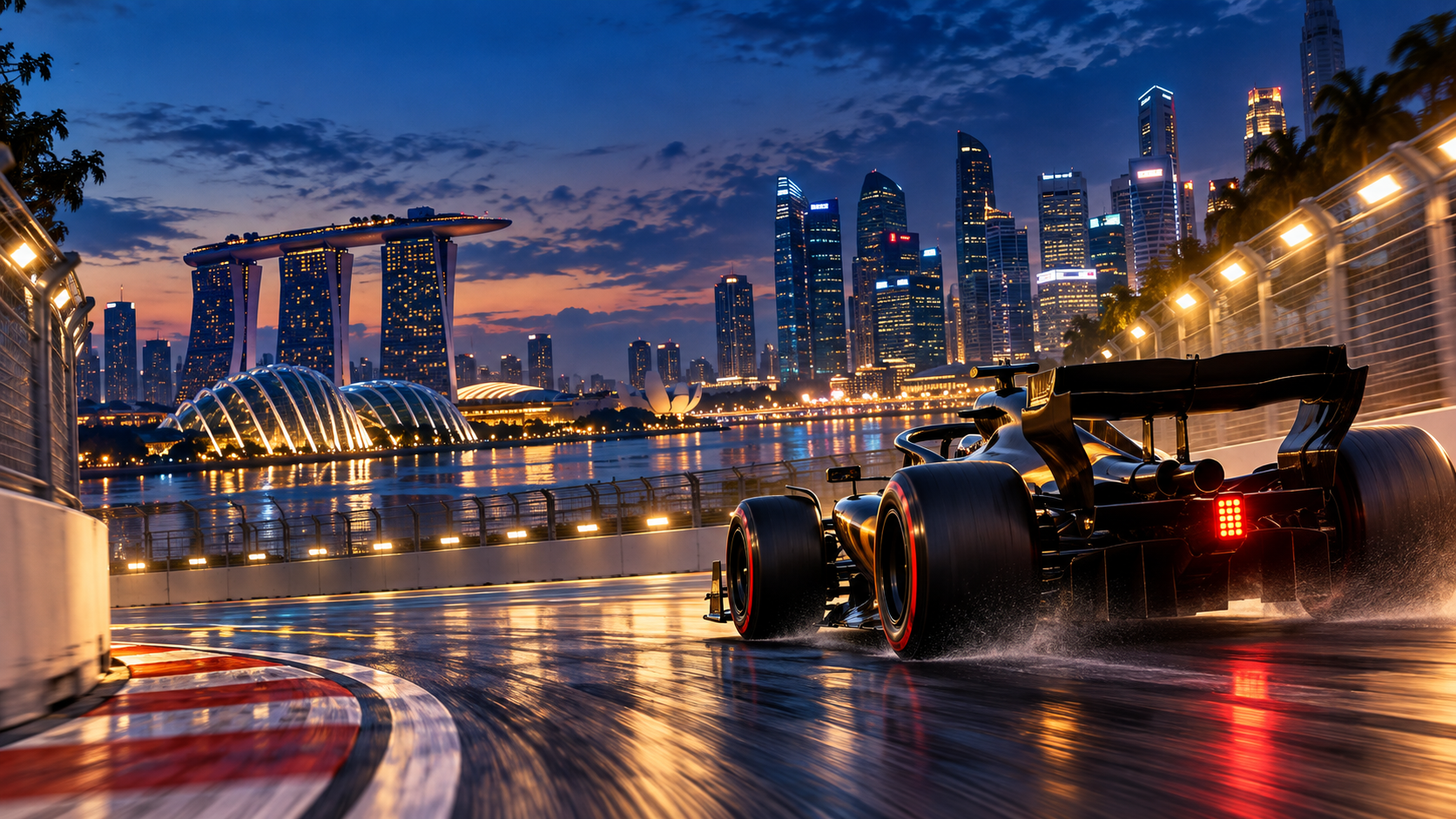
Practice 1 for the Singapore Grand Prix starts at 08:30 UTC (16:30 local) and runs for one hour. Formula 1’s official race hub places Sprint Qualifying later on Friday, which makes this the weekend’s only opportunity to establish a conventional baseline before competitive running begins. This is a start-of-session preview, not a live report: GearPulse is not trackside and has no live telemetry.
That compressed format changes what a meaningful early run looks like. A fast soft-tyre lap can be useful, but Marina Bay makes repeatability more valuable: teams need to understand braking stability, traction and energy use on a temporary street surface before they can make a credible call on setup direction.
The numbers turn the first hour into a filtering exercise
The official Singapore Grand Prix guide lists Marina Bay at 4.927 km, with 19 turns, 62 race laps and a 305.474 km Grand Prix distance. The current layout has used 19 turns since the 2023 revision, which replaced four corners near the bay with a long straight. It remains a circuit built from public roads, so bumps, cambers and close barriers are part of the engineering brief rather than background scenery.
| FP1 question | Why it matters at Marina Bay |
|---|---|
| Can the car brake in a straight line? | Repeated heavy stops and uneven road surfaces punish an unsettled rear axle. |
| Does it rotate without overheating the rear tyres? | Slow, traction-led exits can turn a small balance issue into a long-run limitation. |
| Is the energy plan usable through the lap? | The 2026 cars must balance electrical deployment with the need to preserve corner-entry confidence. |
| Does the platform survive the bumps? | A low, stiff setup may promise downforce but can cost the driver precision on a street circuit. |
The 62-lap race figure matters even on Friday. It is a reminder that the car must work over a stint, not merely connect one clean lap. Teams are likely to use the hour to sequence installation work, a short balance reference and a longer tyre run—while leaving enough margin to react if the circuit evolves quickly.
Singapore’s unusual Friday creates a temperature mismatch
This is Singapore’s first Sprint weekend. Practice 1 takes place in the late afternoon, while Sprint Qualifying is scheduled for the evening under the circuit’s floodlights. Motorsport.com’s pre-session reporting flags the practical issue: recent Singapore weekends have shown Friday evening track temperatures several degrees cooler than the afternoon.
That is a particularly awkward comparison at Marina Bay. The afternoon session can reveal whether the cooling package, brakes and rear tyres tolerate heat and humidity, but it cannot be treated as a one-to-one rehearsal for a cooler evening. The good teams will therefore be looking for a setup range: enough front response to place the car precisely between the walls, yet enough rear stability to keep the tyres in their working window when the temperature drops.
The weather adds another conditional variable, not a prediction. Formula 1 describes October as an inter-monsoon period with high humidity and common afternoon or early-evening thunderstorms; Motorsport.com’s Friday forecast similarly allows for isolated storms and a possible damp surface after earlier showers. At the scheduled start, forecasts point to roughly 30–31C conditions. A shower, even if it misses the session itself, could reset grip and make the first meaningful laps less comparable than the stopwatch suggests.
No legacy DRS-zone calculation in 2026
The old DRS-zone framing no longer applies in the 2026 rules. FIA’s regulations overview describes movable front and rear wings: cars use a higher-downforce cornering configuration and can switch to a low-drag straight-line configuration. The rules also use an electrical Override Mode to improve overtaking opportunities for a following car.
For Practice 1, that shifts the engineering question from “which DRS zone is strongest?” to “can the car transition cleanly between its aero and energy states?” Marina Bay’s long straights invite low-drag efficiency, but the 19-corner lap immediately asks for braking confidence and traction. A setup that chases straight-line speed at the expense of calm corner entries risks handing back its gain every time the driver approaches a wall.
Strategy is about preserving options, not calling the race
Street circuits often reward track position, but no pre-session article can responsibly turn that into a fixed strategy forecast. The relevant evidence is more modest: tyre condition, track evolution and a possible weather interruption will determine whether teams favour a longer opening stint or seek fresh rubber early. The correct FP1 goal is to learn how hard the tyres can be worked before the balance moves—not to pretend the eventual race shape is already known.
There is a useful historical comparison in the venue itself. Marina Bay has hosted Formula 1 since 2008 and is the sport’s original night-race setting, but its public-road character distinguishes it from a permanent circuit. The circuit was shortened and simplified in 2023, yet its core demand remains familiar: drivers must build confidence lap by lap because small corrections carry a larger price when the barriers are close.
The context teams and drivers carry into the hour
Every driver faces the same compression, but the 2026 technical reset makes the baseline especially valuable. The FIA’s new rules combine active aerodynamics with much greater electrical influence and a new generation of smaller, lighter cars. That means each team is still refining the trade-off between low-drag speed, energy recovery and a predictable aero platform.
For drivers, the limited running places a premium on concise feedback: identify whether the limiting factor is front locking, rear traction, kerb compliance or energy delivery, then give engineers enough direction to choose a setup before the evening session. For teams, it is a correlation test. Simulator preparation has to meet a bumpy, hot, evolving street surface in one hour.
For GearPulse readers, that is the technical story worth watching as Practice 1 begins. Singapore does not reward the loudest early number as reliably as it rewards a car that is easy to place, kind to its tyres and flexible across changing temperatures. The team that reduces those unknowns first will enter the Sprint portion of the weekend with the more useful advantage—before any competitive result exists.