
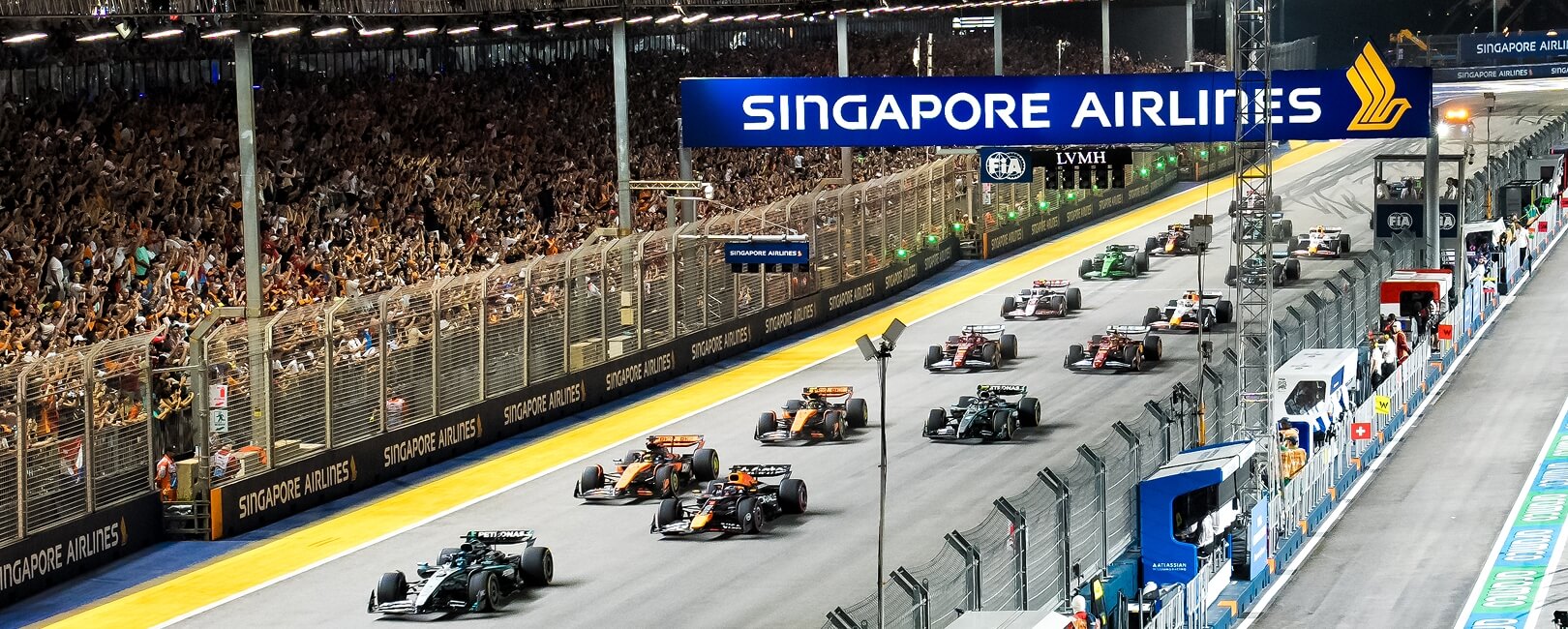
Singapore has always made Formula 1 look difficult. The walls are close, the heat hangs around long after sunset, and a mistake that would become a harmless trip through asphalt elsewhere can end a session here.
This year, Marina Bay removes the usual safety valve too. The October 9–11 weekend will host the circuit’s first F1 Sprint, giving teams a single Friday practice hour before Sprint Qualifying sets a competitive grid. That makes the event a sharper technical exam than the familiar Sunday-night spectacle.
The timetable changes the job
The official promoter schedule replaces Friday’s second practice with Sprint Qualifying and Saturday’s final practice with the Sprint itself. Grand Prix qualifying still follows on Saturday night, then the 62-lap race starts at 8:00pm local time on Sunday.
| Session | Singapore time | What it decides |
|---|---|---|
| FP1 | Friday, 9 October, 4:30–5:30pm | The only conventional setup session |
| Sprint Qualifying | Friday, 8:30–9:14pm | Saturday Sprint grid |
| Sprint | Saturday, 10 October, 5:00–5:30pm | Points and live tyre/setup evidence |
| Grand Prix Qualifying | Saturday, 9:00–10:00pm | Sunday starting grid |
| Grand Prix | Sunday, 11 October, 8:00–10:00pm | The main event |
That is not merely more action for ticket holders. A conventional weekend gives engineers multiple sessions to understand braking temperatures, ride height, kerb strikes and tyre behaviour as the circuit evolves. At a Sprint event, early assumptions travel much farther. Parc fermé restrictions after Sprint Qualifying mean a poor first setup can become an expensive problem rather than a Friday-night footnote.
Sepang made the timing matter
The previous round reset the emotional temperature of the championship. Max Verstappen won the rain-delayed Bahrain Grand Prix in Malaysia, his and Red Bull’s first victory of 2026, while Kimi Antonelli finished second. The FIA’s final classification puts Lewis Hamilton third and records George Russell’s late retirement.
The result did not erase Antonelli’s advantage. Formula 1 says the Mercedes driver arrives in Singapore 84 points clear of Russell with seven rounds remaining; RacingNews365 independently reports the same margin and identifies Marina Bay as the sixth and final Sprint weekend of the season.
For Antonelli, that turns Singapore into a defence of discipline. An 84-point lead does not require a spectacular Saturday, but it does make a wall strike, a compromised qualifying lap, or a Sprint tangle needlessly valuable to rivals. For Verstappen, a first win of the year has changed the question from whether Red Bull can win to whether it can repeat the performance when the track demands a very different kind of car.
Why the Sprint is more than a bonus race
The short race will offer real evidence before Grand Prix qualifying, but it will not offer a clean reset. Teams need to decide what they value during the lone practice: low-fuel qualifying confidence, long-run tyre temperatures, or enough margin to survive the circuit’s bumps and kerbs.
That is especially relevant at a night street race. Track conditions can move as support races run and temperatures fall, so data gathered at one moment may not perfectly describe the next. The Sprint rewards teams that arrive with a credible baseline; it punishes teams that need a long Friday to find one.
Singapore’s promoter describes it as the first Sprint at Marina Bay, and the independent schedule coverage agrees on the sequence: one practice, Friday Sprint Qualifying, Saturday Sprint, then qualifying for Sunday. It is a meaningful format change, not a cosmetic label.
The fan’s practical watch list
| Watch for | Why it matters |
|---|---|
| FP1 gaps and aborted runs | There is no second practice to repair a confused setup. |
| Friday qualifying pace | It can expose who understood the track earliest, even if Saturday changes the Grand Prix order. |
| Sprint tyre behaviour | It is the closest competitive rehearsal for race traffic and degradation. |
| Saturday night qualifying | The Sprint grid is not Sunday’s grid; this remains the decisive single lap for the Grand Prix. |
| Antonelli versus Verstappen | One is protecting a substantial lead; the other arrives with momentum from a breakthrough win. |
GearPulse has already covered how a late-race reliability problem can change a title calculation and why an F1 weekend is often a measurement problem before it is a wheel-to-wheel show. Singapore combines both ideas in unusually concentrated form: fewer chances to measure, more consequences when the measurement is wrong.
Bottom line
The inaugural Singapore Sprint makes a demanding race weekend more revealing, not simply busier. The team that is quickest on Friday will not automatically win on Sunday, but the team that spends Friday lost may have too little time to recover.
For a title fight led by Antonelli and newly complicated by Verstappen’s Sepang victory, that is exactly what makes Marina Bay worth watching: two days of pressure before the main race even begins.