
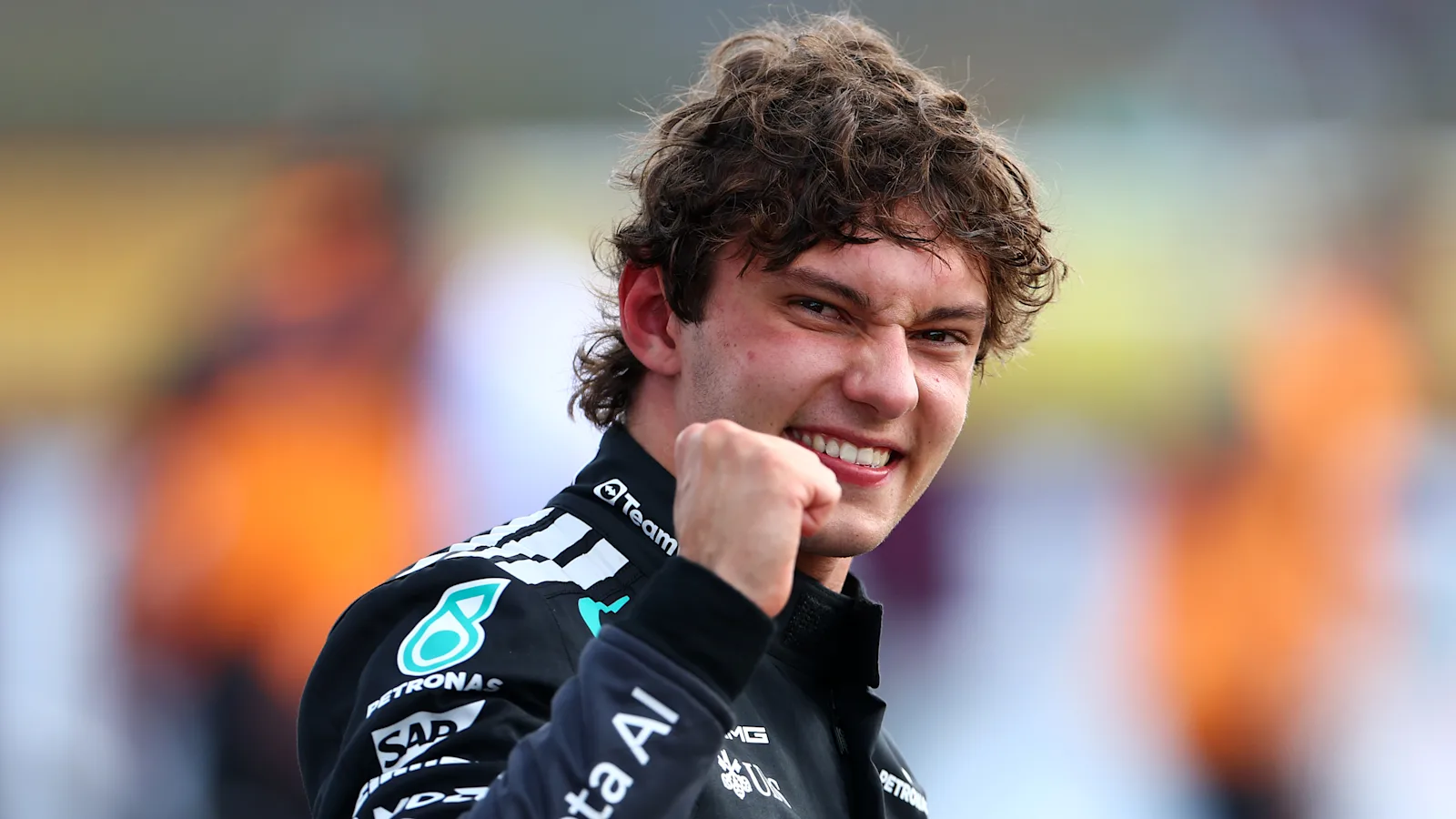
The adjusted Silverstone grid is easy to read and harder to race.
RacingNews365’s post-qualifying grid list gives the useful first pass: Kimi Antonelli starts the 2026 British Grand Prix from pole, Charles Leclerc joins him on the front row, Lewis Hamilton and George Russell sit behind, and Pierre Gasly’s three-place penalty drops the Alpine from 12th to 15th. Formula 1’s official starting-grid page and the FIA’s provisional starting-grid document confirm the same structure, including the Gasly penalty note.
The trap is that the grid does not create one obvious race. It creates three races at once: Mercedes trying to control Ferrari, Ferrari trying to split Mercedes before the tyre picture settles, and Red Bull plus McLaren starting close enough to interfere but not close enough to dictate.
GearPulse’s view: Silverstone’s starting grid makes Antonelli the reference, but it does not make the British GP simple. The most important fight may be whether Mercedes can stop Ferrari turning rows one and two into a two-car pressure problem before the first stop.
The verified grid changes the story
The front eight tell most of the race story. Formula 1 lists Antonelli first with a 1:28.111, Leclerc second, Hamilton third, Russell fourth, Isack Hadjar fifth, Lando Norris sixth, Max Verstappen seventh and Oscar Piastri eighth. The FIA provisional grid confirms the same order after the Gasly penalty is applied.
That matters because qualifying order and starting grid are not identical here. Gasly qualified 12th, but Formula 1 says the stewards penalized him for impeding Lance Stroll in Q1. The FIA grid document records the three-place drop, moving Nico Hulkenberg, Oliver Bearman and Carlos Sainz up one place each and putting Gasly 15th.
| Grid zone | Key starters | What it changes |
|---|---|---|
| Row 1 | Antonelli, Leclerc | Mercedes has pole, but Ferrari has immediate attacking position. |
| Row 2 | Hamilton, Russell | Ferrari can attack with Hamilton while Mercedes can cover with Russell. |
| Rows 3-4 | Hadjar, Norris, Verstappen, Piastri | Red Bull and McLaren are close enough to punish a slow first stint. |
| Rows 5-6 | Lindblad, Lawson, Bortoleto, Hulkenberg | Racing Bulls has track position; Audi has a real midfield opening. |
| Rows 7-8 | Bearman, Sainz, Gasly, Albon | Gasly’s penalty reshapes the lower-points fight. |
| Back three rows | Ocon, Bottas, Colapinto, Perez, Stroll, Alonso | Aston Martin and Cadillac need disruption, not just pace. |
The Race reached the same practical conclusion in its grid summary: Antonelli has the headline position, Ferrari is the immediate threat, Racing Bulls leads the midfield pack, and Gasly’s penalty is the important post-session adjustment.
Mercedes has control, not comfort
Pole is still the best place to start at Silverstone, but this is not a street circuit where track position can do all the work. The run to Abbey, the exposure through the fast sections and the possibility of a one-stop race mean the leader has to manage more than clean air.
Antonelli’s biggest advantage is strategic clarity. If he holds the lead at the start, Mercedes can make Ferrari react. That sounds obvious, but it matters at Silverstone because Pirelli expects the teams to lean toward a one-stop race using the C2 and C3 compounds. A one-stop shape increases the cost of losing time early in traffic or protecting tyres too aggressively.
Russell in fourth gives Mercedes cover, but not a perfect shield. If Hamilton jumps Leclerc or attacks Antonelli, Russell may be asked to pressure the Ferrari rather than simply run his own race. If Russell gets stuck behind Hamilton, Mercedes’ two-car advantage narrows quickly.
The cleanest Mercedes race is Antonelli leading, Russell pressuring Hamilton, and Ferrari forced to choose between attack and tyre life. The messy version is Ferrari splitting the Mercedes cars before the race settles.
Ferrari has the better attacking geometry
Ferrari’s grid is more interesting than a normal second-and-third start because the drivers have different jobs.
Leclerc starts directly beside Antonelli. His role is immediate: make Mercedes defend into the first sequence and test whether the pole-sitter wants to protect track position or tyre temperature. Hamilton starts third, with the home crowd and enough Silverstone history to make any first-lap half-gap feel dangerous.
That gives Ferrari a useful split. Leclerc can attack the lead, while Hamilton can pressure Mercedes from behind or cover Russell. If Ferrari gets either car ahead of Antonelli, the race changes shape. If it merely keeps both cars close, it can still force Mercedes into a defensive first-stop call.
The caveat is tyre stress. Pirelli’s Silverstone preview explains why the hardest range, C1-C2-C3, is in use: high lateral load, fast direction changes and particular stress on the front-left tyre. Ferrari can attack early, but if that attack means sliding through the fast right-handers, the bill may arrive before the pit window.
Red Bull and McLaren are awkwardly placed
Rows three and four are where the race can become untidy.
Hadjar starts fifth, ahead of Norris, Verstappen and Piastri. That is not the expected order for a Red Bull-McLaren fight, but it gives Red Bull a useful blocker and a clean chance to make McLaren race backward before it can race forward. Verstappen starting seventh is not ideal, yet Silverstone gives enough passing zones that he is still a threat if the Red Bull is kinder on tyres than it looked over one lap.
McLaren’s problem is that both cars start behind Hadjar. Norris in sixth and Piastri in eighth still have podium upside if the car is stronger in race trim, but they need either a launch, a tyre-life advantage, or a strategy offset. They do not have the luxury of simply following the leaders and waiting.
GearPulse’s non-betting likelihood read:
| Race path | Likelihood | Why |
|---|---|---|
| Mercedes controls the race through Antonelli | 35-45% | Pole plus Sprint pace gives the cleanest public case. |
| Ferrari converts rows one and two into a win fight | 25-35% | Leclerc and Hamilton are positioned to attack Mercedes from both sides. |
| McLaren recovers into podium contention | 15-25% | Race pace may be better than qualifying, but track position is poor. |
| Verstappen becomes the main disruptor from seventh | 10-20% | Driver ceiling is high, but the grid slot and Red Bull balance evidence are weak. |
| A midfield starter steals major points | 8-15% | Hadjar, Racing Bulls and Audi have useful track position if the front fight slows. |
These are editorial ranges only. They are not betting advice, and they do not use live telemetry or private team information.
Gasly’s penalty matters more than it looks
Gasly dropping from 12th to 15th is not a headline next to Antonelli, Leclerc and Hamilton, but it changes the lower points race.
Formula 1’s penalty report says Stroll was on a timed lap in Q1 when he approached Gasly, who was on an in-lap and remained slow on the racing line. The stewards judged that Gasly had unnecessarily impeded Stroll and applied the standard three-place grid drop. The result promotes Hulkenberg to 12th, Bearman to 13th and Sainz to 14th.
That is a meaningful swing because Silverstone midfield races can become train-like if the front group stretches out. Hulkenberg gains cleaner air and a better shot at joining Bortoleto in an Audi points push. Bearman gets a slightly easier launch lane. Sainz moves one slot closer to making Williams relevant. Gasly, meanwhile, starts in a more awkward pack with Albon and Ocon around him.
For Aston Martin, the penalty does little. Stroll and Alonso still start 21st and 22nd on the official grid. Unless weather, safety cars or early contact intervene, they need the race to come apart.
Silverstone punishes the wrong kind of bravery
The reason this grid is so tense is the track itself.
Pirelli’s preview lists Silverstone at 5.891 km with 18 corners, 10 right-handers and eight left-handers. It also notes lateral forces above 5g and identifies the left-front as a key wear point because of the right-hand corner bias. That means the first few laps are not just about who is brave enough to attack. They are about who can attack without overheating the front axle or spending too much tyre through Copse, Maggotts, Becketts and Chapel.
The fun fact is that Silverstone’s oldest identity still explains the modern race. It hosted the first Formula 1 World Championship round in 1950, and the circuit’s old-airfield openness still makes wind and commitment part of the show. The cars are new, the energy systems are new, and the grid has 22 entries, but the question remains very old: who can carry speed without abusing the car?
That is where the starting grid becomes a pressure trap. Every obvious move has a cost. Mercedes can defend, but may invite Ferrari into an undercut window. Ferrari can attack, but may hurt the tyres. McLaren can push early, but may get stuck behind Hadjar or Verstappen. Red Bull can gamble, but starting seventh leaves little margin.
Bottom line
RacingNews365’s adjusted grid is the right base because it captures the post-penalty order fans actually need before lights out. The official F1 and FIA documents confirm the important details: Antonelli on pole, Leclerc and Hamilton as Ferrari’s immediate threat, Russell fourth, Hadjar ahead of McLaren and Verstappen, and Gasly demoted to 15th.
The race is not “Mercedes versus Ferrari” in the abstract. It is more specific than that. It is Antonelli trying to turn pole into control while Ferrari tries to make the first stint too crowded for Mercedes to manage cleanly. Behind them, Red Bull and McLaren are close enough to punish any hesitation.
Silverstone has given the British GP a grid that looks orderly. That is exactly why it is dangerous.