
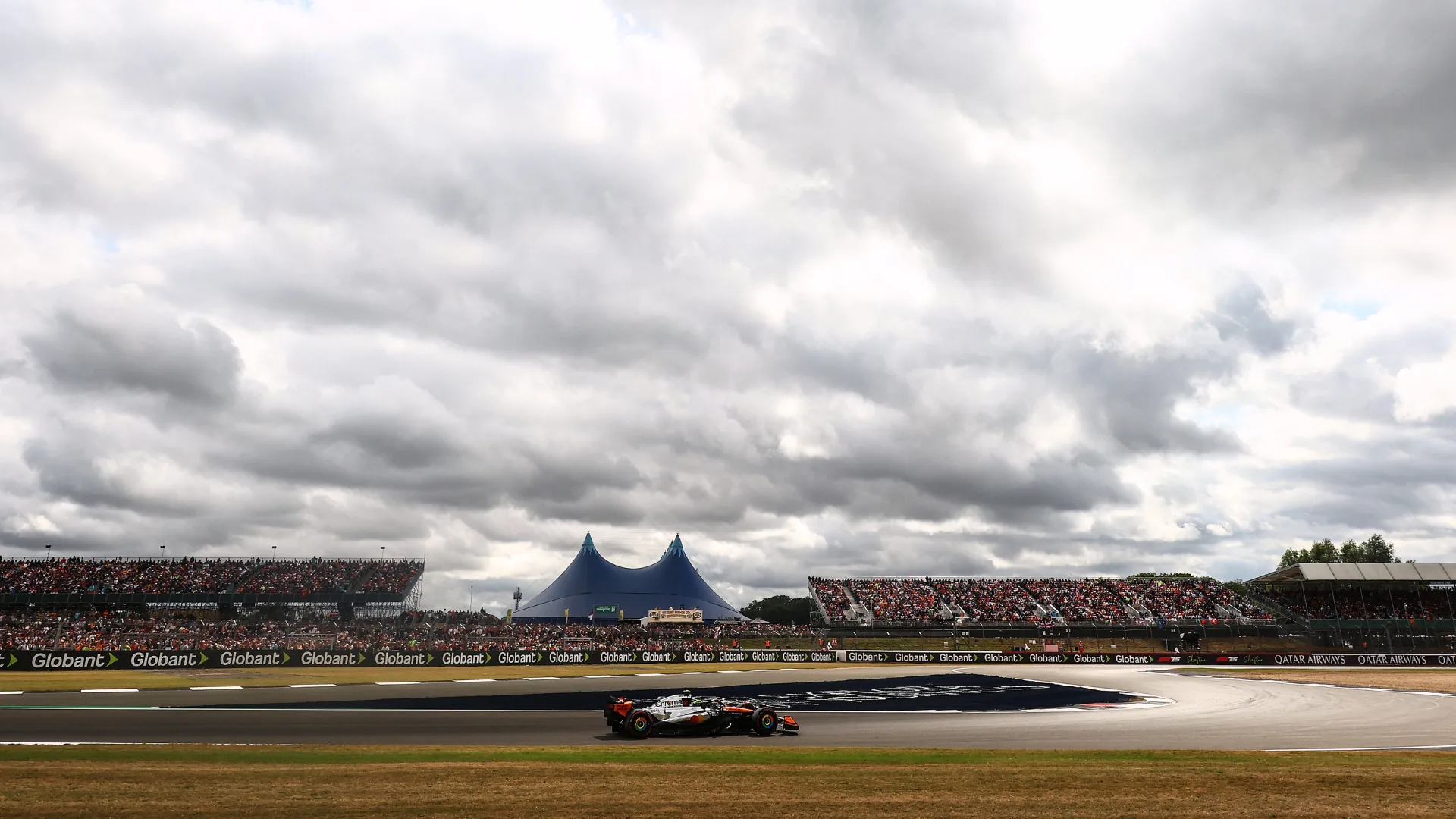
Silverstone’s 2026 British Grand Prix is not shaping up like the usual British weather roulette. Formula 1’s latest forecast points to dry running across Friday, Saturday and Sunday, with warm air, track temperatures around the low 40s Celsius at times and moderate wind. Silverstone’s own forecast also points toward a dry weekend, while Sky Sports F1 is telling viewers to expect three rain-free days of track action.
That sounds like less jeopardy. It may actually be a different kind of jeopardy.
Pirelli has brought the hardest trio in its range, C1 as the hard, C2 as the medium and C3 as the soft, because Silverstone is one of the calendar’s highest-severity circuits. It is also a Sprint weekend, which cuts the dry allocation from 13 sets to 12. The short version: teams are likely to get less practice, less tyre inventory and more heat on a track that already leans hard on the front axle.
GearPulse’s view: the most interesting Silverstone story today is not “will it rain?” It is what happens if it does not.
Why the dry forecast matters
Rain often gives Silverstone its headline. The 2025 British Grand Prix had variable weather, and Pirelli’s preview points out that intermediate tyres were used during the race. That memory matters because it can make a dry forecast feel like a calmer sporting environment.
But a warm, dry Silverstone sharpens a more technical problem. The circuit’s fast right-handers punish the left-front tyre, especially through the high-speed middle sector and the long load sequence around Copse, Maggotts, Becketts and Chapel. Pirelli says the accelerations in some sections exceed 5g, which puts Silverstone in the same severity conversation as Suzuka and Spa.
That makes the forecast relevant before anyone has set a representative lap. If the track is hot and dry, the first question is not whether teams can dodge showers. It is whether they can run enough wing, protect the front tyre and still keep straight-line speed for Hangar Straight and Stowe.
The caveat is obvious: forecasts can move, and Silverstone is an exposed former airfield. Formula 1, Silverstone and Sky all frame the current forecast as dry, but Pirelli still notes that British showers can arrive even in summer. So the right read is not “ignore wet tyres.” It is “the baseline plan now looks dry enough that tyre preservation matters from the first competitive lap.”
The Sprint format makes every set count
This is where the story gets sharper. Silverstone is hosting its first Sprint weekend since the format debuted there in 2021. That means one practice session before Sprint Qualifying on Friday, then a Sprint and Grand Prix qualifying on Saturday before the 52-lap race on Sunday.
Formula 1’s tyre guide says drivers get two hard sets, four medium sets and six soft sets, plus the wet-weather allocation if needed. Mercedes’ own tyre explainer repeats the same 12-set Sprint allocation and adds the dry-race rule that drivers must use at least two different slick compounds if the Grand Prix stays dry.
That creates a quiet trap. In a normal weekend, teams can spend more running on long-run comparison and setup correction. In a Sprint weekend, every lap has more opportunity cost. Use the C1 hard early and you learn about the safest race tyre, but you may burn a set that Pirelli expects to be useful in FP1. Lean heavily on the soft and you get qualifying feel, but Silverstone is not gentle enough to make that a free habit.
The teams with the calmest simulation and tyre models should have an advantage. The teams still trying to understand a Silverstone-specific aero or energy balance will have less time to guess wrong.
What this asks from the front runners
Mercedes has the cleanest paper case because the track, the recent Austria result and the home-race context all point toward a team that should be central to the weekend. The hard part is internal as much as external. George Russell arrives with momentum, Kimi Antonelli remains the championship reference, and the dry forecast removes one obvious chaos route that could scramble Mercedes’ baseline advantage.
Ferrari’s job is different. Lewis Hamilton’s Silverstone record always turns the British GP into a major crowd story, but a dry, tyre-limited weekend asks Ferrari for operational discipline more than emotion. If the car is kind to the front axle and quick enough through the high-speed sector, Hamilton can be more than nostalgia. If Ferrari burns through tyres or chases setup balance after the only practice session, the crowd cannot fix that.
McLaren may be the most sensitive case. The team has already turned up the visibility with a special British GP livery, and Lando Norris is carrying the defending home-winner frame from 2025. A dry Sprint weekend is useful if McLaren’s platform is stable. It is awkward if Mercedes has the better long-run front-tyre answer.
Red Bull and Max Verstappen sit in the background as the spoiler threat. Silverstone’s dry conditions may reduce random opportunity, but they do not remove Verstappen from a race if Red Bull’s Austria progress translates through the faster corners. The question is whether Red Bull can keep the car efficient without overworking the same front-left tyre everyone else is watching.
GearPulse probability board
This is editorial framing, not betting advice.
| Silverstone tyre/weather read | Likelihood | Why it matters |
|---|---|---|
| Fully dry competitive F1 running from Sprint Qualifying through the race | 65-75% | Formula 1, Silverstone and Sky all point to no rain in the current forecast, but local shifts remain possible. |
| One-stop Grand Prix becomes the default strategy | 55-65% | Pirelli expects teams to target a one-stop using the C2 and C3 if the race stays dry. |
| Front-left management decides more than outright single-lap pace | 60-70% | Silverstone’s right-hand load pattern and high-speed direction changes make degradation hard to hide. |
| A team sacrifices Sprint sharpness to protect Sunday tyre knowledge | 40-50% | With one practice and fewer sets, long-run confidence may be worth more than a flashy early run. |
| Rain still materially changes the race plan | 15-25% | Current forecasts are dry, but Silverstone has enough weather history to keep wet tyres in the conversation. |
The most important line is the one-stop expectation. If Sunday stays dry, the race may reward teams that can stretch a medium-soft or medium-hard plan without asking drivers to tiptoe too early. That is not as dramatic as a late shower, but it can be just as decisive.
Track facts that explain the stress
Silverstone is 5.891 km long and the British Grand Prix is scheduled for 52 laps. Pirelli’s preview notes 18 corners, split into 10 right-handers and eight left-handers. That imbalance is why the left-front tyre gets so much attention.
The track surface is not unusually abrasive, according to Pirelli, but that does not make it easy. Low roughness can help grip consistency, while sustained high lateral load still builds heat and wear. That combination is why Silverstone can look smooth on television and still be brutal in the data.
Fun fact: Pirelli points out that the first Formula 1 world championship race at Silverstone in 1950 was won by Giuseppe Farina on Pirelli tyres. The 2026 edition is also Pirelli’s first British GP as title sponsor this year, which makes the tyre story feel unusually on the nose.
Who benefits if it stays dry?
A dry weekend usually lowers variance, but not equally.
| Team or driver group | Dry forecast benefit | Main risk |
|---|---|---|
| Mercedes | Less weather randomness should let its current form show | Intra-team pressure between Russell and Antonelli becomes harder to soften |
| Ferrari | Hamilton’s Silverstone experience can be applied to a stable race plan | Poor tyre life would turn a crowd story into frustration |
| McLaren | A clean weekend gives Norris a better chance to build rhythm | Special-livery attention raises the temperature on any underperformance |
| Red Bull | Verstappen can pressure any front runner that overprotects tyres | If Red Bull lacks high-speed balance, dry conditions expose it clearly |
| Midfield teams | Sprint format can still create track-position chances | Less rain means fewer natural resets for strategy gambles |
The midfield is the hardest place to call. A dry Sprint weekend can produce opportunity because parc ferme and limited practice compress decisions. But it also removes the easiest route to a surprise podium or major points haul. For Haas, Racing Bulls, Williams, Alpine and Aston Martin, the best outcome may be boring execution: no tyre abuse, no track-limits mess, no wasted set at the wrong time.
Bottom line
Silverstone’s dry forecast is the right F1 story today because it reframes the British Grand Prix before the cars run in anger. After recent attention on home drivers, liveries and title momentum, the practical question is now more technical: who can solve a hot, high-load Sprint weekend with fewer tyres and almost no setup runway?
The tempting headline is that rain is unlikely. The better read is that dry weather makes the tyre test harsher, not easier. Silverstone will still be fast, exposed and unforgiving. It just may punish the teams through front-left wear and Sprint-weekend discipline instead of sudden showers.
GearPulse’s view: if the forecast holds, this British GP will reward the team that treats Friday practice like a race-critical engineering session, not a warm-up. The crowd will bring the noise. The left-front tyre may bring the verdict.
Support the site at buymeacoffee.com/gearpulse.site.