
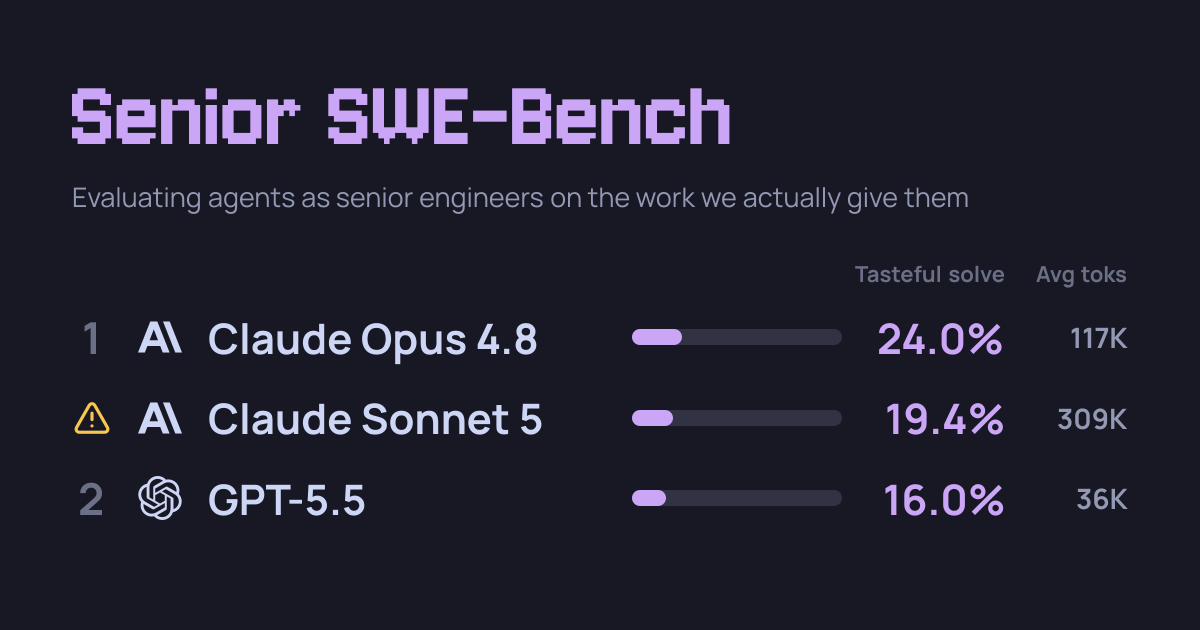
AI coding benchmarks have become a strange kind of scoreboard. A model jumps a few points, a leaderboard updates, and suddenly everyone is arguing about whether software engineering is solved.
Senior SWE-Bench is interesting because it pushes in the opposite direction. Its premise is blunt: if we expect agents to act like senior engineers, we should stop evaluating them like junior engineers working from tidy tickets.
The new benchmark, published with a public dataset on GitHub, focuses on longer, messier software tasks. It includes feature work, bugs, performance issues, multi-stack changes, and under-specified instructions that look more like a Slack message than a carefully prepared coding challenge.
That is the right problem to attack. It is also exactly the kind of benchmark that needs careful interpretation.
What Senior SWE-Bench is trying to measure
The official site frames the benchmark around three ideas: senior engineers build features without over-specified requirements, investigate bugs from behavioral reports, and ship code that fits the existing codebase without being told every detail.
That sounds obvious to anyone who has worked on production software. It is not how most public coding benchmarks feel.
| Benchmark direction | What it tends to reward | What it can miss |
|---|---|---|
| Classic code puzzles | Algorithmic correctness in isolation | Codebase navigation and product context |
| SWE-bench Verified | Fixing real GitHub issues with tests | Messy requirements, private-code generalization, scaffold effects |
| SWE-Bench Pro | Harder long-horizon professional-style tasks | Still depends heavily on grading and harness design |
| Senior SWE-Bench | Under-specified work, taste, runtime investigation | Whether subjective quality can be scored robustly at scale |
Senior SWE-Bench says its public tasks come from repositories including PostHog, Electric, Gitea, better-auth, and Harbor, with a mix of languages and stacks. The site lists 50 public and 50 private tasks, and says some feature tasks can span an average of 11 files.
That is a more realistic shape. Senior engineering is rarely “change one function and pass one test.” It is often “understand the intent, find the hidden constraints, change the right pieces, avoid breaking adjacent workflows, and leave the codebase healthier than you found it.”
Why this matters for AI agents
The next phase of coding assistants is not just autocomplete. It is delegated work.
That makes benchmark design more important. If a benchmark rewards narrow patch generation, tool builders will optimize for narrow patch generation. If it rewards cheap tricks around tests, agents will learn to exploit tests. If it rewards realistic investigation and maintainable changes, it has a better chance of measuring the kind of usefulness teams actually want.
Senior SWE-Bench’s validation-agent idea is the most notable part. Instead of relying only on fixed tests, it uses expert-designed recipes to generate behavioral tests that adapt to submitted solutions. The goal is to avoid overfitting to one exact patch while still checking whether the behavior works.
That is promising because real code review is not only “did these tests pass?” It is “did you solve the problem in a way this system can live with?”
The caveats are not small
Benchmarks can create their own reality distortion field.
Epoch AI’s SWE-bench Verified analysis is a useful reminder. Even strong public benchmarks can have contamination risk, scaffold dependency, narrow repository coverage, and tasks that are cleaner than real workplace requests. Berkeley RDI’s work on benchmark exploits is another warning: if the test harness can be gamed, scores can look impressive without representing real capability.
Senior SWE-Bench is designed partly as a response to those problems. That does not make it immune to them.
| Question to ask | Why it matters |
|---|---|
| Are private tasks meaningfully different from public tasks? | Public tasks can leak into training or tuning workflows |
| How subjective is “tasteful” scoring? | Maintainability is real, but hard to reduce to one number |
| How expensive are top results? | A high solve rate with huge token budgets may not be practical |
| Does the scaffold matter as much as the model? | Agent harnesses can dominate leaderboard outcomes |
| Can the validation agent be fooled? | Adaptive tests still depend on the quality of the validator |
The official Senior SWE-Bench page lists large output-token figures for some leading agents. That is not a flaw by itself. Senior work takes time. But if a benchmark solve consumes six figures of tokens on average, the result is less “this can replace a developer” and more “this can attempt a serious task with a large compute budget.”
That distinction matters for buyers.
A better buying signal for coding tools
For teams evaluating AI coding tools, Senior SWE-Bench is useful because it asks a better question.
The old question was: can the model fix a bug when the issue and tests are clear?
The better question is: can the agent take an imperfect request, inspect the system, run it, reason through the failure, make a maintainable change, and avoid collateral damage?
That is much closer to the work companies actually want to delegate. It also suggests a more grounded way to read leaderboards. Do not look only at the top score. Look at task type, cost, private-task performance, harness, review process, and failure mode. A tool that solves fewer tasks but leaves readable patches may be more valuable than one that wins a number by brute force.
Bottom line
Senior SWE-Bench is a useful correction to AI coding hype. It moves the conversation from “can agents pass polished bug-fix tasks?” toward “can agents handle the messy, under-specified work senior engineers actually do?”
That is the right direction. But it does not make benchmark scores self-explanatory. The hard part of software engineering is not only producing code. It is knowing what change is appropriate, how it fits the system, and what risks it creates.
If Senior SWE-Bench makes AI coding vendors compete on that terrain, it is doing something valuable. Just do not read any leaderboard as a replacement for review, testing, and real evaluation inside your own codebase.