
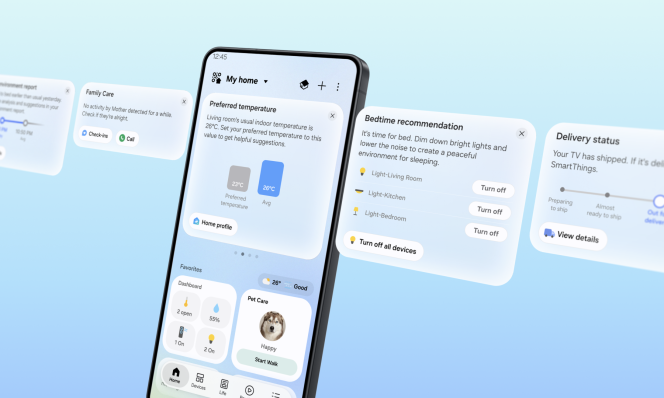
The friendly cards are not the important part of Samsung’s latest SmartThings update. They are the part you will notice first: a top-of-screen layer called SmartThings Now, which suggests a routine, highlights a device or offers a shortcut based on what the platform thinks is relevant.
The more valuable change sits underneath. Samsung says compatible phones and SmartThings hubs can now communicate over the same Wi-Fi network instead of sending an instruction out to the cloud and back. That gives a connected home a better chance of remaining useful when an internet connection is having a bad day—the moment when a smart light, lock or appliance is most likely to expose how dependent it really is.
This is not a blanket promise that every SmartThings device becomes offline-proof. Hardware, protocol support and setup still matter. But the shift is welcome precisely because it treats local control as product quality rather than an enthusiast checkbox.
The feature that matters when nothing seems to be happening
Samsung describes the new local-control path as a direct connection between a mobile device and a SmartThings hub on the same Wi-Fi network. It says the app will automatically use either local or cloud-based remote control depending on whether the phone is at home or away.
That distinction deserves a plain-English reading. At home, a compatible setup can avoid an unnecessary trip through a remote service. Away from home, remote access naturally still needs an internet path. A local Wi-Fi network is not the same thing as total resilience: a failed router, an unavailable hub, an unsupported device, or a device that relies on its maker’s cloud service can still break the chain.
| What Samsung announced | What it should mean | Important limit |
|---|---|---|
| Local control between a phone and a SmartThings hub on the same Wi-Fi | Certain supported controls can stay on the home network during an external internet disruption | It requires a compatible hub, phone and app; it is not a guarantee for every device or automation |
| Automatic switching between local and remote control | The app should choose the appropriate path rather than forcing a manual mode switch | Samsung has not published a complete device-by-device compatibility matrix in the announcement |
| About 30% faster response in Samsung’s controlled tests | A shorter local path can reduce lag | This is a vendor test, and real homes have different networks and radio conditions |
| Matter 1.6 support | SmartThings can recognize more standardized device categories | Matter support does not erase vendor-specific features or make every old device compatible |
Samsung specifically names SmartThings Station, the V2, V3 and V4 hubs, hub-enabled Samsung TVs and Family Hub appliances among the local-control hardware. That is useful specificity, though it also means owners should check their own hub rather than assume an app update has changed every device in the house.
T3’s report confirms that the redesigned app has reached Android after an earlier iOS refresh, while Android Authority separately highlights the local-control and Matter additions. Neither report turns Samsung’s controlled-condition speed figure into a real-world benchmark—and neither should. A smart-home platform earns trust through the boring cases: a router reboot, a flaky ISP, a phone on weak Wi-Fi and a household that simply expects the lights to work.
SmartThings Now is helpful only if it stays in its lane
The update’s headline feature, SmartThings Now, supplies contextual cards at the top of the Home tab. Samsung’s examples include a prompt to turn on lights or an air purifier when the user approaches home, a reminder to create a routine after taking an action, and an alert for a Family Care member showing no device activity for a prolonged period.
There is a sensible product idea here. Smart homes often have plenty of capability but hide it behind too many menus and dusty automations. A card that surfaces the routine a person already wants can be more useful than another dashboard.
The trade-off is that a home platform must infer context from location, device activity and recent behavior. The update should be judged on whether its suggestions remain easy to understand, dismiss and control—not on how clever they sound in a launch announcement. In a care scenario especially, a lack of sensor activity is a prompt to check in, not a reliable conclusion about someone’s wellbeing.
The interface changes support that same practical aim: denser cards, a bottom-positioned Floating Bar and controls across mobile devices, TVs, Family Hub refrigerators, Samsung appliances with 7- or 9-inch displays, and Windows devices. More surfaces can be convenient, but they make a consistent control model more important. Nobody wants to wonder whether the kitchen screen, TV and phone will disagree about a device state.
Matter 1.6 is quiet progress, not a magic interoperability button
Samsung also says the release supports Matter 1.6 and adds four categories: energy meters, closures for specialized doors and gates, irrigation devices and soil sensors. These are less glamorous than a new visual design, but they point SmartThings toward the parts of a house that turn automation from a gadget demo into maintenance.
Energy meters can make a routine responsive to actual consumption; irrigation and soil sensors make outdoor automation more grounded; closure support is relevant to gates and specialized doors. The caveat is familiar: a standard defines a common language, but the quality of each device, its commissioning process and the features a platform chooses to expose still decide the experience.
That is why the local-control work and Matter work belong in the same update. Interoperability is more convincing when it is paired with a control path that does not always need a remote server to be involved. It does not make the smart home independent of the cloud, but it makes a better argument for reducing avoidable dependence on it.
Bottom line
SmartThings Now may make Samsung’s app feel more current, but local control is the part that makes the update more mature. For supported hardware on the same Wi-Fi network, keeping a control command inside the home is a straightforward improvement in resilience and potentially in responsiveness.
Treat Samsung’s 30% performance claim as a direction, not a promise, and verify compatibility before buying hardware around it. Still, this is the kind of unflashy infrastructure change smart-home platforms should make more often: fewer needless cloud hops, clearer standard support and a system that remains useful when the connection outside the house does not.