
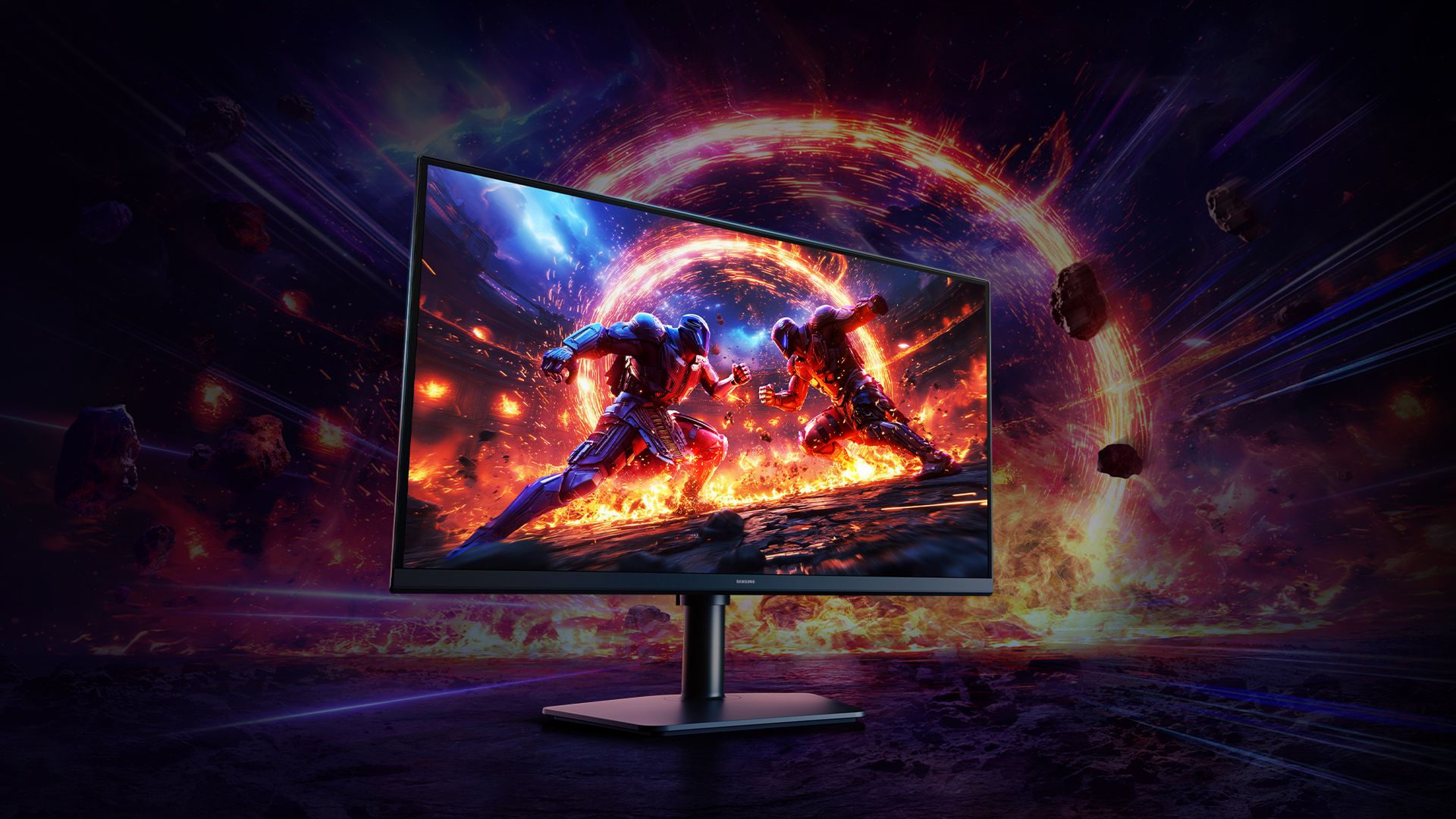
Samsung’s new Odyssey G6 has a number designed to stop a Gamescom hall in its tracks: 1,100Hz. It is an impressive engineering target, and it is also exactly the sort of number that can make a buyer forget to ask the more important question: what did we trade to get there?
The answer is resolution. The 27-inch Fast IPS G6 (model G60H) runs at up to 600Hz in its native 2560 × 1440 QHD mode. Its headline 1,100Hz ceiling arrives only after switching to 1280 × 720 HD through Samsung’s Dual Mode. That is one quarter of the native pixel count. Samsung says the monitor will be available globally in the second half of 2026, but has not announced market-by-market timing or pricing.
That makes the G6 more interesting than a simple record claim. It is a clear admission that even the fiercest competitive player does not want the same thing in every game—or, for that matter, in every moment of the same game.
The number is real; the conditions matter more
At 1,100Hz, a panel refreshes roughly every 0.91 milliseconds. That reduces the display-side interval between frames, but it does not magically make a game or a system react in 0.91 ms. The PC still needs to render at a suitably enormous frame rate; the game engine, CPU, GPU, input device, connection and pixel response all remain part of the chain.
Tom’s Hardware notes the fundamental compromise plainly: Samsung’s 1,100Hz mode is 720p, while QHD is capped at 600Hz. The 1ms Fast IPS response-time claim should also be read as a manufacturer rating, not as a substitute for independent motion and input-lag measurements.
| Odyssey G6 mode | Resolution | Maximum refresh rate | The sensible use |
|---|---|---|---|
| Native mode | 2560 × 1440 (QHD) | 600Hz | Most fast PC play, where legibility and detail still count |
| Dual Mode | 1280 × 720 (HD) | 1,100Hz | Narrowly focused esports use, if the game and PC can sustain it |
The G6 is therefore not a conventional picture-quality upgrade. At 27 inches, 720p will look noticeably coarse at normal desktop distance. HUD text, distant targets and fine environmental detail all surrender something. A player who competes in a title that can genuinely exceed 1,100 fps may sensibly accept that exchange; most players will not, and should not feel behind for preferring QHD.
A better idea than one fixed “best” mode
Samsung’s larger announcement helps explain the G6. The new 32-inch OLED G8 offers three selectable pairs—4K at 360Hz, QHD at 520Hz and Full HD at 680Hz—while the 49-inch OLED G9 offers 5120 × 1440 at 360Hz or 2560 × 720 at 720Hz. The company is not simply escalating refresh rates; it is treating resolution and speed as variables a player should be able to balance.
That is a welcome change from the old monitor-buying ritual of picking one compromise at checkout and living with it for years. A cinematic single-player game benefits from pixels. A fast shooter benefits from motion cadence and low persistence. A monitor that can change its character is more useful than one that wins a spec-sheet race in only one reduced-resolution mode.
TechRadar’s Gamescom interview added a useful dose of realism. Samsung Europe monitor lead Pepe Dijkstra described the ultra-high-refresh audience as small and said the company still needs to see how the hardware is used once it reaches the market. That is not a retreat from the claim; it is the right caveat. An exotic mode earns its keep only if the games, hardware and players can take advantage of it.
What buyers should wait to learn
Samsung has confirmed a 27-inch Fast IPS panel and 1ms response time, but several practical questions remain before anyone should treat the G6 as a default recommendation:
| Open question | Why it matters |
|---|---|
| Price and regional launch dates | Samsung has announced neither, and they define whether this is specialist equipment or an aspirational curiosity. |
| Input lag and pixel-overdrive behavior | Refresh rate alone cannot show ghosting, overshoot or end-to-end responsiveness. |
| Port and GPU requirements | Driving even 600 fps at QHD—and especially 1,100 fps at HD—will be title-specific and demanding. |
| Scaling quality | The usefulness of 720p on a 1440p panel depends on how cleanly that mode is presented in real games. |
The high-frame-rate discussion is also inseparable from the games themselves. As we noted when looking at what Rockstar has actually confirmed about GTA 6, hardware anticipation can easily outrun practical information. Here, too, the exciting claim is not a substitute for tested behavior in the games people actually play.
Bottom line
The Odyssey G6’s 1,100Hz figure is technically remarkable, but its 600Hz QHD mode is the more valuable promise. It gives a competitive-player monitor a broadly usable setting rather than asking every owner to live at 720p for the sake of a world-first badge.
Treat the G6 as a specialist display with an unusually honest set of trade-offs, not proof that every gaming setup suddenly needs four-digit refresh. If independent tests show clean motion, low latency and competent scaling, Samsung’s Dual Mode could be more meaningful than the headline number itself. Until pricing and retail hardware arrive, the right takeaway is simpler: choose the frame rate that serves the game, not the largest one on the box.