
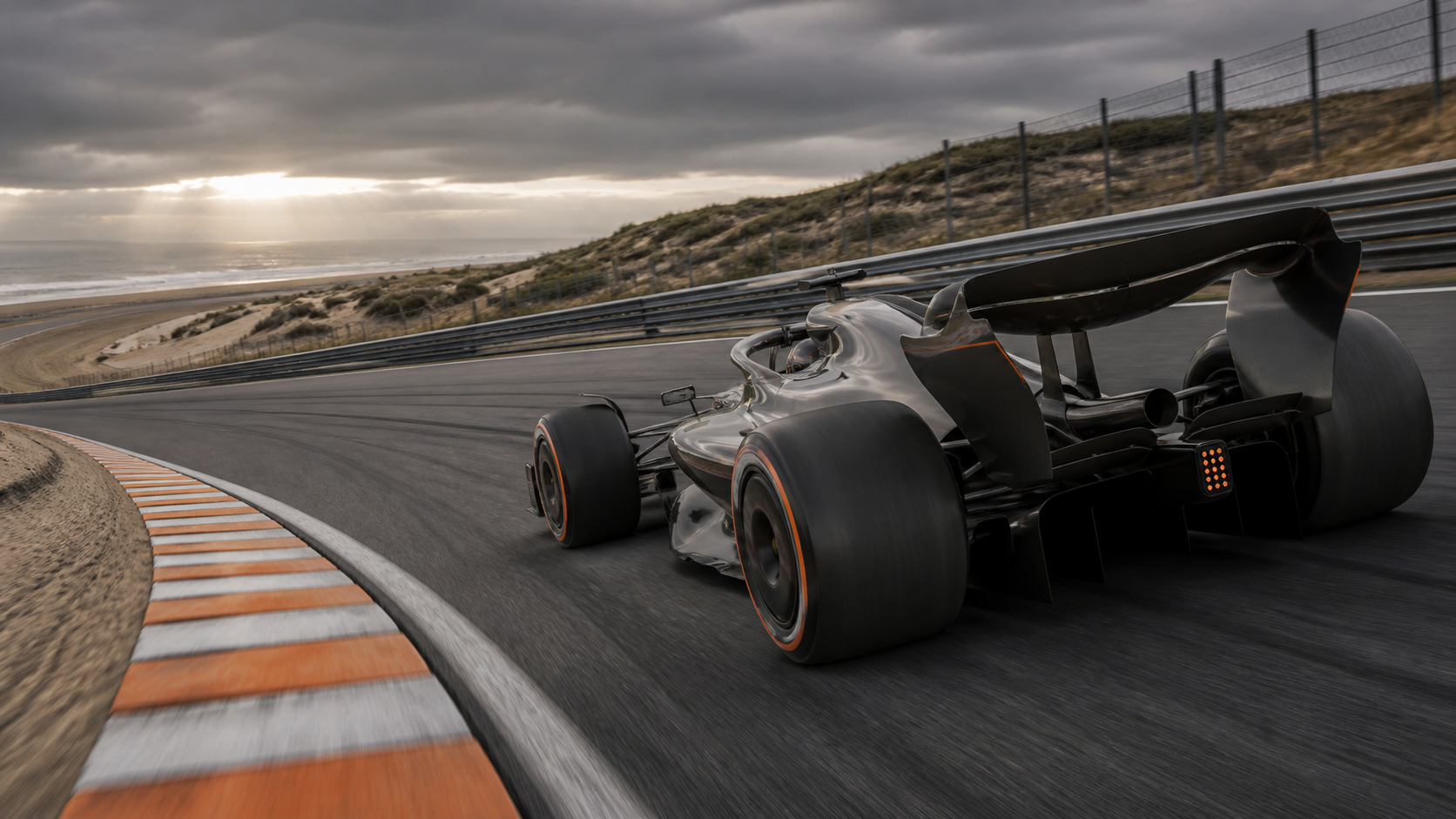
Spoiler note: this article discusses Friday’s Dutch Grand Prix Sprint Qualifying.
George Russell did not merely put a Mercedes on pole at Zandvoort. He put a useful complication into a championship fight that had begun to look neatly divided between Mercedes’ young leader and the rest of the grid.
The official timing is suitably unforgiving: Russell’s 1:11.567 beat Lando Norris by 0.041 seconds, Charles Leclerc by 0.055s and Oscar Piastri by 0.099s. Four different title narratives, four cars inside one tenth, one 24-lap Sprint to make the margins matter. It is only Friday, and it is only eight points for the winner, but it is the first proper reminder after the shutdown that Mercedes’ greatest asset may be depth rather than a single protected driver.
Kimi Antonelli still arrives as championship leader on 219 points. Lewis Hamilton has 169, Russell 160, Leclerc 138 and Norris 128, according to Formula 1’s official table. Mercedes leads Ferrari 379 points to 307 in the constructors’ championship. Russell’s pole does not alter any of that arithmetic yet. What it changes is the tone: the team with the most to protect also has a second driver close enough to the front to shape how everyone else can attack it.
Forty-one milliseconds, four different pressures
Norris was the first of the front-runners to establish a final-segment benchmark, a 1:11.608. Russell then found the 0.041s that mattered. Leclerc’s Ferrari was a further 0.014s away; Piastri was only 0.044s behind his team-mate. That is not the profile of a weekend in which one car has discovered a secret. It is the profile of a short, high-commitment circuit where a small change in wind, preparation lap or confidence through the banking can reorder the sharp end.
That caveat is important. A Sprint pole is not a race verdict, and Zandvoort is too specific to declare a season-long pecking order from one eight-minute shootout. But it is informative in a different way. The top four came from Mercedes, McLaren and Ferrari—the same three teams whose points totals make the next phase of the season more interesting than a simple Antonelli-versus-Hamilton story.
Russell was fifth in the standings, not absent from them; the difference is that his pole is proof of conversion. A driver 59 points behind his team-mate does not need a grand declaration to become relevant again. He needs to keep turning competitive weekends into positions that force the team, and its rivals, to account for him.
Mercedes has the luxury rivals would like
Mercedes’ points advantage is built on both sides of the garage. That sounds obvious until a title fight squeezes every internal relationship. A leading team can prefer one driver’s clean path to the crown, but it also needs the other car near the front to take points from its opponents, dictate strategy and prevent Ferrari or McLaren from concentrating all their resources on a single target.
At Zandvoort, Russell’s pole creates precisely that useful tension. If he converts it into a strong Sprint, Antonelli benefits from a rival being held behind a Mercedes—even if the points do not go directly to the championship leader. If Antonelli fights forward and Russell is in the mix, the team must make rapid, disciplined choices about how much to optimise for the drivers’ table and how much to defend the constructors’ lead.
That is harder than it sounds because the chasing teams are not playing one note. McLaren has both Norris and Piastri in the first two rows; Ferrari has Leclerc third and Hamilton seventh. Neither can reasonably ignore a chance to take points from Mercedes. Russell’s presence means Mercedes can answer with options instead of hope.
GearPulse examined Antonelli’s pressure management earlier this month. Friday gives that theme a fresh companion: the title leader’s resilience matters, but so does whether the team can keep a fast, ambitious Russell feeling like a competitive participant rather than an item in someone else’s campaign.
The grid is a warning, not a forecast
There is another reading of the tiny gap at the front. This 2026 field can punish even good weekends. Russell’s lap was excellent; Norris, Leclerc and Piastri were close enough that a different line through one corner could have written the headline for any of them. Antonelli, fifth, was 0.227s from pole—not a collapse, but enough to show how quickly a tight session turns a front-row prospect into a recovery drive.
The Sprint will therefore test more than raw pace. Passing at Zandvoort is rarely effortless, tyre temperatures can make a short race surprisingly tactical, and the front runners need to preserve their larger objective: Grand Prix qualifying and Sunday’s points. No sensible team should treat Saturday morning as a blank cheque for aggression.
For Russell, though, that is exactly why pole has value beyond the handful of points available. It lets him control the opening phase rather than spend it trying to escape traffic. For Mercedes, it places one car in the best possible defensive position while its championship leader has a chance to read the race from just behind the first two rows.
The bottom line
Russell’s pole is not proof that Mercedes has solved every competitive question after the break. A margin of 0.041s proves almost the opposite: the front is fragile, and all three leading teams are within reach.
What it does show is that Mercedes returns with more than one answer. Antonelli remains the points leader. Russell has just demonstrated that he can be a front-row variable. In a title fight this compressed, that is not an internal nuisance. It is the kind of leverage rivals have to plan around.