
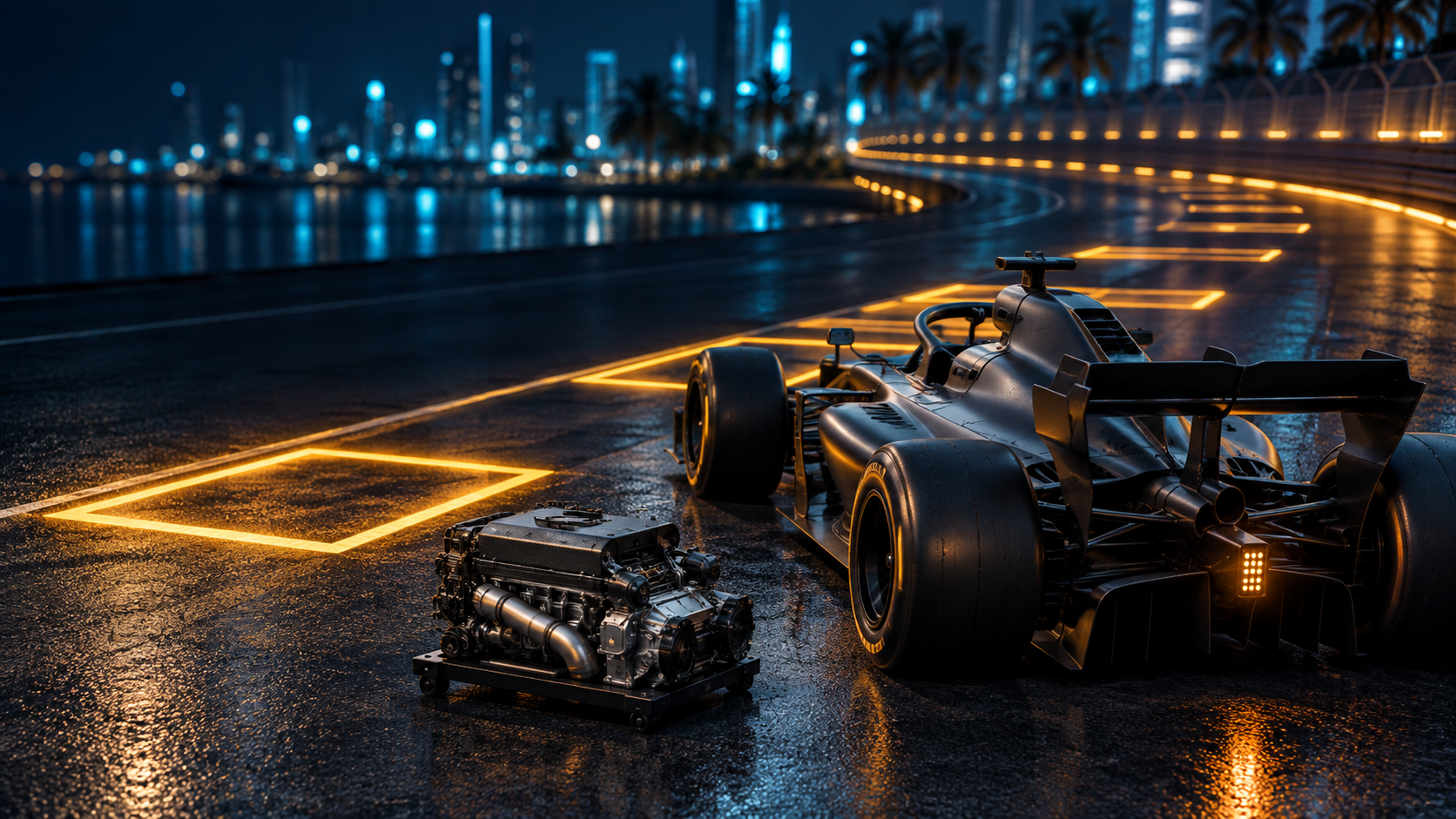
George Russell’s Singapore weekend has become much harder before a wheel has turned.
Mercedes is set to fit a new power unit after Russell’s late retirement at Sepang, putting him beyond his 2026 allocation and into a 10-place grid penalty at Marina Bay. The team’s deputy principal, Bradley Lord, has described the initial diagnosis as a mechanical failure on the power-unit side. The full cause is not public, and it should not be invented from a television image of a car stopping at Turn 1.
The sporting consequence, though, is already clear. Russell was five laps from a likely podium when his Mercedes stopped in Malaysia. Now he has to recover at a street circuit where a 10-place loss is much more than a bookkeeping inconvenience.
That is not chiefly a story about whether Russell can revive a drivers’ title bid. As GearPulse noted after Madrid, that personal fight had already become exceptionally narrow. It is about whether Mercedes can still use its second car as a live strategic instrument when its champion-elect team-mate, Kimi Antonelli, needs protection at the sharp end.
A penalty is most painful when the track removes the shortcuts
Autosport, Sky Sports and Motorsport Week all report that the new engine will bring a 10-place grid drop. The penalty is not a discretionary response to a retirement; it follows the season’s power-unit allocation rules once the fresh element is fitted. Mercedes had been trying to manage Russell’s component pool. Sepang removed the luxury of choosing a friendlier circuit or a less damaging moment.
That timing changes the calculation. Singapore is a demanding, slow-speed street race where qualifying position normally has an outsized influence on the race. A rapid car can still make progress, especially when strategy, tyre life or a Safety Car creates an opening. But “can” is not the same as “will.” A recovering driver is more exposed to traffic, to rivals taking deliberately long first stints, and to losing the temperature window that makes the car work in the first place.
| The Sepang failure cost | The Singapore penalty now adds |
|---|---|
| A probable podium and a useful haul of points | A 10-place starting-position deficit before qualifying pace can be used |
| Live race data from the closing stint | More dependence on clean air, timing and pit-wall flexibility |
| A chance to keep two Mercedes near the front | A greater risk that Antonelli is isolated in battles with rivals |
| Component-management choice later in the year | An immediate new-engine decision at a difficult circuit for overtaking |
The important caveat is that Marina Bay has never been immune to disruption. A Safety Car can compress a race, a well-timed undercut can unlock a train of cars, and a driver of Russell’s quality should not be written off because of a grid number. Yet none of those is a plan. The baseline task is to gain places without burning the tyres, brakes or strategic options that make a recovery possible.
Mercedes needs usefulness, not a miracle drive
There is a lazy way to tell this story: Russell is no longer realistically in the title fight, so his grid penalty belongs in the bad-luck column and Mercedes can focus entirely on Antonelli. The team should resist that temptation.
Two competitive cars matter even when only one driver has a credible route to the championship. The second car can split rivals on tyre choice, cover an undercut, put pressure on a leader’s pit-stop timing and provide a second reference when the race changes. When that car starts deep in the order, those advantages do not vanish, but they take longer to earn.
This is why the penalty is a test of Mercedes’ operational depth rather than a verdict on Russell. A strong Saturday can limit the damage before Sunday. A patient first stint can give the pit wall a different tyre-life picture from the cars at the front. A clean recovery can still turn Russell into a factor in the middle of the race rather than an observer. The ideal outcome is not a cinematic charge through the field; it is restoring enough flexibility that Antonelli is not left to defend the entire front-running contest alone.
That distinction is especially relevant after Mercedes’ recent upgrade work. The team’s Malaysia package was valuable only if it created a broader operating window for both drivers, not a flattering one-lap headline. Singapore is an awkward but revealing place to test that idea. A car that is predictable over kerbs, braking zones and repeated low-speed traction events gives its driver choices. A car that requires a narrow setup or tyre state makes a back-of-grid recovery far more fragile.
None of that lets outside observers diagnose the W17 from a distance. The public record does not tell us whether Russell’s replacement unit differs in specification, whether the team has revised an installation detail, or how much margin it has in hand. It does establish a simpler truth: reliability and race strategy are now joined. One mechanical failure has changed the timing, track position and tactical value of the next weekend.
Reliability is a championship issue even after the title gap opens
Formula 1’s official report of the Malaysia race records the immediate loss: Russell stopped just five laps from the finish, after being in podium contention. For a driver, that is painful enough. For a team leading a campaign, it also creates a second-order cost.
The pressure falls on the component pool, on the preparation required for the replacement, and on the race team that must recover the points somewhere less convenient. It is easy to treat those as separate stories—an engine failure on Sunday, a penalty on Friday, a difficult Sunday to follow. In reality, they are one chain.
Mercedes does not need to turn this into melodrama. Lord’s cautious description of the issue is the right tone while the investigation continues. The team should learn what it can, contain the allocation damage and give Russell a realistic plan for Singapore. Drawing a sweeping conclusion about the whole power unit from one public incident would be as unserious as declaring the penalty irrelevant because Safety Cars sometimes appear.
What it cannot do is pretend the second car is optional. Antonelli’s points lead changes the order of priorities; it does not change the value of a rival being forced to cover two credible Mercedes strategies rather than one.
Bottom line
Russell’s Singapore penalty is not merely the aftershock of a bad retirement. It is a compressed test of Mercedes’ ability to recover from reliability trouble without making its championship-leading car tactically lonely.
If Russell qualifies strongly and races with enough patience to regain strategic relevance, Mercedes can limit a costly weekend to a manageable one. If traffic, heat and timing leave him buried, the Sepang failure will have imposed its second penalty exactly where the calendar makes it hurt most. That is why Singapore matters: not as a chance for a heroic narrative, but as a measure of how much resilience Mercedes really has.
Support independent source-backed coverage at buymeacoffee.com/gearpulse.site.