
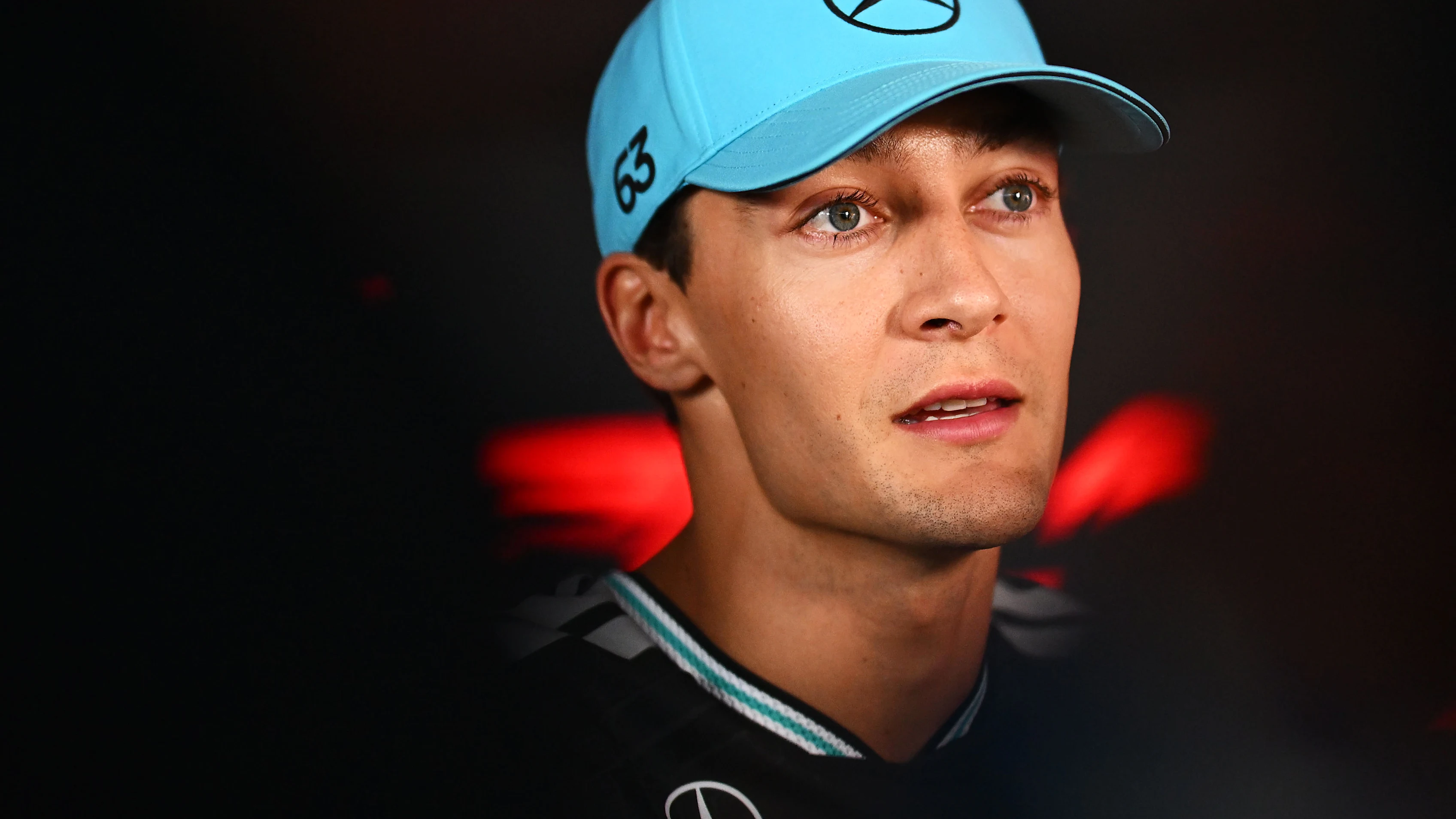
George Russell’s Hungarian Grand Prix has changed shape before a wheel has turned.
Two days ago, the Mercedes story was uncertainty. Russell had been hurt by a straight-line and energy-deployment deficit across recent weekends, then Spa turned that private frustration into a very public title problem. Mercedes could describe the symptoms, but the cause still sounded buried somewhere between power-unit behaviour, software control and the way the 2026 cars manage electrical energy.
Now the team believes it has found the fault. Formula 1 and Sky Sports F1 both carried Russell’s Thursday explanation from Budapest, with the Mercedes driver saying the problem was not his driving style and that the team had found a software-related issue after Spa pointed engineers toward the right part of the system. The Guardian’s account adds the sharper technical frame: Russell described something deeply embedded in the calibration of the hybrid battery system.
GearPulse’s view: the interesting part is not that Mercedes has declared victory. It has not. The interesting part is that Russell finally has a specific enemy. Hungary is now a trust test for the fix, the driver and Mercedes’ title management.
Why this story rose today
The trend signal was strong because the story appeared from several credible angles at once. Formula 1 published a fresh Russell interview on the mental strain of his title fight. Sky led with Mercedes being hopeful that the power-unit problems have been resolved. The Guardian reported from the Hungaroring that Russell believes Mercedes has identified and solved the engine-related issue. The FIA’s Thursday press conference transcript, while not a Russell document, also kept the wider 2026 energy-deployment debate alive through Oscar Piastri’s comments about power-unit algorithms remaining a factor under the current regulations.
That makes this more than a routine pre-race optimism quote. It is a same-day update to a story GearPulse covered on July 21, when Mercedes was still in diagnostic mode.
The before-and-after matters:
| Question | July 21 state | July 23 state |
|---|---|---|
| Is Russell’s deficit real? | Mercedes and outside reports said yes. | Still yes. The new reporting does not walk it back. |
| Was it just driving style? | Mercedes had investigated that possibility. | Russell says the team now thinks it was not. |
| Does Mercedes know the cause? | Not with confidence. | The team believes it found a software/calibration bug. |
| Is the title damage repaired? | No. | Still no. Hungary has to prove the fix. |
That is the news angle. The stopwatch has not validated the fix yet, but the explanation has become more precise.
The fix is technical, but the damage is psychological
Modern F1 power units are not simple engines with batteries bolted on. The 2026 rules have made electrical deployment, harvesting, state-of-charge targets and software-controlled energy decisions a major part of performance. At Spa, that became visible in the ugliest way for Russell: the car did not give him the energy he expected when he needed to defend himself.
Sky’s interview is useful because Russell separated two points that often get blurred. First, he said Mercedes had to dig deeply to find the issue. Second, he said it was not the way he was driving that caused the power loss. That distinction matters inside a team. If a deficit is driver input, the driver owns part of the correction. If it is a hidden software calibration problem, the team owns the confidence repair.
This is where Antonelli makes the comparison harsher. Kimi Antonelli has been converting Mercedes’ peak performance into wins and a large championship lead. Russell has been living through the less comfortable side of the same car: enough pace to know the opportunity is real, enough technical inconsistency to feel as if the ground keeps moving under him.
The result is not just a 50-point gap. It is a trust deficit. Russell has to believe that when he exits a corner and asks for deployment, the car will answer in a predictable way.
Hungary is a useful but imperfect test
The Hungaroring is not Spa, and that is both good and inconvenient.
Formula 1’s race hub lists a 4.381 km lap, 70 race laps and a 306.63 km distance. The circuit’s own character is clear: short straights, repeated corners and a downforce-heavy layout often compared to a karting track. F1’s race-week preview also noted that Hungary should reduce at least some of the straight-line deficit drama because it is not as power sensitive as Silverstone or Spa.
That helps Russell immediately. If Mercedes has fixed the software bug, Budapest gives him a cleaner place to rebuild rhythm before the summer shutdown. If the fix is only partial, Hungary may still be forgiving enough to hide the worst symptoms.
That is the caveat GearPulse would keep on the board. A normal-looking Friday does not automatically prove Mercedes has solved every energy-deployment edge case. The tougher proof will come when the car returns to tracks where full-throttle time and battery state are more brutal. But a messy Hungary would be very bad evidence. On a circuit that should be less exposed to the Spa weakness, any repeat problem would make the summer break feel less like recovery and more like an audit.
Fun fact: Hungary has often rewarded precision over horsepower. The first Grand Prix there was in 1986, and Lewis Hamilton still owns the official fastest race lap from 2020. That history fits the weekend. Russell does not need a straight-line monster in Budapest. He needs a car that behaves exactly the same way twice.
Mercedes has a two-driver management problem
Mercedes can publicly say the right thing: both drivers matter, both cars get support, and the championship is still open. That is fair.
But title fights do not wait for perfect fairness. Antonelli’s lead changes the decision environment. If Russell gets through Hungary cleanly and cuts into the deficit, Mercedes can keep treating the title fight as an internal contest with time left. If he loses more ground because of lingering car behaviour, the team’s practical focus will start to tilt toward protecting Antonelli’s lead and the constructors’ fight against Ferrari.
The awkward part is that Russell’s frustration may have helped Mercedes find the issue. The Guardian reported that he stood by being vocal because the problem needed to move forward. In a normal week, that reads like a driver justifying radio heat. In this case, the team’s new confidence makes it look more defensible. Russell pushed hard because he believed the car was not giving him what it should.
GearPulse’s probability board, as editorial analysis rather than betting advice:
| Question | GearPulse read |
|---|---|
| Russell looks more settled in Hungary practice | 60-70%, because the track is less power-sensitive and Mercedes has a clearer fix path. |
| The software issue is fully gone for all circuit types | 45-55%, because one weekend at Hungary cannot prove the full operating window. |
| Antonelli remains Mercedes’ practical title reference after Hungary | 65-75%, because the points gap is already large. |
| The broader 2026 energy-deployment debate fades before the break | 20-30%, because Piastri and others are still describing algorithm effects as baked into the rules. |
The last line is important. Russell’s specific bug may be fixed. F1’s wider problem is not. Drivers are still talking about being surprised by how the cars deploy energy, and the FIA transcript shows that the subject has not disappeared just because the paddock has moved from Spa to Budapest.
Skipped candidates
Aston Martin’s Hungary upgrade package had fresh Formula 1 and Alonso coverage, but GearPulse already published the core Aston Martin credibility-test angle on July 14. Today’s material was useful context, not a clean new lead.
McLaren’s upgraded-car follow-up and Lando Norris’s cautious comments were timely, but GearPulse published the McLaren/Fornaroli upgrade tradeoff yesterday. Repeating McLaren today would have needed practice evidence, not another pre-FP1 quote stack.
Cadillac’s first-points discussion with Sergio Perez and Valtteri Bottas was a good human story, but it is still more aspiration than development. The Mercedes fix has clearer technical consequence and stronger championship relevance.
The possible Malaysia/Portimao calendar contingency had mainstream pickup, but without a fresh official F1 or FIA confirmation it stayed too speculative for today’s Daily Dose lead.
Bottom line
Mercedes finding a likely software-calibration fault does not erase Russell’s lost points, and it does not prove the W17 will behave perfectly when F1 returns to more power-sensitive circuits. It does, however, turn the story from vague frustration into a testable claim.
Hungary now has a simple job for Russell: make the car feel boring again.
GearPulse’s bottom line: Antonelli has been proving Mercedes’ ceiling. Russell’s software fix has to prove the team can give both sides of the garage the same floor before the title fight starts hardening around one driver.