
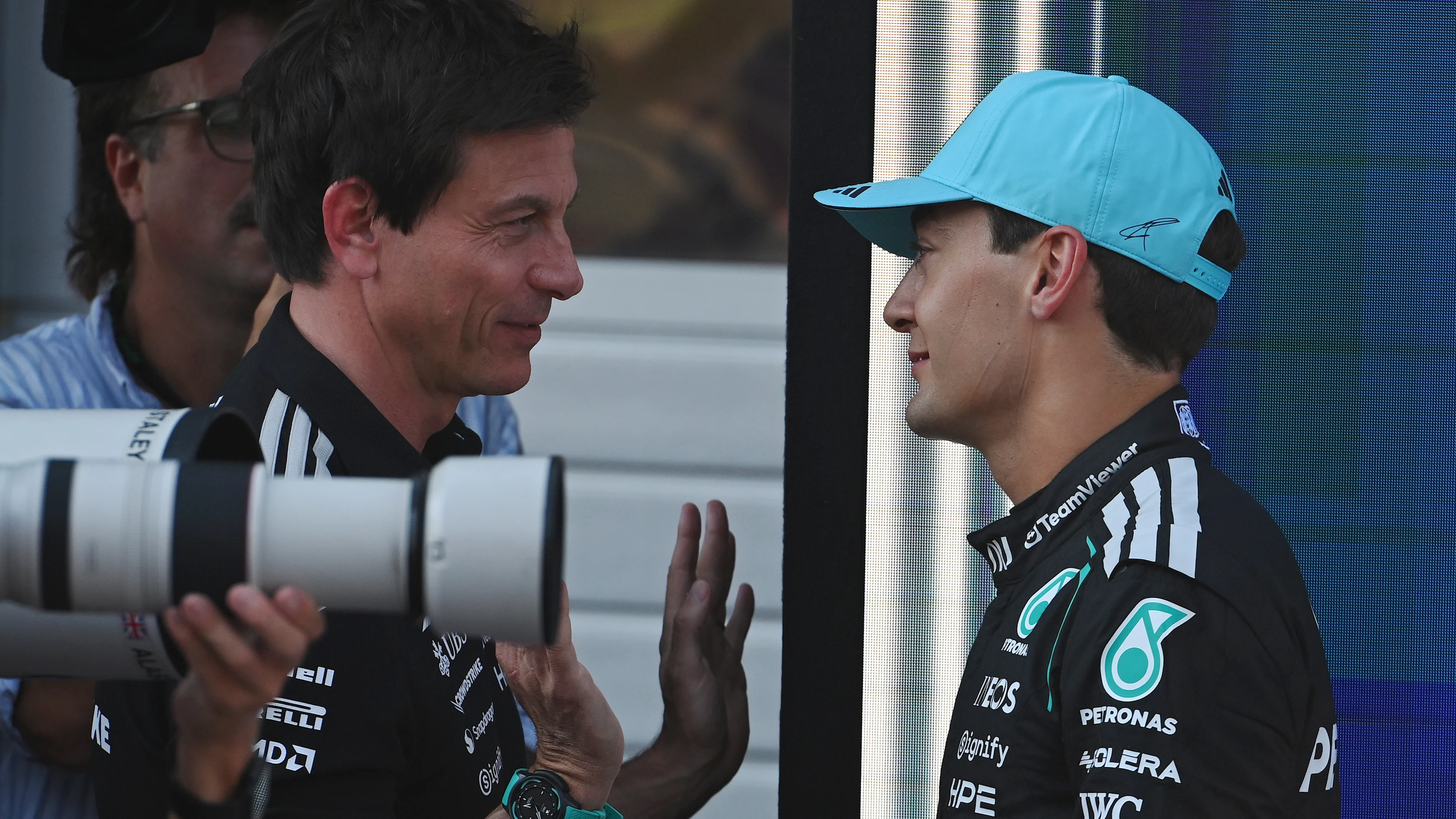
George Russell does not need another sympathy piece. He needs an answer.
That is why Mercedes’ post-Spa problem is still today’s most useful Formula 1 story. The Belgian Grand Prix result has already been processed: Kimi Antonelli won, Russell retired early, Lewis Hamilton was penalised for the contact, and the title gap moved heavily against the Briton. GearPulse covered the Mercedes boost glitch after the race, then the wider driver backlash against 2026 energy-deployment algorithms.
The new angle is narrower and more uncomfortable. On July 21, Sky Sports F1 framed Russell’s next weekend as a fight to get back up before Hungary. Motorsport.com reported that Mercedes is still trying to understand why driving-style changes did not fully cure Russell’s deployment deficit. RaceFans picked up Russell’s blunt description of being slower than a Formula 2 car at the start. Mercedes’ own Spa report says the opening-lap boost issue was separate from what the team had been chasing earlier in the weekend.
GearPulse’s view: Hungary is no longer just the last race before the summer break. For Russell and Mercedes, it is a diagnostic session with championship points attached.
Why this story rose today
The trend signal is strong because it came from multiple directions at once. Sky had the emotional and title-race framing. Motorsport.com had fresh technical detail from Mercedes deputy technical director Simone Resta. RaceFans carried Russell’s sharper post-race assessment. Mercedes supplied the primary team record, including Russell, Toto Wolff and Andrew Shovlin explaining the boost loss. Formula 1’s own coverage from qualifying established that Wolff had already called part of Russell’s deficit “not his fault” before the race even started.
That matters because this is not just a driver having a poor weekend and looking for an excuse. The source stack points to two related but distinct problems:
| Problem | When it appeared | Why it matters |
|---|---|---|
| Russell’s recurring straight-line and deployment deficit | Silverstone and Spa practice/qualifying | It raises a fairness question inside the same Mercedes garage. |
| Mercedes-powered cars lacking energy after Turn 1 | Spa race start | It turned an internal performance issue into a first-lap vulnerability. |
The distinction is the article. If Mercedes had one race-start software glitch, it could file Spa as a painful but understandable operational miss. If Russell also has a car-side or driver-interaction issue that follows him from Silverstone to Spa, then Hungary becomes the first serious proof test.
Russell’s problem is not one clean failure
The most important detail from Mercedes is that the race-start boost loss was not the same as the issue Russell had been chasing earlier in the weekend.
In the team’s Spa report, Russell said he had made a good start and expected to fight for the lead, but did not have the speed he needed on the run to Turn 5. Wolff said both Mercedes cars lacked boost out of Turn 1, with Russell affected more severely. Shovlin described the same pattern: both cars were under pressure, but Russell’s problem was more extreme and put him into the pack before the Hamilton contact.
That is already damaging. What makes it worse is the pre-existing deficit. Formula 1’s Saturday report had Wolff saying Russell was suffering a straight-line speed loss Mercedes could not fully explain. Motorsport.com’s July 21 follow-up then added the key technical wrinkle: Mercedes had identified driving style as a major contributor after Silverstone, Russell adapted, and the deficit still did not vanish.
That is the nightmare shape for a title contender. If the cause is purely hardware, replace it. If it is purely driving style, coach it. If it is the interaction between harvesting, deployment, throttle shape, battery state, software limits and circuit profile, then every weekend becomes a live experiment.
Spa punished that uncertainty in public.
Antonelli is making the comparison harsher
Russell’s problem would feel different if Mercedes were nowhere. It feels brutal because Antonelli is winning in the same team.
The Italian has now built the kind of points cushion that changes how every Mercedes debrief sounds. Before Spa, Russell had cut the gap dramatically over the previous races. After Spa, Sky noted he was 50 points behind his team mate. That is two full Grand Prix wins, and it came from a weekend where Russell believed he should have been fighting at the front rather than being swallowed on the Kemmel Straight.
The comparison is not simply “Antonelli good, Russell bad.” That is too lazy. Antonelli has also had reliability pain this season. Mercedes has repeatedly admitted it is still learning the 2026 package. The more interesting comparison is how much margin Antonelli has created when the car behaves, and how little margin Russell has when it does not.
There is a fun fact in the discomfort: Spa is 7.004 km long, the longest lap on the calendar, and yet Russell’s weekend hinged on losing tenths on straights where he was already full throttle. At that point the driver has very few tools left. He can change inputs before the straight, but once the energy state is wrong, courage does not add kilowatts.
That is why this has become a Mercedes problem, not just a Russell problem.
Hungary can hide the issue, or expose Mercedes differently
Budapest is not Spa. That helps and hurts.
The Hungaroring is slower, tighter and less energy-starved than Spa-Francorchamps. Wolff’s Sky comments made that point directly: a less energy-sensitive circuit might have made the Spa issue harder to identify. In other words, Hungary may not reproduce the same dramatic straight-line weakness. Russell could look normal again, and Mercedes could still leave without fully proving the root cause is gone.
That is the caveat. A clean Hungary weekend would be useful, but it would not automatically solve the case.
What Hungary can test is trust. Does Russell arrive with a car that behaves consistently through practice? Can Mercedes correlate what it sees in Brackley and Brixworth with what Russell feels on throttle? Does the team avoid component changes or software fixes that push him into penalties? Most importantly, can Russell spend a weekend thinking about tyres, balance and race craft instead of staring at the steering wheel wondering where the straight-line speed went?
If the answer is yes, Hungary becomes a psychological reset. If the answer is no, the summer break starts with Mercedes owning the fastest team story and the most awkward internal reliability story at the same time.
The title math now changes the politics
Mercedes can say, correctly, that it is behind both drivers. Wolff told Sky the team is fully there for Russell and wants to help recreate optimism. That is the right public message and probably the right internal one.
But championship math has a way of hardening good intentions.
Antonelli leads. Hamilton is now closer to Antonelli than Russell is, and Ferrari’s recent form means Mercedes cannot treat every lost Russell weekend as a private garage matter. Wolff also pointed out that these failures cost constructors’ points against Ferrari. That is where the politics become practical.
The probability board, as editorial analysis rather than betting advice, looks like this:
| Question | GearPulse read |
|---|---|
| Russell rebounds competitively in Hungary | 55-65% likely, because the track should reduce the Spa-specific energy stress. |
| Mercedes fully understands the Russell-side deployment deficit before the break | 40-50%, because the team language still sounds investigative. |
| Antonelli becomes the clear Mercedes priority by late summer | 50-60% if the gap stays above 40 points after Hungary. |
| Ferrari keeps pressure on Mercedes in constructors’ points | 60-70%, because Leclerc and Hamilton are both scoring while Mercedes has left points on the table. |
The last line is the one Mercedes should care about most. A team can manage a driver-title fight. It cannot easily manage one car winning while the other car keeps being dragged into unresolved technical cases.
Skipped candidates
Ferrari’s Hamilton unsafe-release protocol was already published earlier today by GearPulse, and there was no materially new FIA document after that post.
The Red Bull succession story around Gianpiero Lambiase’s eventual replacement had interest, but the current reporting still leans heavily on secondary confirmation rather than a clean Red Bull primary announcement.
Another broad 2026 energy-algorithm backlash article would have duplicated GearPulse’s July 20 piece. Today’s Mercedes story uses that context, but the focus is Russell’s car-specific diagnostic and Hungary timing.
McLaren’s Hungary upgrade and rear-wing trial had some freshness, but at the time of selection it had less official source depth and a weaker trend signal than the Russell/Mercedes follow-up.
Bottom line
Russell’s Spa was not only bad luck. It was a technical confidence problem arriving at the worst possible point in a title fight.
Mercedes has the championship-leading driver, the strongest overall package, and enough evidence to say Russell was not simply imagining the deficit. That is exactly why Hungary matters. If Russell is back on terms, Mercedes can cool the story before the shutdown. If he is not, the summer break becomes an engineering audit with a drivers’ championship attached.
GearPulse’s bottom line: Antonelli’s wins are proving what the W17 can do. Russell’s unresolved deployment problem is proving Mercedes still does not fully control when it can do it.