
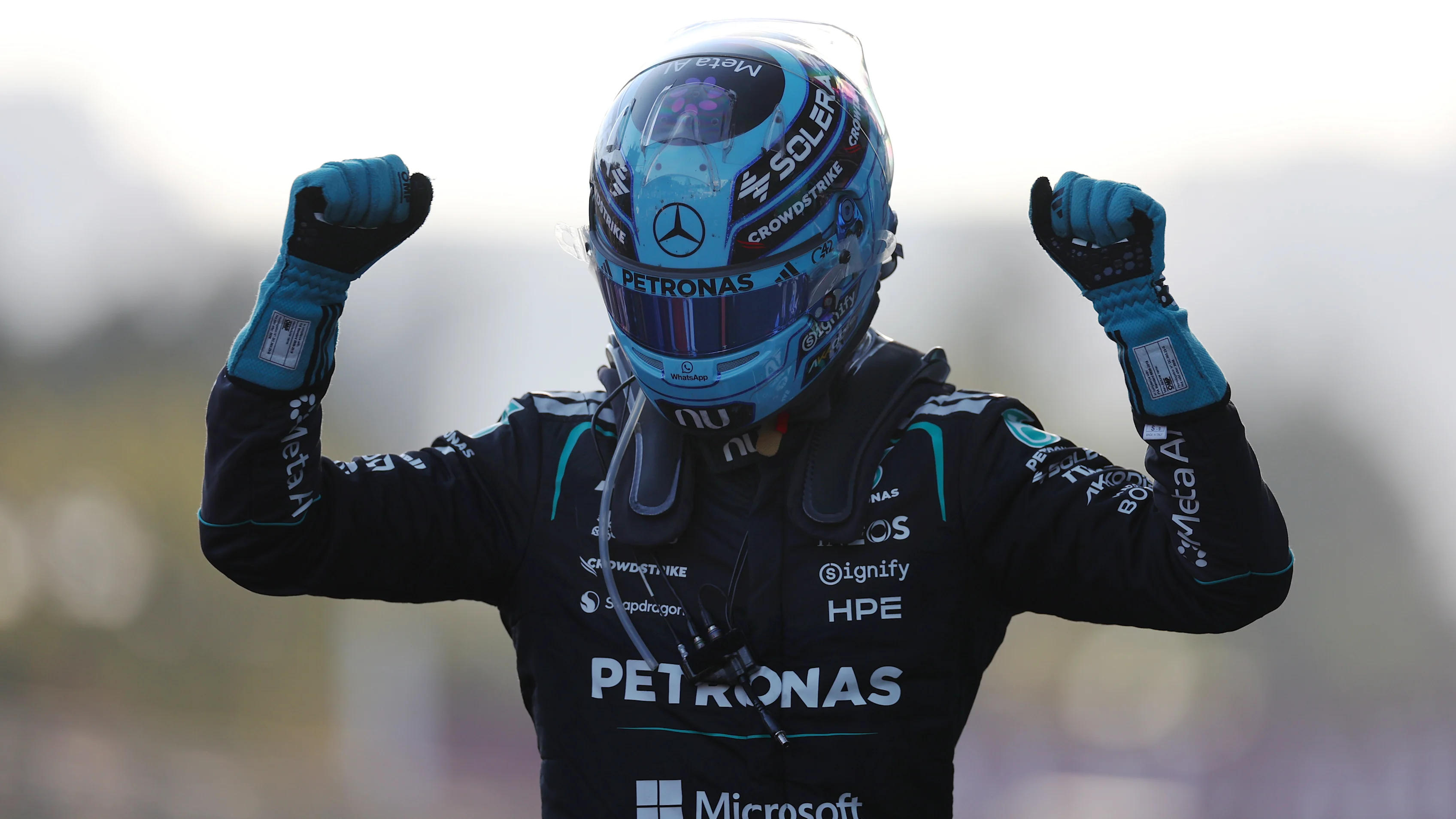
George Russell’s Azerbaijan Grand Prix win will be remembered for the final few laps: Max Verstappen closing in, the margin at the line only 0.196 seconds, and a Mercedes that had looked comfortable suddenly having to defend every millimetre of Baku’s walls.
The bigger consequence is less cinematic. Russell’s third win of 2026 cut Kimi Antonelli’s championship advantage from 81 points to 66 after the championship leader recovered from a qualifying accident to finish fifth. Mercedes now has the sort of asset every team wants—a second driver taking points from rivals—and the management problem that comes with it: two drivers who can change the shape of the title fight.
That is a healthier position than relying on a single lead car. It is also very different from having a clear number one.
A win that mattered twice
Formula 1’s official classification puts Russell first after 51 laps, Verstappen second and Isack Hadjar third. The race had two Safety Car interruptions, including a restart crash that eliminated both Alpines and Lando Norris. Those interruptions mattered because they repeatedly erased Russell’s track-position cushion and gave Verstappen fresh opportunities to attack.
Russell held on anyway. Grandprix.com’s race analysis describes how the restarts transformed tyre management from a long-run exercise into a question of who could switch the tyres on quickly. RacingNews365 likewise identified the disruption—and Norris’s retirement—as the event’s sharpest competitive consequence.
| Baku’s title-relevant outcome | Why it changes the next phase |
|---|---|
| Russell won by 0.196s over Verstappen | Mercedes banked 25 points while denying Red Bull the maximum |
| Antonelli finished fifth after his Q1 accident | His lead shrank, but he limited a potentially ruinous weekend |
| Norris retired | One established rival left Baku without a score |
| Hadjar finished third | Red Bull showed it has a second car capable of affecting strategy and points |
The important detail is that Russell did not inherit this result from a chaotic race alone. He started from pole, led the early phase and remained composed when the Safety Cars converted the final stint into a defence. The Formula 1 race report says he survived a late Verstappen challenge after controlling the first half. That combination—front-running pace and restart resilience—is the credible form of a comeback, not simply a fortunate podium.
Mercedes has a luxury problem
Antonelli still leads the championship, and a 66-point gap is not a casual deficit. But Baku changes the conversation because Russell is no longer merely the experienced teammate gathering useful Sundays. He has three wins this season, and Formula 1 says Antonelli has eight. Both numbers matter.
Mercedes’ advantage is that it can deploy two genuinely fast drivers against the rest of the field. A rival cannot build a strategy only around Antonelli when Russell can start at the front and take points himself. That is especially valuable on weekends where one driver is compromised: Antonelli’s fifth was a damage-limitation result; Russell ensured it was not a lost weekend for the team.
The pressure point is internal. The closer Russell gets, the less simple it becomes to describe every tactical decision as serving Antonelli’s title campaign. No sensible team should manufacture a conflict from one race, and there is no indication Mercedes has changed its driver policy. But it now has to preserve a car capable of winning with either driver while keeping every strategy call defensible to both.
That tension is more productive than the false drama of a team order controversy. It gives Mercedes choices. It also demands discipline.
The result needs one caveat
Baku was unusually volatile. Six drivers retired, according to Formula 1’s race report, and two Safety Cars made the final order less cleanly predictive than a conventional dry race. Russell’s finish margin tells us the Red Bull was close; it does not prove Mercedes will own the next circuit.
Nor should Antonelli’s fifth be read as a sudden collapse. He recovered points from 16th on the grid after his Q1 incident. The loss was meaningful because Russell won, not because fifth is a disastrous result in isolation.
For a useful gauge of Mercedes’ underlying position, the next rounds must answer two more ordinary questions: can Russell and Antonelli qualify near one another without creating strategic compromise, and can the W17 preserve its pace when restarts and safety cars are not rewriting the race? Our look at Mercedes’ Malaysia development baseline is a reminder that a rapid one-off weekend and a repeatable operating window are not the same thing.
Bottom line
Russell’s Baku victory did not overturn the championship. It did something more durable: it confirmed that Mercedes has two drivers capable of deciding it.
That makes the team harder for Verstappen and the other contenders to manage, while making its own calls more consequential. Antonelli remains the leader; Russell has made sure he is no longer the only Mercedes story worth planning around.