
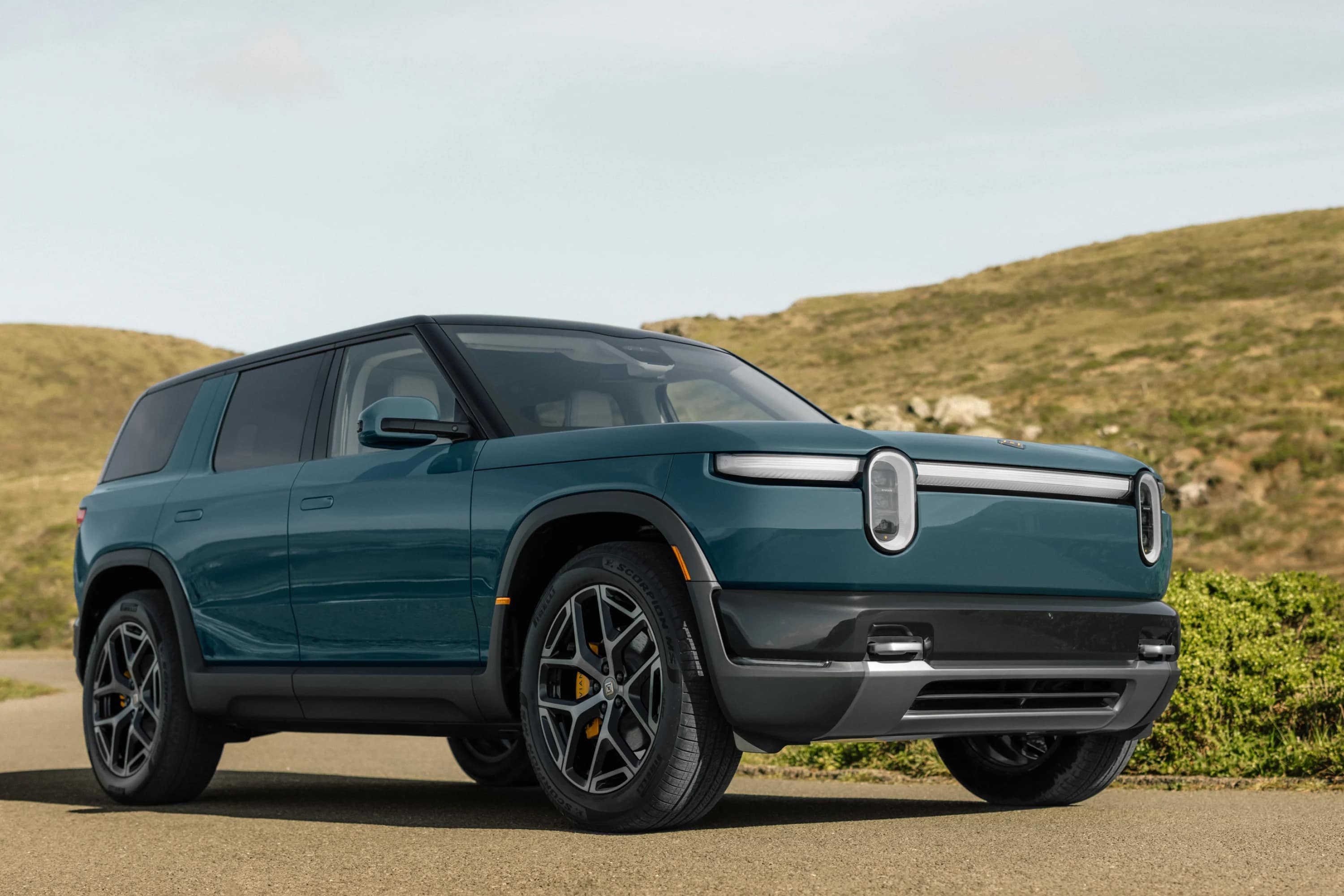
Rivian R2 has already won the easy part of the EV argument: people want to look at it.
The harder part starts now. Rivian has moved the R2 from attractive promise to production pressure, and that is where the story becomes more useful for buyers, EV watchers and anyone trying to understand the next phase of the U.S. electric-vehicle market.
Rivian’s official R2 page positions the vehicle as a midsize five-seat electric SUV. Its earlier R2 and R3 launch material says the platform is designed around two battery sizes, over 300 miles of estimated range with the larger pack, native NACS charging plus CCS via adapter, and a 10-to-80% DC fast-charging target of under 30 minutes. TechCrunch reported that R2 deliveries began in June 2026, while The Verge’s factory reporting frames the next few months as the crucial ramp.
GearPulse’s view: R2 matters because it is not another six-figure halo EV. It is Rivian trying to become a real volume car company while the EV market is less forgiving, incentives are weaker and Tesla is no longer the only reference point buyers understand.
The R2 job is clear
Rivian does not need the R2 to be the most radical EV on sale. It needs it to be credible, buildable and broadly desirable.
The formula is easy to see. R1T and R1S gave Rivian a strong identity: outdoorsy, cleanly designed, software-heavy and less abrasive than the truck/SUV norm. The problem is that R1 pricing keeps Rivian in a premium corner. The R2 is supposed to pull that identity into a smaller, less expensive SUV that can reach a much larger audience.
That is why the ramp matters more than the reveal. A beautiful launch car proves design taste. A sustained R2 production run proves whether Rivian can scale the company.
| R2 lever | Verified direction | Why it matters |
|---|---|---|
| Body style | Midsize five-seat SUV | Hits the center of U.S. family and crossover demand |
| Range target | Over 300 miles with the larger pack, according to Rivian launch material | Keeps it in the practical daily-driver conversation |
| Charging | Native NACS, CCS with adapter, 10-80% target under 30 minutes | Reduces buyer anxiety around charging access |
| Performance | Single-, dual- and tri-motor configurations; quickest under 3 seconds 0-60 mph | Lets Rivian stretch from sensible to halo without a separate model |
| Platform | New midsize architecture using high-pressure die castings and structural battery design | Suggests the cost story depends on manufacturing simplification |
The caveat is that official specifications are not the same thing as owner reality. Early deliveries, EPA labels, software behavior, service experience and production quality will decide whether the R2 feels like a scaled Rivian or a rushed one.
Why 2026 is a tougher launch window
Rivian is not launching the R2 into the EV boom years. It is launching into a colder market.
The Verge’s reporting describes a company dealing with factory disruption, supply-chain risk and the pressure of ramping its most important product. TechCrunch notes that Rivian wants the R2 to scale through the second half of 2026. The Guardian’s interview with CEO RJ Scaringe adds the broader industry point: he argues carmakers that retreat from EV investment for short-term profit risk falling behind on the technology stack.
That argument is persuasive, but it does not erase the buyer math. EV customers in 2026 are more price-sensitive. Charging has improved but remains uneven. Policy support is less reliable. Used Tesla inventory and discounted legacy EVs give shoppers more alternatives. A new R2 has to be emotionally appealing and financially coherent.
Rivian’s advantage is that the R2 does not feel like a compliance car. It looks like a smaller version of the brand people already liked. Its risk is that admiration does not equal throughput.
The Tesla comparison is useful but incomplete
Every affordable-ish American EV story eventually gets dragged toward Tesla. The comparison is useful, but only up to a point.
Tesla Model Y set the template for what a successful electric crossover can become: high volume, strong software identity, charging confidence and simple purchase logic. Rivian’s R2 has a different personality. It is boxier, more outdoors-coded and less minimalist. That could be an advantage for buyers who find Tesla too common or too polarizing.
But Rivian should not be graded only on whether it “beats Tesla.” The healthier question is whether it can create a second strong U.S. EV lane. A market with Tesla plus Rivian plus serious Korean, European and Chinese pressure is better for buyers than a market where every new EV is a fragile startup bet or a half-hearted legacy compliance model.
The R2 could also help Rivian’s R3 story. Rivian’s own launch material ties R2 and R3 to the same midsize platform. If R2 production is clean, R3 becomes more believable. If R2 struggles, the R3 becomes a design object people love from a distance.
Buyers should watch these signals
The R2 is exciting, but buyers should not confuse early enthusiasm with a complete ownership picture. These are the practical signals worth tracking through the rest of 2026.
| Signal | Healthy sign | Warning sign |
|---|---|---|
| Delivery pace | Steady handovers without vague timing shifts | Repeated delivery windows slipping for reservation holders |
| Build quality | Early-owner reports focus on small software fixes | Widespread fit, finish or hardware reliability complaints |
| Service capacity | Rivian service keeps up with launch volume | Long repair waits become part of the R2 reputation |
| Real range | Owners see practical highway range close to expectations | Range drops sharply outside ideal use |
| Pricing discipline | Rivian keeps a clear path to the accessible version | Early trims drift too far into premium pricing |
| Software maturity | Driver assistance and infotainment feel stable | Feature promises outrun what ships |
Car and Driver’s report that Rivian removed the least expensive Dual Motor Standard Pack R1T and R1S trims is also worth watching as a positioning signal. It creates more room between the premium R1 family and the smaller R2, but it also puts more responsibility on R2 to be the accessible Rivian buyers were promised.
The manufacturing story is the product story
The R2’s most important spec may not be range or acceleration. It may be whether Rivian can remove enough complexity from the vehicle to build it repeatedly at the right cost.
Rivian’s launch material points to high-pressure die castings, a structural battery unit and simpler closure systems. Those are not reader-friendly features in the way a flashlight in the door is. They are manufacturing choices. If they work, they help Rivian build a smaller vehicle with fewer parts and better margins. If they do not, the R2 becomes another attractive EV trapped by cost.
That is why the R2 is more interesting than a normal new-SUV launch. It asks whether Rivian’s design taste can survive industrial scale. The first few thousand owners will help answer whether the company can deliver the feel of a premium adventure EV without keeping the business stuck in premium-only volume.
Bottom line
Rivian R2 is relevant because it turns the company’s brand promise into an execution test. The SUV has the right category, the right design temperature and enough verified specification strength to matter. But the next story is not the shape of the headlights or another Tesla comparison. It is the ramp.
If Rivian can build the R2 steadily, keep quality under control and make the lower-price versions real, it has a credible shot at becoming the second American EV brand buyers mention without hesitation. If the ramp stumbles, the R2 will still be a desirable object, but it will not be the company-making vehicle Rivian needs.