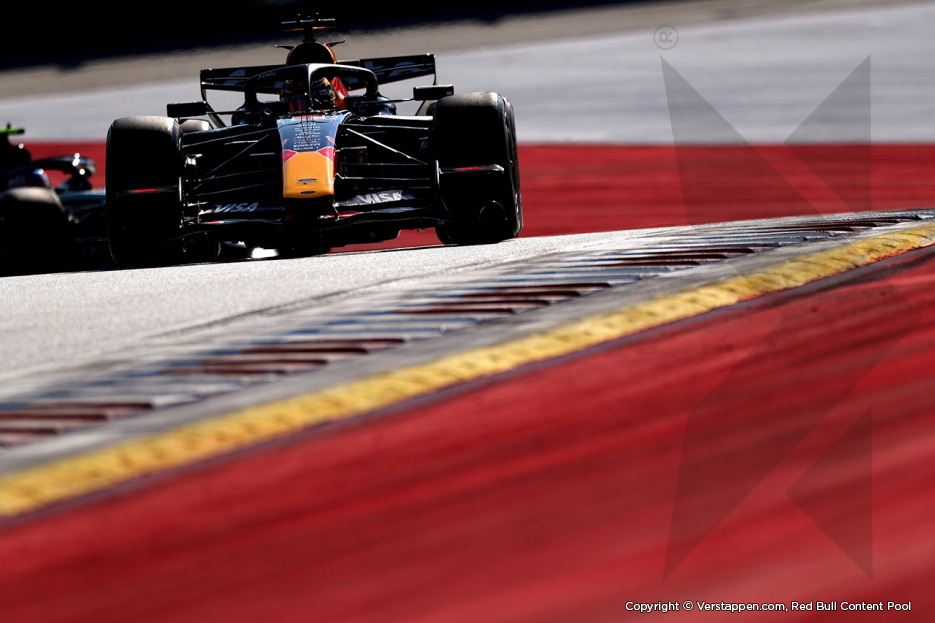
Red Bull’s Austrian Grand Prix problem is not only that Max Verstappen starts behind Mercedes, Ferrari and the clean-air fight. It is that the team’s most encouraging upgrade weekend also produced the kind of failure that makes every encouraging lap harder to trust.
Formula 1’s official team notes say Verstappen was fifth after qualifying at the Red Bull Ring, with a 1:06.475. The FIA’s qualifying report confirms the bigger headline: George Russell took pole after Verstappen’s late crash, Ferrari locked in second and third with Charles Leclerc and Lewis Hamilton, and the yellow-flag debate became the public argument.
GearPulse already covered that stewarding and timing angle. Today’s better Red Bull story is narrower: the RB22 looked faster, but Verstappen’s Turn 9 crash turned the upgrade into a proof test.
What changed after qualifying
Red Bull brought a large package to Austria, and the team’s own post-qualifying language matters. Laurent Mekies framed it as a broad update covering the car and power unit, while also admitting that Red Bull is still learning where the new package works best.
That is normal for a meaningful upgrade. It is also why the crash matters.
Verstappen had already had a tight qualifying path. Formula 1 noted that Red Bull carried fewer fresh soft tyres into qualifying than its main rivals, which forced risk into the run plan before Q3 even started. Once in the final segment, Verstappen’s first lap was good enough to keep him fifth. His second lap was the one that got away.
The important detail is Red Bull’s explanation. Verstappen and Mekies both pointed to a rear-aero loss or rear-end damage rather than presenting the incident as a simple driver mistake. Verstappen described a sudden loss of rear grip through Turn 9, and Mekies accepted team responsibility after the session.
That changes the read. A driver overstepping in Q3 is one type of problem. A rear-aero loss during the fastest, most exposed part of a home qualifying lap is a different one.
The upgrade signal was real
The awkward part for Red Bull is that the upgrade did appear to move the car forward.
Verstappen was not on pole pace by his own account, but he was close enough to make the top-five order uncomfortable. Isack Hadjar also put the sister Red Bull package eighth, ahead of both Racing Bulls and Alpine’s Pierre Gasly. On a 4.326 km circuit, those details matter because small lap-time gains are compressed into very few corners.
| Red Bull question | Austria qualifying evidence | Why it matters for Sunday |
|---|---|---|
| Did the upgrade add pace? | Verstappen reached Q3 and held fifth after a crash-shortened final run. | Red Bull can plausibly fight forward if the car is stable in race trim. |
| Is the operating window clear? | Mekies said the team is still learning the package. | Setup and cooling choices matter in extreme heat. |
| Was the crash only driver error? | Red Bull linked it to rear aero loss or damage. | Reliability and inspection become as important as lap time. |
| Is strategy still alive? | Red Bull saved tyre allocation differently from rivals. | A hot 71-lap race can reward flexibility, but only if the car behaves. |
This is why the story is not “Red Bull is back” or “Red Bull is broken.” The honest read is more useful: the RB22 has shown a better ceiling, but Red Bull has not yet shown that the ceiling is easy to access.
Austria is a harsh place to learn an aero package
The Red Bull Ring is short, fast and exposed. There are only 10 listed corners on the current Formula 1 layout, so a driver gets fewer chances to mask a car that is nervous on entry or unstable over the kerbs. Turn 9 is especially unforgiving because the car is loaded, fast and close to the limit.
That makes Austria a useful test but a risky classroom. If the upgrade improves peak downforce but narrows the balance window, the stopwatch may look better until the driver reaches the part of the lap where confidence matters most.
The heat adds another layer. Formula 1’s qualifying notes repeatedly flagged high temperatures and tyre degradation as race factors. Hot conditions can punish rear sliding, change cooling margins and make a car that is quick for one lap less comfortable across a stint.
Red Bull’s challenge is therefore practical, not dramatic:
- inspect the rear of Verstappen’s car without introducing rebuild compromises;
- understand whether the aero loss was damage, sensitivity, or a one-off failure mode;
- keep enough cooling and tyre life for race pace;
- avoid turning the upgrade into a setup chase during the race.
None of that is glamorous. All of it decides whether fifth place is a recovery platform or a ceiling.
Why this is different from the yellow-flag story
The yellow-flag argument is about whether Russell’s accepted pole lap made sense under the rules. The Red Bull angle is about whether Verstappen’s car gave him a stable enough platform once the team had made its big Austria step.
Those stories intersect, but they are not duplicates.
For Mercedes, the question is trust in the stewarding and lap data. For Red Bull, the question is trust in the package. The first is about how Formula 1 explains a legal result. The second is about how a team turns development work into repeatable performance.
That distinction matters because Red Bull’s season needs more than a fast qualifying sector. It needs a car that Verstappen can lean on every weekend, in dirty air, on hot tyres and under race-stint fuel load. Austria gave the team signs of pace, then immediately handed it a durability and correlation problem.
Bottom line
Red Bull’s upgraded RB22 looked more competitive in Austria, but Verstappen’s Turn 9 crash means the package leaves qualifying with an asterisk.
The pace signal is encouraging. The source of the crash is the warning. If Red Bull can verify the rear-aero issue, rebuild cleanly and keep the tyres alive in the heat, Verstappen can still turn fifth into a useful home-race result. If the upgrade remains peaky or fragile, Austria will look less like a breakthrough and more like an expensive lesson in how hard it is to make new performance usable.
GearPulse’s read: Red Bull has found something, but it has not yet proved it can trust it.
Support independent source-backed coverage at buymeacoffee.com/gearpulse.site.