
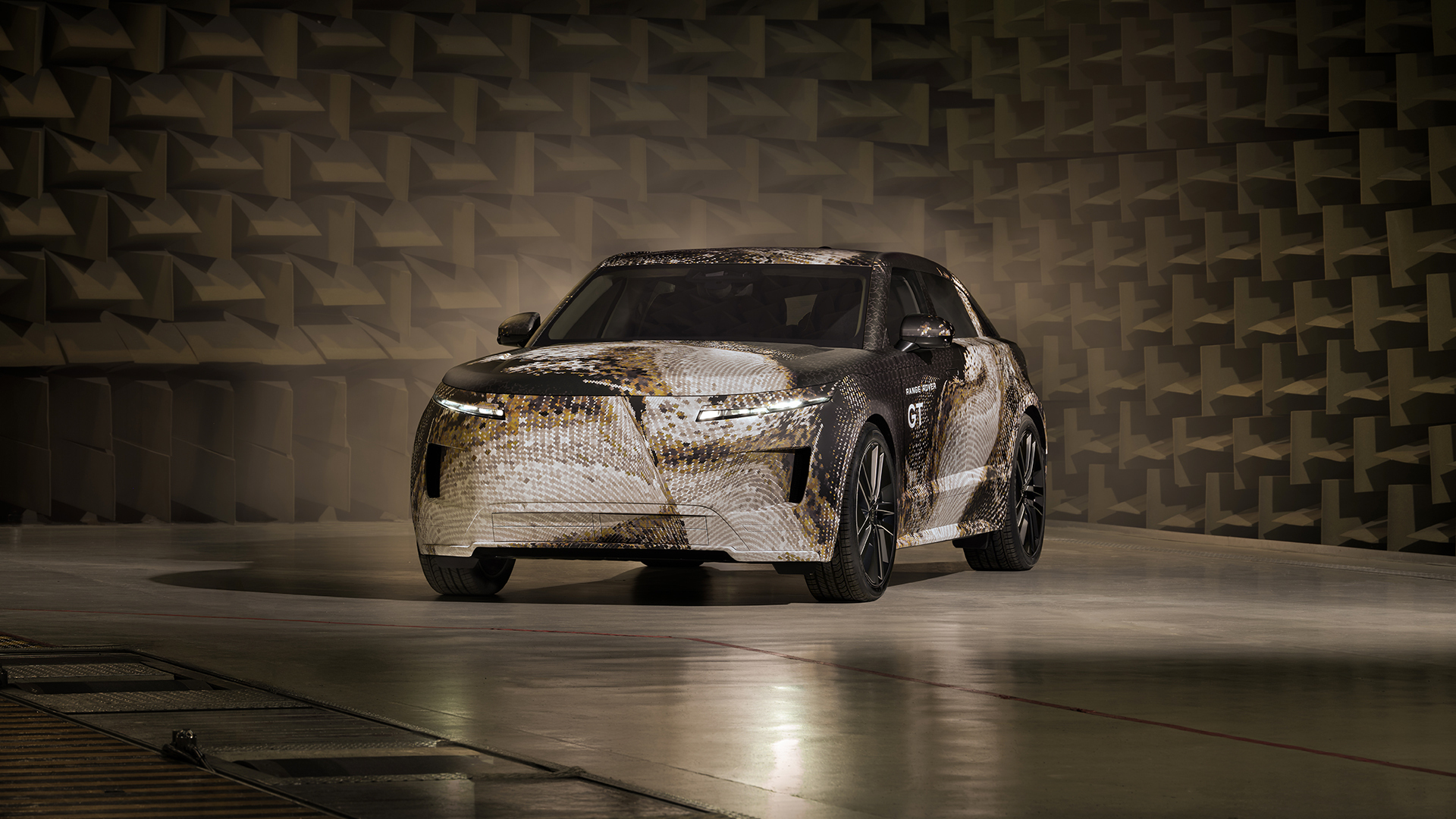
The most interesting thing about the Range Rover GT is that it does not look like another safe extension of the Range Rover catalog.
Range Rover has confirmed a fifth model line, called simply Range Rover GT, and the company is positioning it as a grand tourer with long-distance luxury, electric performance and enough all-terrain credibility to keep the badge honest. The first official images are still camouflaged and the company has not released power, range, battery size or pricing. That matters. This is not a full spec reveal. It is a statement of intent.
GearPulse’s read: the GT is relevant because luxury EVs are getting more crowded and less convincing at the same time. A badge alone is no longer enough. Buyers at this end of the market already have quiet cabins, huge screens and violent acceleration available from multiple brands. Range Rover now has to prove that its version of an electric grand tourer has a reason to exist beyond being another expensive shape on a new platform.
What Range Rover has actually confirmed
The official details are careful, but there is enough to understand the direction. Range Rover says the GT is the fifth member of the family and that it will be the first all-electric Range Rover vehicle on JLR’s new EMA architecture. It will be built at Halewood in the UK, launch first as a battery-electric vehicle, and gain a full hybrid option later in its lifecycle.
The company is also leaning hard on the cabin. The first interior preview shows a minimalist layout with a central screen, a driver display instead of a traditional instrument cluster, concealed ventilation across the dashboard and textile material wrapped through the dash to hide speakers. Range Rover says the second row has class-leading legroom, and the prototype images point to a lower, sleeker car than the SUVs that made the brand famous.
| Confirmed point | Why it matters |
|---|---|
| Fifth Range Rover model line | This is not just a trim or facelift; it expands the family. |
| EMA platform | The GT starts on JLR’s new electrified midsize architecture. |
| BEV first, HEV later | Range Rover is hedging between electric luxury and hybrid buyer reality. |
| Halewood production | It ties the GT to JLR’s UK electrification investment. |
| Specs still withheld | Range, price, battery and power claims should be treated as unknown for now. |
The restraint is frustrating, but probably intentional. Range Rover is showing atmosphere before numbers.
The Jaguar question is unavoidable
WIRED’s sharpest point is also the one JLR cannot duck: Range Rover GT arrives just as Jaguar is trying to rebuild itself around electric grand touring. Both brands live inside JLR. Both are talking about luxury, design and electric long-distance comfort. Both need wealthy customers who want something more expressive than another conventional SUV.
Range Rover’s defense is capability. The company says the GT keeps the breadth of Range Rover ability, while Jaguar is meant to be its own electric-luxury proposition. That may be true mechanically. It still needs to become obvious emotionally.
The risk is not that two JLR products share some hardware philosophy. The risk is that buyers see two expensive JLR electric GTs and ask which one is the real halo car. Jaguar needs space to become dramatic again. Range Rover needs permission to become lower and more road-focused without losing the quiet authority that made the name valuable.
That tension is what makes the GT worth watching. If JLR handles it well, Range Rover gets a new kind of grand tourer and Jaguar gets room to be stranger, cleaner and more design-led. If it handles it badly, the two brands could end up explaining each other instead of seducing different customers.
Touchscreens are the wrong kind of confidence
The cabin preview is beautiful in the way modern luxury concept interiors are often beautiful: calm surfaces, hidden hardware, low visual noise. I like that direction. Range Rover should feel like an escape from the cheap piano-black mess that still infects too many premium cars.
But the touchscreen-heavy approach deserves skepticism. Carmakers have spent years discovering that hiding basic controls can make expensive cars feel less intuitive, not more advanced. A grand tourer is supposed to make long journeys easier. If climate, seat, drive-mode and media controls require too much screen attention, the interior risks becoming a showroom idea rather than a road companion.
That does not mean Range Rover has already failed. It means the interface will matter as much as the leather, textile and legroom. Luxury is not minimalism by default. Luxury is the absence of unnecessary effort.
The missing numbers matter
The GT’s final credibility will come from details Range Rover has not published yet.
| Unknown | Reader takeaway |
|---|---|
| Battery size and range | The car needs enough real motorway range to justify grand-tourer language. |
| Charging speed | Long-distance EV comfort depends on stops, not just range. |
| Power and weight | A GT can be quick, but it also has to feel composed. |
| Price | It must avoid colliding awkwardly with Jaguar’s electric flagship ambitions. |
| Cabin control layout | The touchscreen-first interior needs to work when the novelty fades. |
This is where patience helps. Range Rover has shown a credible silhouette and a confident cabin, but it has not earned the driving story yet.
Bottom line
The Range Rover GT is more intriguing than another electric SUV because it forces the brand to answer a harder question: what does Range Rover mean when the vehicle is lower, sleeker and built for grand touring?
My hunch is that the GT could work if JLR lets it be calm, capable and quietly expensive rather than chasing supercar theater. The caveat is clear: until range, charging, price and real cabin ergonomics are public, this is a promising preview, not a verdict.