
The next big AI fight may be less about who owns the flashiest accelerator and more about who can keep it fed.
Qualcomm and Amazon have announced a multi-generation collaboration on customized silicon for AWS AI infrastructure, focused on inference—the work of running trained models for real users. The companies are also developing optical connectivity that reaches up to 1.6 terabits per second. Qualcomm’s announcement contains no glossy benchmark duel with NVIDIA. Instead, it puts chips and the links between them in the same sentence. That is the useful signal.
Inference is where an AI service earns or loses its keep. A model has to fetch context, exchange information across servers, generate an answer and serve the next request without making the whole system feel rationed. Faster compute helps, but compute waiting for data is still waiting.
What the agreement does—and does not—say
Qualcomm says the partnership covers multiple generations of customized silicon at scale and high-bandwidth optical connections for Amazon data-center networks. It also says Qualcomm plans to use AWS AI infrastructure, including Amazon Bedrock, for electronic-design-automation workloads. The SEC filing adds a meaningful commercial detail: Amazon received a warrant to buy up to 25 million Qualcomm shares at $161.26 per share, in connection with purchases of Qualcomm server-chip products, technology, systems and manufacturing services.
Reuters reported that the warrant is tied to purchase milestones that can reach $60 billion over a decade. That is a potential ceiling, not a booked sales figure, and it should not be mistaken for immediate revenue or capacity.
| Confirmed today | Still unknown |
|---|---|
| Qualcomm and Amazon are collaborating across custom inference silicon and optical connectivity | The chip architecture, node, memory and performance |
| Optical solutions are being developed up to 1.6T | Which systems ship first, and when |
| Amazon has a warrant for up to 25 million Qualcomm shares | The actual value and pace of future product purchases |
| Qualcomm will deepen its use of AWS for EDA workloads | Pricing, cloud regions and customer-facing availability |
That lack of product detail is not a defect in the reporting; it is the sensible place to draw the line. Announcements can establish intent and direction. They cannot establish tokens per watt, reliability or cost without hardware and workloads to inspect.
Why 1.6T matters more than it sounds
AI infrastructure has become a data-movement problem. A large service does not behave like one giant processor with a magic memory pool. It is a mesh of accelerators, memory, storage and networking, constantly moving model weights, user context and partial results. As models become mixtures of experts, agents call tools, and requests carry longer context windows, the network becomes part of the answer’s latency.
The 1.6T figure refers to the targeted speed of optical connectivity solutions, not to an internet connection readers will buy. But it captures a real design priority: wider, faster links can let clusters act less like isolated boxes and more like a coordinated system. That matters for cloud AI because an impressive accelerator is only useful if work arrives and leaves fast enough.
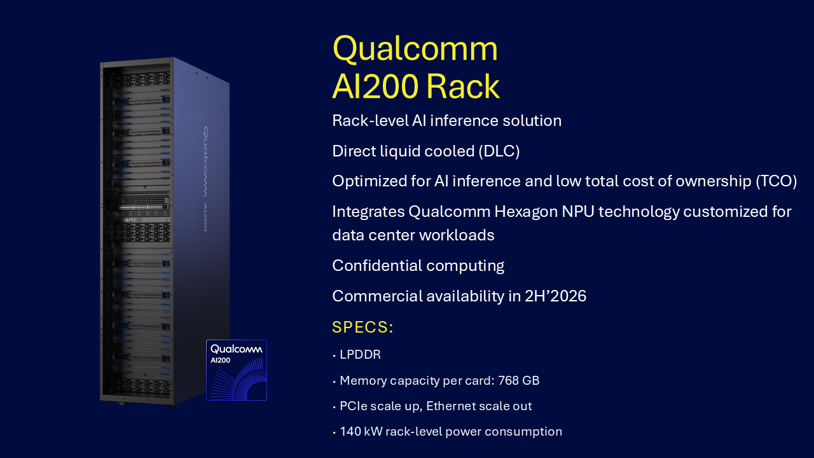
Qualcomm has been building toward that position with its AI200 rack platform. Its official materials describe liquid cooling, LPDDR memory, PCIe scale-up and Ethernet scale-out, with commercial availability targeted for the second half of 2026. Those are vendor specifications, not independent performance results, but they explain why a network-heavy AWS partnership is credible rather than random.
Amazon is buying options, not declaring a winner
This does not mean AWS is abandoning its own Trainium and Inferentia chips, or suddenly replacing NVIDIA GPUs across its cloud. The better reading is that Amazon wants more than one route to scalable inference. Custom silicon can optimize a narrow workload. Merchant GPUs offer a mature and flexible ecosystem. High-speed networking determines how well either strategy works once it is deployed at serious scale.
That is familiar terrain for AWS. The difference is Qualcomm’s role: a company best known to many readers for phone modems and Snapdragon chips is now trying to become an AI-data-center supplier and a connectivity partner at the same time. Bloomberg Law’s reporting frames the agreement as a significant customer win for that push. The stock warrant gives Amazon a reason to care about Qualcomm’s success, but it does not guarantee the technical outcome.
For users, this is one more reason not to treat every AI price rise or rate limit as an abstract “compute shortage.” The bill is made of chips, memory, cooling, electricity and links. Our earlier look at OpenAI and Broadcom’s inference-silicon project focused on the chip side. Qualcomm and Amazon are making the interconnect side harder to ignore.
Bottom line
Qualcomm and Amazon have not unveiled a finished rival to NVIDIA, and they have not published the numbers needed to crown one. They have made a sharper point: AI inference at scale is a system problem.
The winner will not simply have the fastest chip. It will have the chip, memory, software, power and network that work together without leaving users staring at a spinner. This deal is worth watching because it tackles that less glamorous half of the AI race directly.