
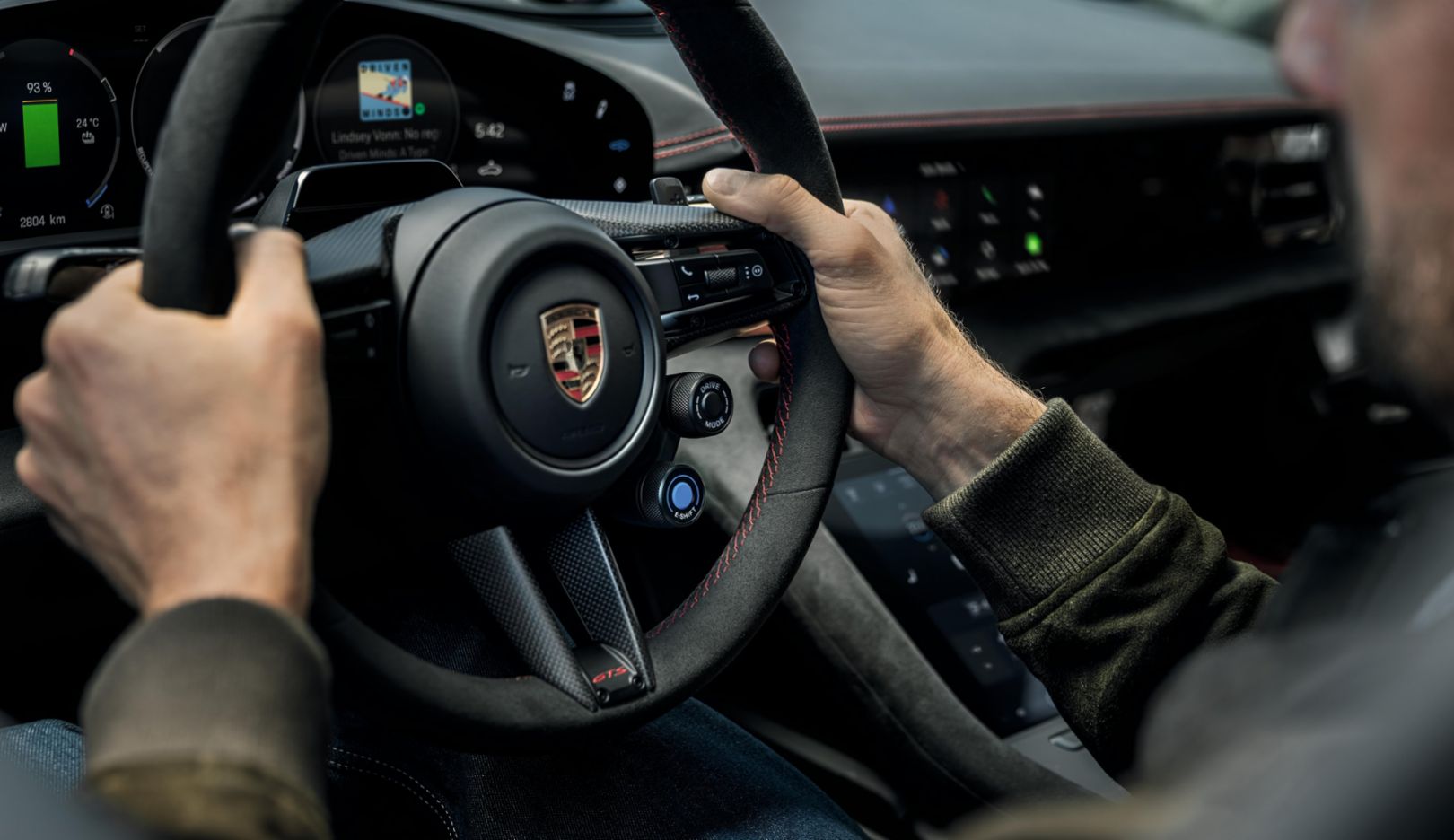
The electric-car argument has usually been framed as a clean break: no gears, no revs, no waiting. Porsche’s new Taycan E-Shift asks a better question. What if some of those old sensations were not mechanical baggage, but useful information?
For the 2027 Taycan, Porsche has created an optional software system that simulates an eight-speed PDK dual-clutch transmission. It adds paddle-operated virtual shifts, a digital tachometer, a shift “kick,” synthesized sound and gear-specific drag torque. The car remains an EV; E-Shift does not add power or shorten a lap on its own. It changes the conversation between car and driver.
That distinction is the whole story. This is not Porsche pretending it has rebuilt an internal-combustion Taycan. It is acknowledging that instantaneous torque can be technically excellent while still leaving an enthusiast with fewer cues to work with.
What the paddles actually do
Porsche says E-Shift is available across the 2027 Taycan range and is standard on the Turbo GT. In the U.S., Car and Driver reports it is a $1,030 option on other models. The system can run automatically, or the driver can use the paddles to choose from eight virtual ratios; a dedicated steering-wheel switch turns the feature on.
| Element | What Porsche says it changes | What it does not change |
|---|---|---|
| Virtual ratios | Simulates an eight-speed PDK | The Taycan’s electric propulsion layout |
| Shift feedback | Adds a perceptible jolt, sound and visual rev response | The car’s peak performance claim |
| Manual mode | Lets the driver use wheel paddles and meet a virtual limiter | A real combustion engine or clutch |
| Drag torque | Mimics the deceleration feel associated with lower gears | The fundamental efficiency advantage of an EV |
The implementation matters because the Taycan already has a real two-speed transmission at the rear axle. Car and Driver’s drive report says Porsche synchronizes that hardware shift, which occurs at roughly 55 mph, with the virtual second-gear change. That is smarter than simply laying sound effects over a single-speed drivetrain: the simulated rhythm is being designed around an actual change in the car’s behavior.
Porsche also says the new soundscape adapts to virtual rpm, vehicle speed and charge state. That may sound theatrical—and it is, deliberately—but theatre is not automatically deception. A steering wheel, a head-up display and an indicator click are all designed feedback. Their job is to make a complex machine legible at speed.
Why this is more than an EV gimmick
The strongest objection is obvious: an electric motor’s seamless response is one of its best qualities. Why add interruptions back in?
Because fast driving is not only about minimizing elapsed time. It is also about knowing what the car is doing, anticipating its response and choosing how to shape a corner or an exit. A conventional powertrain delivers that information through revs, engine braking and shift points. EVs replace some of those signals with silence and uninterrupted thrust. For commuting, that is lovely. For an involved road, it can feel oddly featureless.
Hyundai’s Ioniq 5 N made the same case more rowdily; Porsche’s version appears aimed at restraint. The Drive’s reporting describes the feature as a response to that emerging category of simulated shifts, while Porsche’s own explanation emphasizes engagement rather than a performance benefit. That is a useful line to hold. If an artificial shift makes the driver more attentive and offers a satisfying choice, fine. If it merely makes a car noisier, leave it off.
The good news is that E-Shift is optional and switchable. Drivers who value uninterrupted EV thrust can keep it that way. Drivers who want paddles and a more deliberate power delivery get an additional mode rather than a compulsory personality transplant.
The more important Taycan message
E-Shift arrives alongside practical 2027 updates, including a new infotainment generation and, in the U.S., a NACS DC fast-charging port. But the virtual gearbox is the bolder signal: mature EVs are moving past the phase where every decision had to imitate a smartphone—frictionless, flat and optimized.
As we argued in our look at the gas Macan’s endgame, the transition works best when manufacturers are clear about what is being gained and lost. Porsche has not discovered that gear changes are necessary for electric cars. It has recognized that they can be a valuable user interface.
That makes E-Shift more interesting than a nostalgia button. It is a small experiment in giving electric performance cars their own vocabulary: software-crafted, honest about its artifice and judged by whether it gives the driver better feel.
Bottom line
Porsche’s simulated shifts will irritate purists who want EVs to be ruthlessly smooth, and they will be right to demand an off switch. But E-Shift is persuasive precisely because Porsche has made it optional and has not dressed it up as extra horsepower.
The Taycan does not need fake gears to be quick. It may benefit from them to be more involving. That is a far more mature use of software than adding another screen trick: it gives the driver a choice about how a fast electric car should communicate.
Support independent GearPulse articles at buymeacoffee.com/gearpulse.site.