
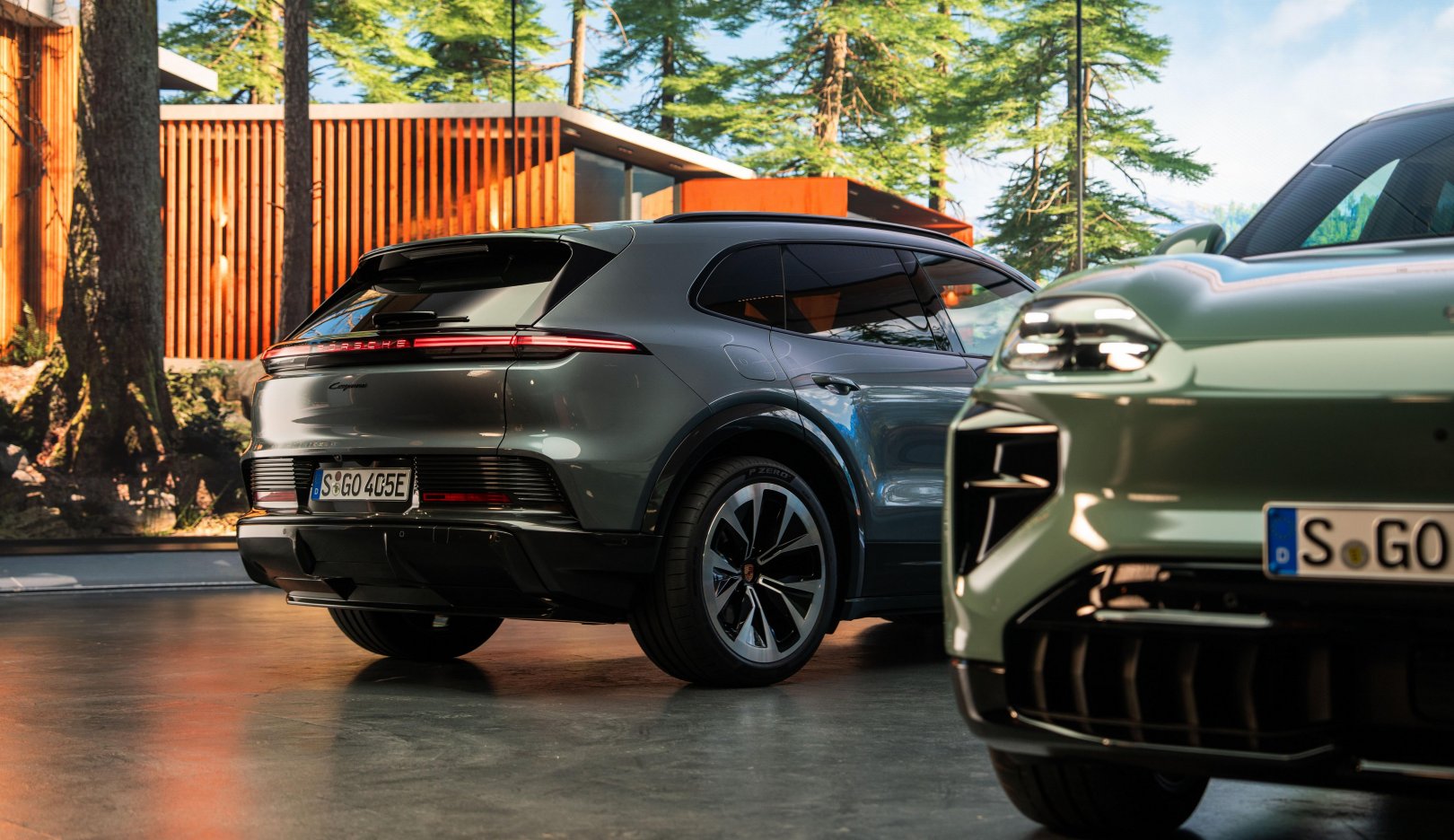
The Porsche Cayenne Turbo Electric has made the kind of performance claim that normally belongs to a low-slung exotic: 0–60 mph in 2.4 seconds, 1,139 hp with Launch Control, and a 162-mph top track speed. Those are Porsche numbers. What makes the big electric SUV more interesting this week is what an independent test found once the acceleration stopped being the point.
Car and Driver measured the Turbo charging from 15 to 90 percent in 24 minutes on a 400-kW NACS charger. Its recorded peak was 383 kW and its average was 239 kW, while the car returned 300 miles in the publication’s 75-mph highway range test. That is a better travel story than a Nürburgring-style power figure: the test team estimates roughly 225 highway miles returned in under half an hour.
That does not mean every Cayenne owner should expect the same stop. It does mean Porsche’s unusually aggressive charging hardware is beginning to look meaningful outside a product presentation.
The headline figures, sorted by who says what
| Measure | Porsche’s specification | Independent result or context |
|---|---|---|
| Battery | 113 kWh gross; 108 kWh usable | Top Gear also lists 113 kWh / 108 kWh usable |
| Peak DC charging | Up to 400 kW in ideal conditions | Car and Driver saw 383 kW on a 400-kW NACS charger |
| Fast-charge claim | 10–80% in under 16 minutes | 15–90% took 24 minutes in Car and Driver’s test |
| Turbo output | Up to 1,139 hp and 1,106 lb-ft with Launch Control | — |
| Turbo 0–60 mph | 2.4 seconds | Car and Driver reports a 9.5-second quarter-mile at 146 mph |
| Highway range | Porsche has not quoted an EPA figure in its launch release | 300 miles at 75 mph in Car and Driver testing |
The difference between the 10–80 manufacturer claim and the 15–90 test window matters. They are not interchangeable measurements, and anyone reducing either to a single “charge time” is flattening the useful detail. The measured result is still strong because the test started at a higher state of charge and ended at a higher one, where charging normally tapers.
A performance SUV that understands the road-trip problem
Ultra-fast charging often ends up as a brochure number because the public network cannot consistently meet it. Porsche has given the Cayenne some practical headroom: its 800-volt architecture can accept up to 400 kW, while many high-power public chargers are capped at 350 kW. In the right conditions, that margin should help it maintain high rates rather than merely chase a momentary peak.
There is still no universal shortcut around the variables. A 400-kW-capable vehicle needs a compatible charger; cold batteries, a busy site, charge sharing and battery conditioning can all change the result. And a 300-mile 75-mph test is particularly useful, but it is not an EPA label or a promise for every weather and wheel choice.
That caveat is why the Car and Driver result lands better than a simple claim of “fastest.” The test gives a tangible outcome: a family-sized, nearly 6,000-pound SUV that can plausibly add several hours of motorway distance during a lunch stop. Top Gear’s review reaches a similar conclusion on the car’s broad brief—big, practical and unusually quick to charge—while WIRED notes the base, S and Turbo have very different priorities and prices.
The rest of the vehicle has to earn the time saved
It helps that the Cayenne is not engineered as a battery with a crest on it. Porsche says the wheelbase is nearly five inches longer than the combustion Cayenne’s, opening up rear-seat room; it quotes up to 56.1 cubic feet of rear cargo capacity plus a small front trunk and a 7,716-pound maximum towing capacity when properly equipped. The Turbo brings active aerodynamics, rear-motor oil cooling and optional Active Ride suspension to the familiar SUV brief.
The price is the unavoidable counterweight. Porsche lists the U.S. Cayenne Electric from $109,000 and the Turbo from $163,000 before its $2,350 delivery charge; options can push either much higher. This is not a democratic breakthrough in EV travel. It is Porsche using its price band to solve the part of electric long-distance driving that remains tedious.
For a different kind of electrification experiment, see how Bentley’s first EV is being asked to persuade the doubters. Porsche’s pitch is less philosophical and more blunt: make the stop short enough that the fastest family SUV stays fast when it is parked, too.
Bottom line
The Cayenne Turbo Electric’s 1,139-hp party trick will grab the attention. The credible reason to care is the charging test. Porsche has not abolished the constraints of public charging, but its 400-kW hardware and the independent 15–90 percent result suggest a rare thing in the luxury-EV class: the spec-sheet advantage can translate into a noticeably easier long drive.