
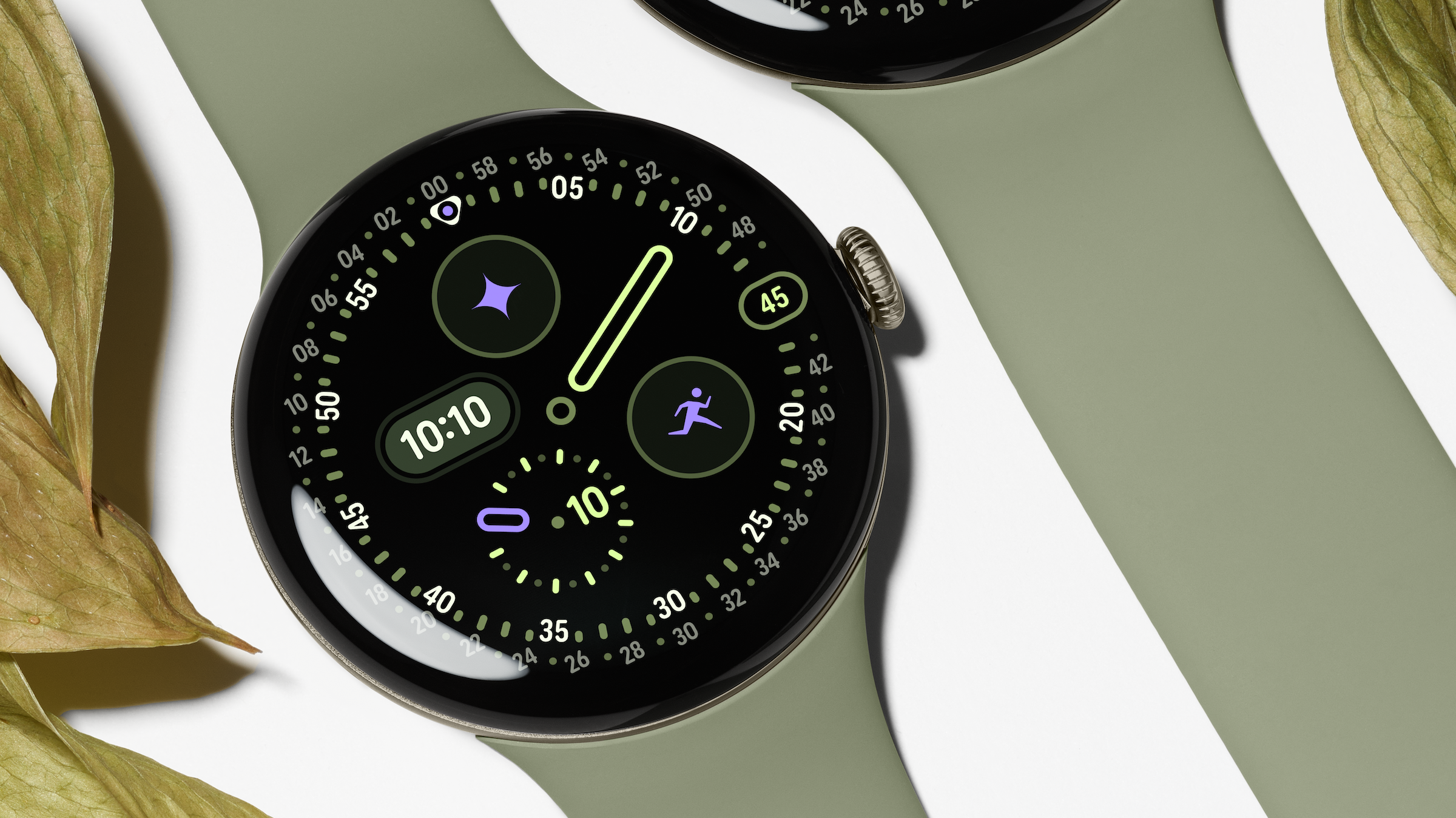
The Pixel Watch 5 is Google’s most persuasive argument yet that a smartwatch should earn its place when the phone is not nearby.
The headline features—Gemini assistance and a bright new display—will attract the predictable attention. The more consequential changes are practical: dual-frequency GPS, satellite SOS in supported markets, a stated 30-hour always-on battery figure for the 41mm model and 40 hours for the 45mm model, and a growing Health Guardian safety layer. Starting at $399 for 41mm and $429 for 45mm in the US, it is no longer a casual accessory purchase. It is a decision about whether that extra independence is useful in your actual life.
That is a healthier way to judge it than treating every new wrist feature as a fitness breakthrough.
The upgrade is about being less phone-dependent
Google’s specification sheet lists dual-frequency GPS, Bluetooth 6.0, Ultra-Wideband, LTE options and satellite SOS communication, with the latter restricted to Japan. The regional qualifier matters: a feature can be technically present in a product story while offering nothing to a buyer in another country. The same is true of carrier support and many health features.
Still, the direction is clear. Watches have long claimed to be useful on a run or hike without a handset, but location accuracy, endurance and a credible fall-back route have determined whether that claim felt reassuring or decorative. Better positioning and a longer claimed battery window are improvements people can understand without needing an AI demo.
| Pixel Watch 5 detail | What it changes | Important boundary |
|---|---|---|
| Dual-frequency GPS | Can improve route positioning where satellite signals are difficult | Google’s claim is not a substitute for comparing real-world route tests in your area. |
| Satellite SOS | Adds a possible emergency path when cellular service is absent | The official specs list it for Japan; it is not a universal watch capability. |
| Up to 30 / 40 hours always-on battery | Makes daily charging less constraining, especially on the 45mm | Battery estimates depend on configuration and use; the 41mm and 45mm figures differ. |
| Health Guardian tools | Puts breathing and longer-term trend alerts at the center of the pitch | An alert is a prompt to seek appropriate care, not a diagnosis. |
| $399 / $429 starting prices | Makes the safety-and-independence value calculation unavoidable | LTE service and market availability can add cost or restrictions. |
Google says both case sizes use a 3,000-nit Actua 360 display, while the 41mm carries a 332mAh battery and the 45mm a 465mAh cell. Those are straightforward hardware gains. They are also more durable buying criteria than whether a conversational assistant can find an answer faster than a phone already in your pocket.
Health features need more restraint than launch language
The most sensitive feature here is Breathing Emergency Detection, part of the new Health Guardian package. Google frames it as a system that can respond when it detects a user may have stopped breathing. That is an inherently serious proposition, so the right consumer reaction is neither dismissal nor blind faith.
Independent coverage from TechCrunch and WIRED puts the watch’s health and AI push in context, but it cannot turn a product announcement into medical validation. Fitness and safety wearables can be valuable when they create a useful prompt—call for help, check in with a person, talk to a clinician. They become less useful when marketing encourages people to treat probabilistic sensing as certainty.
That caveat should be familiar to readers of GearPulse’s look at why Fitbit’s Apple Health connection matters. The best wearable features reduce friction around information people already need; they do not make the wrist a replacement for judgment.
Gemini is a convenience feature, not the reason to upgrade
Google also promises low-latency Gemini features and proactive, contextual suggestions. Some buyers will love hands-free timers, messages or quick answers while moving. But assistant quality changes with accounts, supported languages, connected services and software updates. It is a poor foundation for an expensive hardware decision.
The watch’s clearer value is more mundane: it may be a more capable companion when you leave the phone behind. For an Android user who regularly runs, cycles, hikes or travels in places with unreliable reception, that is a concrete improvement. For someone whose watch mostly mirrors notifications at a desk, a well-functioning previous-generation model may remain the rational choice.
Bottom line
Pixel Watch 5 does not make every health alert or satellite feature equally available everywhere, and buyers should read the country and carrier footnotes before paying for LTE. But Google is at least moving the category toward a more useful question: can the watch help when the phone cannot?
For people who genuinely spend time away from a handset, the improved GPS, claimed endurance and safety architecture make a stronger case than another round of assistant tricks. Everyone else should wait for independent battery, route-accuracy and safety-feature testing—and buy the watch for its dependable basics, not for a promise that it will become a tiny clinic or a tiny phone.