
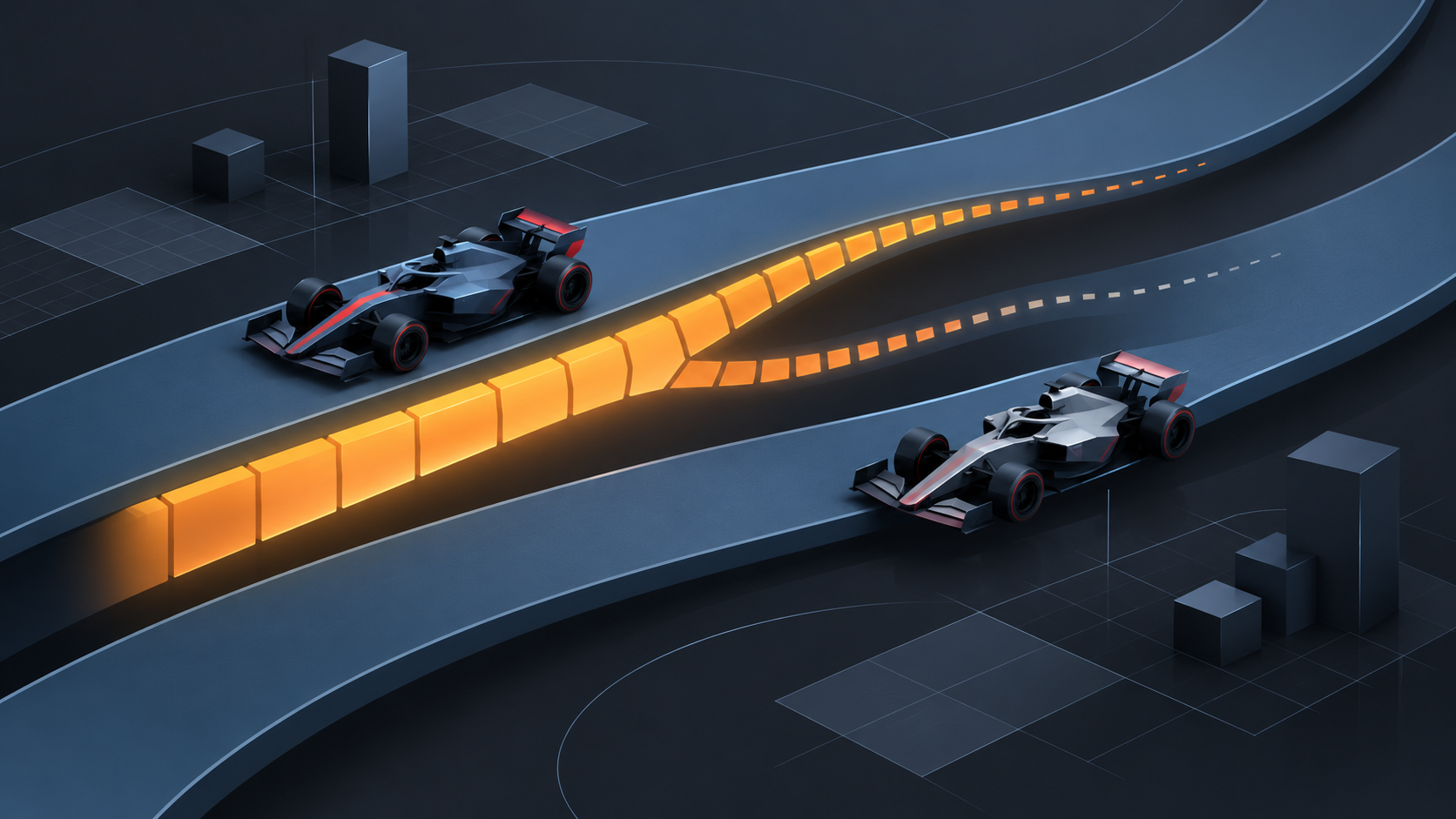
The 2026 regulations were meant to make Formula 1’s electrical power a more active part of the contest. In Baku, they exposed the point at which a clever energy-management game can become a driver-safety problem.
Sergio Pérez says he nearly hit Liam Lawson while defending during the Azerbaijan Grand Prix because the two cars’ power deployment behaved so differently. Motorsport.com and Grande Prêmio reported the Cadillac driver’s concern after the race; The Race had already described a separate high-speed near miss involving Lawson and Lewis Hamilton in Baku practice. These are not results to be converted into a grand theory about one engine supplier or one team. They are much more basic than that: a driver needs a reliable sense of how quickly the car ahead or behind will arrive.
F1 has already accepted that this needs attention. The FIA changed the rules from Miami after early-season feedback, cutting maximum recharge in qualifying from 8MJ to 7MJ, lifting peak superclip power from 250kW to 350kW and capping race-boost availability at +150kW to limit sudden performance differentials. The aim was sensible: less excessive harvesting, more consistent flat-out driving, and fewer moments when a car’s power state changes the race without warning.
But Baku supplied the caveat. A rule can make a risky behaviour rarer without making the racing relationship legible enough.
The dangerous part is the surprise
It is tempting to treat a speed difference as normal Formula 1. Faster cars have always passed slower ones; better engines and cleaner aerodynamics have always mattered. Pérez’s account points to a more awkward distinction. This is not simply one car being faster over a lap. It is a sharp, situational gap created by where two cars happen to be in their energy cycles.
The FIA’s 2026 design explicitly uses energy to create opportunity. The leading car’s deployment tapers after 290km/h, while the following car can use Override Mode, subject to the rules, with up to 350kW to 337km/h. That can make an overtake possible without returning to the old DRS-only rhythm. It is a sporting idea with real appeal.
It becomes harder to defend when the same machinery creates an unexpected closing rate in a narrow, flat-out sequence. On a conventional straight, the visual reference is generous: drivers can see the approach, place their car and abandon a move. Baku’s Turn 18–20 section is the opposite: walls, bends, traffic preparation laps and very little spare margin. A deployment mismatch there can turn a closing car into a problem before either driver has the room to make a normal racing decision.
| A competitive energy effect | A safety concern |
|---|---|
| A following car earns an attack with a clear run and braking point | A closing-speed change arrives while drivers are committed through a confined high-speed section |
| The driver can judge the move and the defender can react | The speed gap is large enough that the available reaction window collapses |
| Different energy strategies create visible tactical trade-offs | Different energy states make ordinary traffic behaviour unexpectedly hazardous |
The difference is not semantic. It is the line between a regulation that rewards judgement and one that asks judgement to compensate for a system the driver cannot fully read in the moment.
Baku did not create this weakness
The circuit made it vivid. The FIA’s April intervention followed data from the first three events, and the governing body said its changes were designed to reduce both driver workload and abrupt performance differences. That is an acknowledgement that the original balance needed correction, not a reason to pretend the correction settled the matter.
Pérez’s warning should also be kept in proportion. It is a driver’s account of a near miss, not a published FIA finding that a particular car, manufacturer or piece of software caused an unsafe incident. No public energy trace tells us the exact state of either car at the instant he describes. Claims about a hidden horsepower ranking or a team’s energy maps would be guesswork.
The relevant evidence is nevertheless substantial. Two separate Baku episodes involved Lawson needing to respond to a rapidly changing approach, and F1’s regulator has already altered the framework to reduce the very kind of differential at issue. That is enough to demand a better answer than, “the cars are new.”
New regulations deserve an adjustment period; they do not get a permanent exemption from being raceable.
Sepang is a useful test, not a verdict
The championship now heads to Sepang for the Bahrain Grand Prix in Malaysia, a circuit with long, fast sections but a far wider and more open character than Baku. That makes it a useful next observation point. If the same concerns emerge, the issue is less easily dismissed as a street-circuit quirk. If they do not, it still does not erase the Baku lesson: rules have to work at the calendar’s awkward venues as well as its forgiving ones.
F1 should resist the urge to solve this with a one-off track procedure every time an uncomfortable pattern emerges. The Race reported that teams rejected Hamilton’s proposed Baku-specific management idea during the weekend. That decision is understandable. Artificial queues or local fixes can create fresh confusion and make the sporting rules harder to follow.
The stronger response is to keep refining the parameters that determine how quickly energy is spent, recharged and released—and to judge them by a practical standard. Can a driver approaching a slower car, or defending from a faster one, predict the speed relationship early enough to race safely?
That is a higher bar than merely showing that the theoretical overtaking model works.
The bottom line
Pérez has identified the uncomfortable residue of F1’s 2026 energy experiment. The championship has successfully made electricity part of the race, but it cannot let energy state become a hidden multiplier that turns routine traffic into a high-speed surprise.
The FIA’s first correction was a credible start. Baku says the job is not complete. F1 should preserve the overtaking benefit of Override Mode while narrowing the moments when two otherwise competent drivers are suddenly operating with incompatible expectations of speed. That would make the technology more impressive, the racing more readable and the margin for error less absurdly thin.
For related context, read GearPulse’s analysis of the FIA’s ADUO measurement problem and our look at why the 2027 distance reduction is really an energy-management reset.