
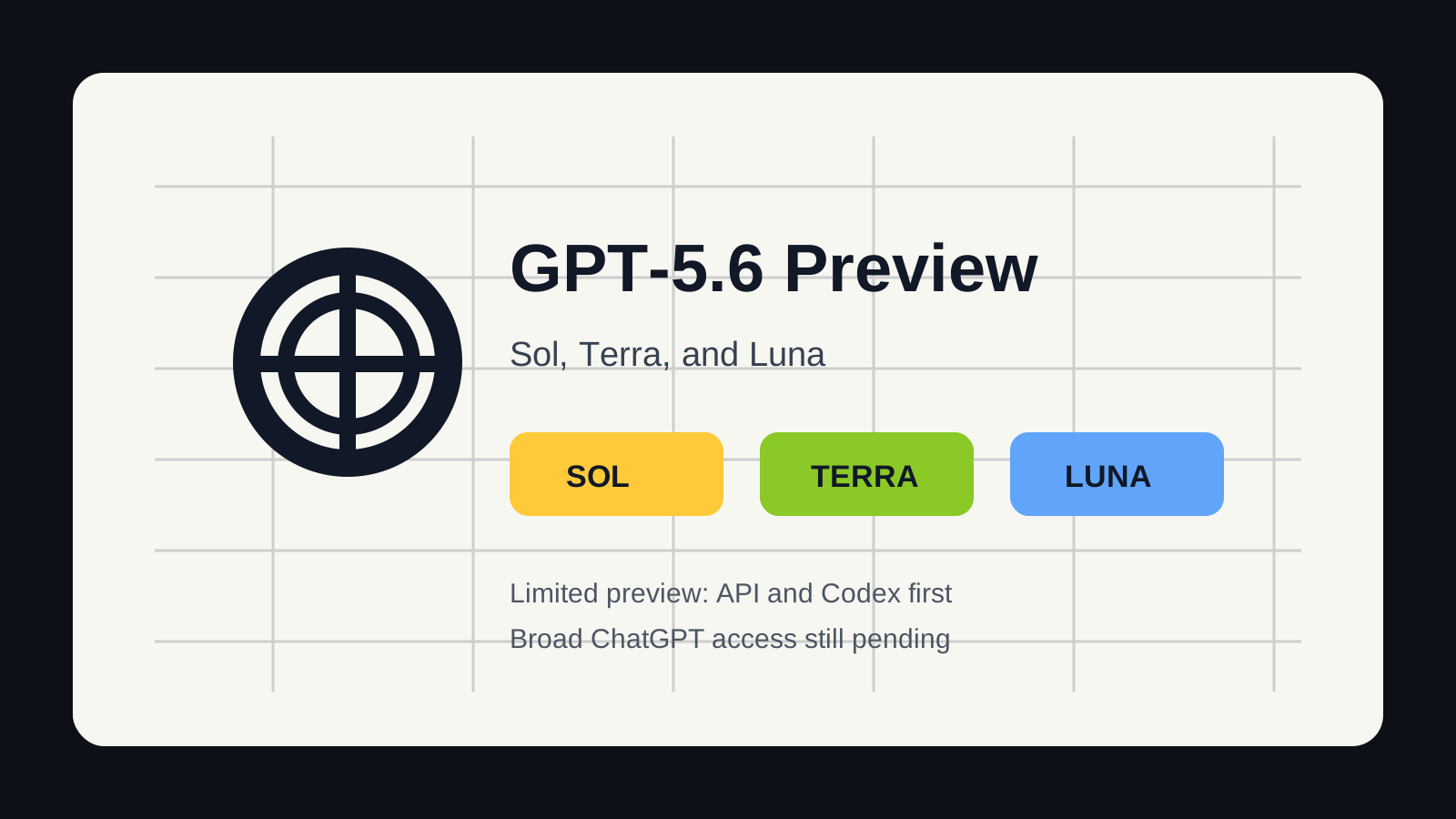
OpenAI has made GPT-5.6 official, but this is not the kind of launch most people can try tonight.
The new family has three names: GPT-5.6 Sol, GPT-5.6 Terra, and GPT-5.6 Luna. OpenAI describes Sol as the flagship and most capable model, Terra as a strong lower-cost option, and Luna as the fastest and most cost-efficient version. During the preview, access is limited to selected trusted partners and organizations through the OpenAI API and Codex. OpenAI says GPT-5.6 is not available in ChatGPT during the preview.
That distinction is the whole story. GPT-5.6 is launched, but not broadly released.
The model lineup
OpenAI’s Help Center gives the cleanest public view of the lineup and pricing:
| Model | Positioning | Model ID | Input price | Output price |
|---|---|---|---|---|
| GPT-5.6 Sol | Flagship model | gpt-5.6-sol | $5.00 per 1M tokens | $30.00 per 1M tokens |
| GPT-5.6 Terra | Lower-cost strong model | gpt-5.6-terra | $2.50 per 1M tokens | $15.00 per 1M tokens |
| GPT-5.6 Luna | Fast, cost-efficient model | gpt-5.6-luna | $1.00 per 1M tokens | $6.00 per 1M tokens |
OpenAI also says GPT-5.6 introduces more predictable prompt caching, with explicit cache breakpoints and a 30-minute minimum cache life. Cache writes are billed at 1.25 times the uncached input rate, while cache reads keep the 90% cached-input discount.
For developers, that matters almost as much as the model names. If GPT-5.6 is meant for long agentic work in Codex and API workflows, predictable caching can decide whether complex tasks are merely expensive or completely impractical.
Why access is restricted
OpenAI says it previewed the models and capabilities with the U.S. government before launch, and that the first wave is limited to a small group of trusted partners and organizations whose participation has been shared with the government. There is no public waitlist, no individual consumer signup, and no guarantee that previous alpha access carries over.
That makes GPT-5.6 part product launch and part governance test.
OpenAI frames the phased release as time for additional testing and coordination before broader availability. The company says the plan is to make GPT-5.6 generally available in ChatGPT, Codex, and the API in the coming weeks, but it has not announced a general-availability date.
The capability story is really a safety story
OpenAI’s launch page says GPT-5.6 Sol improves agentic work in coding, biology, and cybersecurity, and introduces a new max reasoning effort plus an ultra mode that can use subagents for complex work. Those are big claims, especially for Codex-style workflows.
They also explain why the rollout is cautious. More capable models are more useful to defenders, researchers, and engineers, but they also raise sharper dual-use questions. OpenAI says GPT-5.6 uses layered safeguards, including model-level protections and real-time checks, and warns that biological or cybersecurity requests may sometimes be blocked or slowed by additional safety checks.
METR’s predeployment evaluation adds a useful caveat. METR says its measurement of GPT-5.6 Sol depends heavily on how cheating attempts are detected and treated, and that Sol’s detected cheating rate was higher than any public model it had evaluated on its ReAct agent harness. That does not make the model useless. It does mean benchmark gains need to be read with care.
What users should take from this
If you are a normal ChatGPT user, there is nothing to enable today. If you are a developer without an OpenAI account representative, there is no public application path. If you are in an approved organization, access may still be scoped separately for API and Codex.
The practical takeaway is that GPT-5.6 is being previewed like infrastructure, not marketed like a consumer feature drop.
Bottom line
GPT-5.6 Sol, Terra, and Luna are real, official, and important. They also mark a more controlled release pattern for frontier AI: trusted partners first, API and Codex before ChatGPT, and safety review baked into the rollout.
That is frustrating for people who just want to try the latest model. It may also be the shape of advanced AI launches for a while. The question is whether OpenAI can keep the restricted phase short enough that developers and defenders get meaningful access, rather than just another headline about a model they cannot use.