
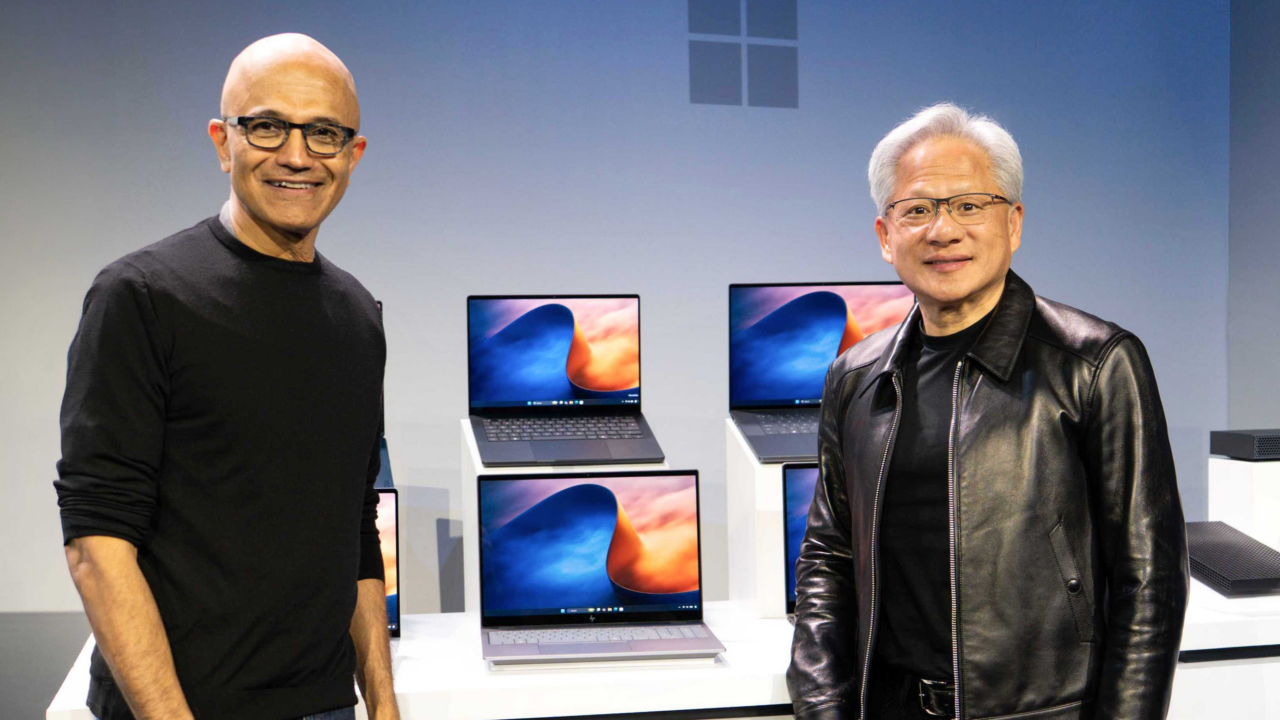
The first RTX Spark laptops are finally close enough to judge as products, not keynote architecture diagrams. Microsoft and NVIDIA say the new Windows systems can be preordered now and start shipping October 16; Axios reports the Surface Laptop Ultra starts at $2,599.
That is a steep opening price for a PC whose headline feature is “personal AI.” But it also makes the launch more interesting than the usual NPU parade. NVIDIA is putting a Blackwell RTX GPU and Grace CPU into thin Windows hardware with up to 128GB of unified memory. Microsoft is putting the other half of the proposition into Windows: a framework meant to contain, identify and manage software agents that can work in the background.
For GearPulse readers, the question is not whether a laptop can produce an eye-catching AI benchmark. It is whether the combination can make local AI practical without asking people to trust an overpowered assistant with a loose set of permissions.
The launch in useful terms
NVIDIA says RTX Spark combines up to a 20-core Grace CPU with a Blackwell RTX GPU containing up to 6,144 CUDA cores. The company quotes up to one petaflop of FP4 AI performance and up to 128GB of unified memory. Those are vendor specifications and peak-format figures, not a promise that every model or app will feel equally fast.
Microsoft’s October 7 announcement supplies the more consequential software context. Its Microsoft Execution Containers, or MXC, are now generally available, with the company describing policy-driven containment for agents. Windows ML has also added experimental llama.cpp support and an API path for developers building local model workflows.
| What is new | What the companies say | The practical reading |
|---|---|---|
| RTX Spark laptops | Preorders are open; systems begin shipping October 16 | This is the arrival of a new high-end Windows category, not a feature update for existing PCs. |
| Surface Laptop Ultra | Starts at $2,599, according to Axios | Local large-model work has a premium entry price before memory or compatibility questions are answered. |
| Unified memory | Up to 128GB | Bigger local models and longer contexts may fit, but usable capacity depends on the model, runtime and other work running at the same time. |
| Microsoft Execution Containers | Agent containment and management built into Windows | A meaningful safety building block, not a blanket guarantee that every agent or connector is safe. |
| Windows ML updates | Experimental llama.cpp support alongside PyTorch and Triton work | Developers get more routes to local inference; ordinary users still need applications that use them well. |
The distinction matters because “local” describes where inference can happen, not what an application may access. An agent that works with your files, mail or code still needs carefully scoped permissions. A container can improve the boundary; it cannot decide whether the task itself was sensible.
Why RTX Spark is a different bet from the familiar AI PC
Most AI PCs so far have asked a modest neural processor to speed up small features: background blur, transcription, image effects, perhaps a lightweight assistant. RTX Spark is a more ambitious claim. NVIDIA is pitching enough shared memory and GPU throughput to run substantially larger models locally, then carry the same CUDA-oriented toolchain into larger NVIDIA machines if a project grows.
That brings it closer to a compact workstation than a conventional laptop refresh. Microsoft says the platform can run local models and build local agentic systems; NVIDIA names open-model workflows rather than a single, locked-in assistant. That is potentially useful for developers, researchers, creative professionals and organizations that have a real reason to keep selected work close to the machine.
It also puts a spotlight on the value question. A $2,599 starting point needs to justify itself with more than occasional offline prompts. The persuasive use case is a recurring workflow—working with private material, prototyping with a local model, or creating media—where cloud usage, latency or data handling is an actual constraint.
That is the same discipline buyers need when sizing a dedicated local-AI system. Our recent look at NVIDIA’s 64GB DGX Spark found that memory capacity is not an abstract bragging right; it determines the models, contexts and concurrent tasks a machine can support. RTX Spark shifts that logic into a laptop, with all the thermals, battery life and application-compatibility questions that entails.
The Windows part is more important than the petaflop headline
An AI agent that merely answers a question is one thing. An agent that reads a repository, rearranges files, contacts services or keeps working while you are away is another. The latter needs an operating system that can say who the agent is, what it can reach and what happened when it acted.
Microsoft’s MXC approach deserves attention for that reason. The company says it gives agents a policy-controlled execution environment and pairs with identity, security and management tooling. That is directionally the right idea: agent safety cannot rest on a cheerful confirmation box alone.
But this is where launch language must meet real-world tests. We do not yet have broad, independent evidence showing how MXC behaves under poorly written agents, compromised plugins, unusual enterprise policies or everyday consumer software. Nor does containment remove the familiar risks of granting a tool access to a cloud account or letting it act on bad instructions. The safe default remains narrow access, clear logs and human review for consequential actions.
Tom’s Hardware also highlights the Windows-side agent updates in its launch coverage, while AP’s earlier report on the platform captured the broader bet: NVIDIA and Microsoft want a Windows computer that can run more capable AI workloads locally. Hardware makes that possible; operating-system controls decide whether it is responsible enough to normalize.
What to watch before buying
- Independent battery and thermal testing. Peak AI throughput is not a substitute for a laptop that remains quiet, cool and useful away from a wall socket.
- Windows on Arm compatibility. A powerful new architecture still has to coexist with the applications, drivers and tools people already rely on.
- Actual model tests. Watch for named models, quantization settings, context lengths and tokens-per-second results—not just parameter-count headlines.
- Agent controls in practice. The useful question is whether MXC makes permissions and logs understandable enough for a normal team to supervise.
- The rest of the market. NVIDIA says systems are coming from Acer, ASUS, Dell, HP, Lenovo, Microsoft, MSI and Gigabyte. Configurations, prices and regional availability will matter as much as the reference pitch.
Bottom line
RTX Spark gives Windows a credible path to local AI that is more capable than the typical “AI PC” label suggests. NVIDIA’s hardware could make a demanding local-model workflow feasible in a portable computer, while Microsoft’s agent-containment work acknowledges that a useful agent needs more guardrails than a chat window.
For now, this is a workstation-class proposition with a workstation-class price. The promise will be earned only if independent testing confirms the performance and if Windows makes local agents controllable enough to trust with real work. Until then, the smartest way to read RTX Spark is as an ambitious first test of what an AI-native Windows laptop should be—not proof that every buyer needs one.