
The most interesting part of NVIDIA’s new Omniverse showcase is not that an AI agent can make a robot simulation from a prompt. It is that NVIDIA is putting the agent inside a workflow with enough moving parts to expose bad assumptions.
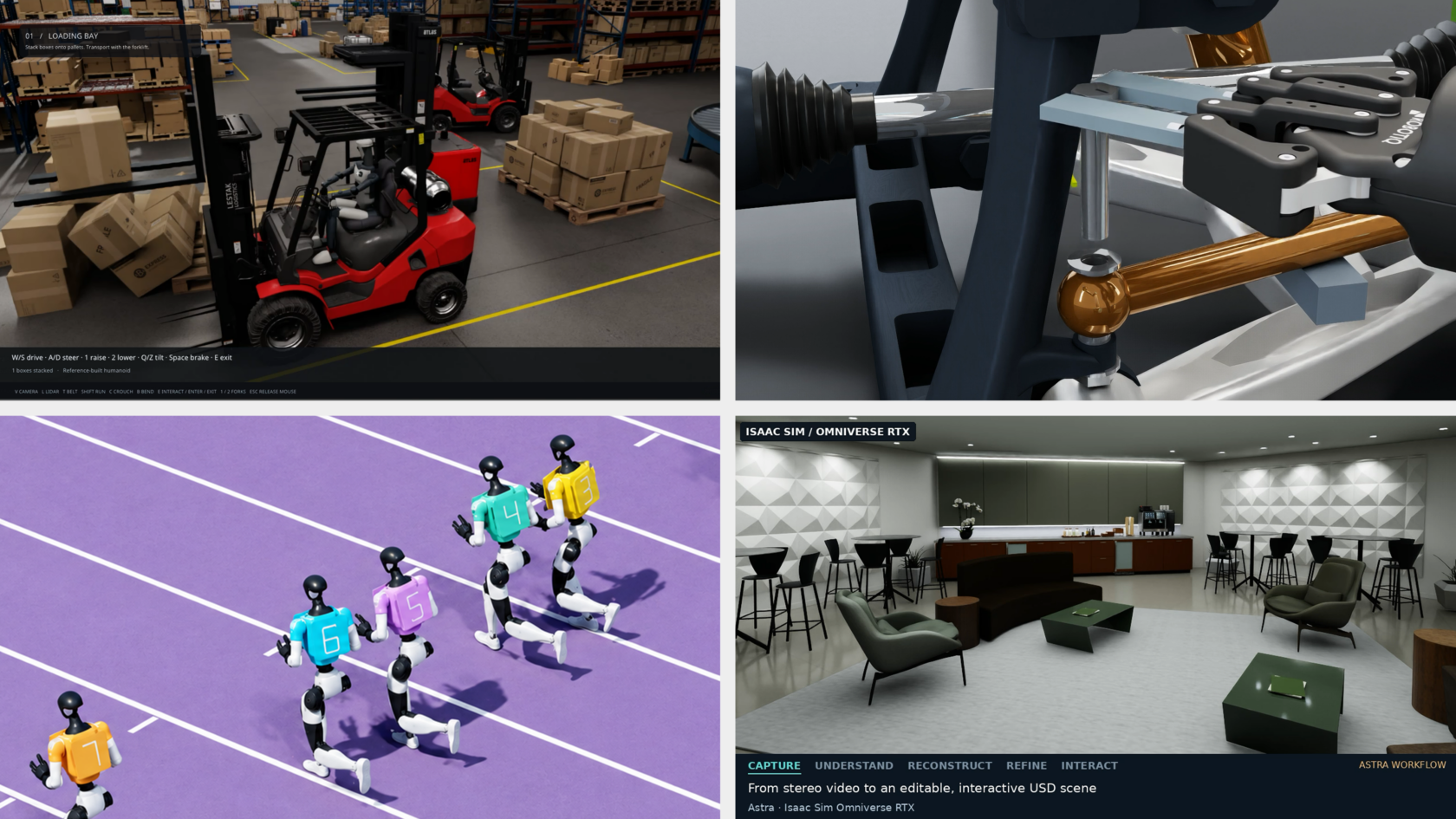
In a set of examples published October 8, NVIDIA shows developers directing frontier AI agents to assemble warehouse, autonomous-driving, digital-twin and browser-based simulation projects. The claimed output is not a finished robot or a certified vehicle. It is working software that joins scene assets, physics, sensor rendering and an interface—then gives the human a place to inspect and revise what happened.
That distinction makes this more than another generative-AI demo. For readers who care about cars, robotics and the increasingly software-defined things around them, simulation is where a clever idea meets gravity, occlusion, latency and a stubbornly misplaced pallet.
What NVIDIA is actually showing
The examples span a warehouse humanoid, a San Francisco autonomous-driving test environment, camera-and-LiDAR digital twins, robot disassembly and an interactive International Space Station model. NVIDIA says people guided the agents with natural-language instructions and reviewed the results as they connected its Omniverse libraries.
Those libraries are real building blocks rather than one monolithic simulator. NVIDIA’s public documentation describes ovphysx as the physics layer, ovrtx as physically accurate real-time sensor simulation and visualization, and ovstage as the shared OpenUSD scene-data layer. In other words: an agent can help assemble the workshop, but the workshop still has separate tools with separate failure modes.
| Example | What the agent was asked to help build | The useful human question |
|---|---|---|
| Warehouse humanoid | A physics-based environment with first- and third-person views | Do the task and controls still make sense when the scene has constraints? |
| Driving workflow | A reusable Market Street scenario with traffic, sensors and a driving model | Which scene, sensor or model change caused a different result? |
| Digital twins | Camera and raw-LiDAR comparisons against recorded data | Does the simulation match the measurements closely enough to trust the test? |
| Robot disassembly | A car-suspension scene, reachability check and tool concept | Can the robot actually reach and remove the part? |
The breadth is deliberate. NVIDIA is arguing that agents should be able to move between scene assembly, code generation and iterative validation. Independent coverage from The Meridiem and VFF reaches the same practical conclusion: this is a bid to make agents part of the simulation-development pipeline, especially for robotics and autonomous vehicles.
The important word is “test”
NVIDIA’s own examples contain the right corrective to the hype. The digital-twin workflow compares synthetic camera and LiDAR output with recorded data and uses the differences to revise geometry and materials. The driving example changes weather and lighting, then compares how the model responds. The humanoid example runs repeated physics trials rather than presenting one choreographed success.
That is where AI-assisted simulation earns its keep. A model can generate a scene quickly; it cannot make a scene faithful merely by sounding confident. Nor can it infer the right safety boundary from a prompt.
For autonomous systems, the useful loop is straightforward:
- Build or modify a scenario.
- Run the physics and sensors.
- Compare the output with a measurement, expectation or test criterion.
- Investigate the mismatch before promoting the result.
The agent can shorten steps one and perhaps two. It cannot be allowed to wave away steps three and four. That is especially true when a photorealistic camera image, a plausible trajectory or a fluent explanation can conceal a fundamentally wrong model of the world.
Why this matters beyond NVIDIA’s demo reel
Physical AI is becoming less mysterious and more infrastructural. We saw the same direction in GearPulse’s look at NVIDIA Isaac ROS 5.0: the valuable work is moving toward reusable tools, data paths and validation loops, not merely more charismatic robots.
If an automotive supplier can rapidly create a repeatable rain-and-glare scenario, or a warehouse team can test whether a manipulator has clearance before touching hardware, the practical gain is time spent on better questions. That is a far more credible promise than “type a prompt, deploy a robot.”
There is a strategic wrinkle. Omniverse’s components are increasingly public and modular, but the examples also make NVIDIA’s ecosystem more central: OpenUSD scenes, RTX sensor simulation, PhysX, streaming and NVIDIA compute form a tidy stack. Openness helps developers inspect and integrate pieces; it does not make the platform neutral.
What the examples do not prove
NVIDIA has shared showcases, not third-party validation that these workflows reduce engineering time or improve real-world safety. The company does not publish a common baseline, cost comparison or error rate for the featured agents. Some tasks also involved human direction over days, which is more honest—and more useful—than pretending the human was removed from the loop.
That caveat should shape how the work is read. A simulation can be beautifully rendered and still omit the nuisance that matters. A robot can succeed in 64 of 100 simulated trials and still be nowhere near ready for a factory. A driving stack can respond consistently to synthetic weather while remaining brittle on an unfamiliar road.
The audience relevance is not that everyone needs to install Omniverse. It is that the quality of these invisible test benches will determine whether the next wave of robots, driver assistance and smart industrial products behaves competently when the live environment refuses to cooperate.
Bottom line
NVIDIA’s October examples are persuasive because they make the AI agent a collaborator in a test bench, not the hero of a magic trick. The strongest version of this trend is not autonomous agents replacing simulation engineers. It is engineers getting faster ways to build scenarios, surface mismatches and spend their judgment where it matters.
That is a future worth watching closely: fewer immaculate demos, more systems that can explain how they were challenged before they are asked to touch the real world.
Support independent GearPulse articles at buymeacoffee.com/gearpulse.site.