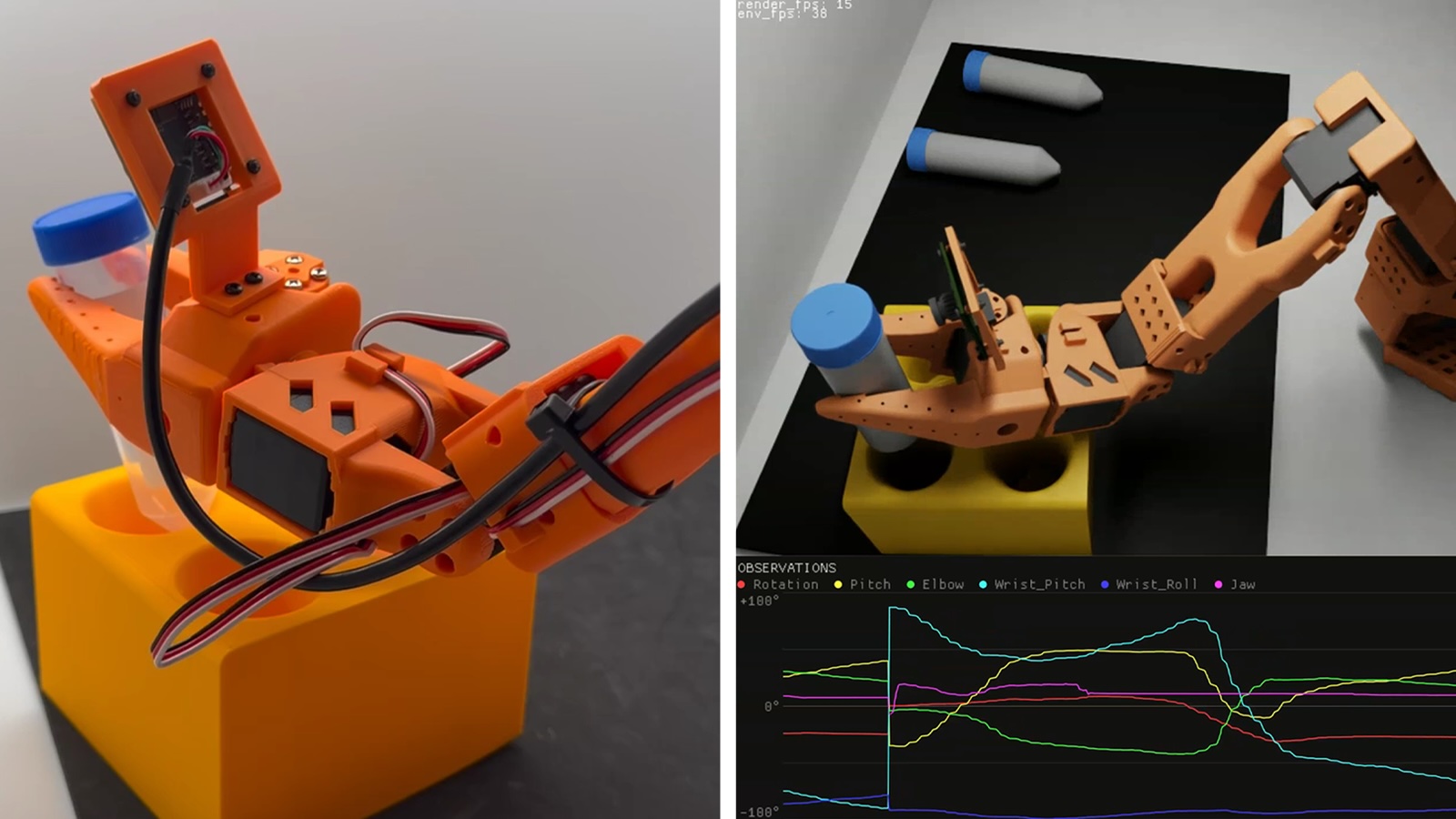
Robotics has spent years sounding like the next big AI frontier and feeling like a maze of custom hardware, simulation plumbing and expensive lab work.
NVIDIA and Hugging Face are trying to make that maze look more like a software stack. NVIDIA says its Isaac and GR00T technologies are being integrated into Hugging Face’s LeRobot framework, with GR00T N models and Isaac Lab-Arena available through LeRobot for fine-tuning and evaluation. Hugging Face’s LeRobot project, meanwhile, describes itself as a PyTorch-based library for real-world robotics with datasets, pretrained models, simulated environments and control interfaces.
GearPulse’s view: this matters because robotics needs boring developer habits before it can have explosive consumer adoption. Shared datasets, repeatable benchmarks, robot interfaces and downloadable models are less glamorous than humanoid demo videos, but they are what turn a research trick into something builders can actually reuse.
What changed
The headline is not just that NVIDIA and Hugging Face are working together. They announced that NVIDIA’s open robotics pieces are moving into an ecosystem that already has a community, a repository, model collections and a developer workflow.
| Piece | Public role | Why it matters |
|---|---|---|
| LeRobot | Hugging Face robotics library and community | Gives developers a shared place for datasets, policies and tools. |
| GR00T N models | NVIDIA open VLA models for humanoid-style robotics work | Adds a serious physical-AI model family to an existing framework. |
| Isaac Lab-Arena | NVIDIA simulation/evaluation framework | Helps move evaluation away from one-off demos. |
| Reachy 2 and Reachy Mini references | Hugging Face open robots tied into NVIDIA hardware paths | Makes the stack feel less abstract than a model-card announcement. |
| Jetson Thor and DGX Spark support | NVIDIA compute targets | Points to local or edge robotics work, not only cloud demos. |
That combination is why this story travels beyond robotics insiders. Open AI models became useful when they were easy to find, run, fine-tune, compare and remix. Robotics is harder because the world is physical, sensors are messy and hardware varies wildly. But the direction is familiar: standardize enough of the workflow that more people can build on the same base.
The real promise is less fragmentation
The LeRobot GitHub repository says the project aims to provide models, datasets and tools for real-world robotics in PyTorch. It also describes a hardware-agnostic Python interface, a standardized dataset format and support for robots ranging from low-cost arms to humanoids.
That is the useful part. Robotics development often fragments across different arms, cameras, simulation tools, training pipelines and custom data formats. A small team can spend more time making its setup repeatable than testing the actual behavior it wants.
NVIDIA’s pitch fits into that pain. Isaac Lab-Arena is meant to help evaluate robot policies in simulation, while GR00T N models give developers a more capable starting point for vision-language-action work. If those pieces are easier to reach through LeRobot, the workflow becomes less proprietary and less isolated.
GearPulse’s opinion: the practical win is not that every hobbyist suddenly gets a warehouse robot. It is that the path from idea to robot experiment gets shorter. That is how software ecosystems grow.
The caveats are physical
Robotics is not text generation with wheels.
Models can look good in simulation and fail in the real world. A robot arm can be supported in software and still be painful to calibrate. Dataset quality can vary. Safety cannot be treated like a leaderboard afterthought. And the most impressive demo hardware may be far outside the budget of a student, hobbyist or small company.
| Software-style promise | Robotics reality check |
|---|---|
| Download a model | You still need compatible hardware, sensors and calibration. |
| Train on shared datasets | Data may not match your robot, lighting, gripper or task. |
| Evaluate in simulation | Sim-to-real gaps remain stubborn. |
| Use a common interface | Motors, cameras and controllers still behave differently. |
| Build on open tools | Licenses, support and safety responsibilities still matter. |
That is why the right reaction is measured interest, not hype. Open robotics needs shared tools, but shared tools do not remove the physics.
Why builders should care
The robotics field is getting the same kind of ecosystem pressure that reshaped AI development. Researchers want common benchmarks. Developers want reusable model checkpoints. Hardware teams want software that does not have to be rebuilt from scratch for every robot. Investors and companies want faster iteration.
LeRobot sits at the intersection of those needs. It is visible on Hugging Face, active on GitHub, and organized around the kind of artifacts builders understand: install commands, datasets, model families and hardware guides.
NVIDIA brings another kind of gravity: compute, simulation, robotics tooling and an enormous developer network. Its CES 2026 announcement claims 2 million robotics developers in NVIDIA’s ecosystem and 13 million AI builders in Hugging Face’s broader community. Those numbers should be read as ecosystem scale, not proof of active LeRobot production use. Still, they explain why this collaboration has weight.
The relevance for GearPulse readers is simple: physical AI is moving from keynote language into developer infrastructure. That does not mean consumer robots are around the corner. It means the layer underneath future robots is becoming easier to inspect.
What to watch next
The next signal is not another humanoid walking across a stage. It is whether developers outside NVIDIA and Hugging Face can reproduce useful robot behavior with the stack.
Watch for three things:
| Signal | What it would show |
|---|---|
| More third-party robot support | LeRobot is becoming a real hardware abstraction, not a narrow demo path. |
| Independent benchmarks | The community can compare policies without trusting vendor claims. |
| Affordable working examples | The tools are reaching builders who do not have enterprise lab budgets. |
The best version of this ecosystem is not flashy. It is a robotics workflow where a small team can collect data, fine-tune a policy, evaluate it, run it on a supported robot and share the result in a way other people can inspect.
Bottom line
NVIDIA and Hugging Face are making open robotics feel more practical by connecting serious physical-AI models, simulation tools and robot interfaces to a community platform people already use.
The caveat is that robots remain hard. Hardware, safety, data quality and real-world reliability will decide whether this becomes infrastructure or just another impressive AI stack diagram.
GearPulse’s read: this is relevant because robotics is finally starting to acquire the developer plumbing that modern AI needed before it became widely usable. The robots are still the hard part. The tooling around them is getting more real.