
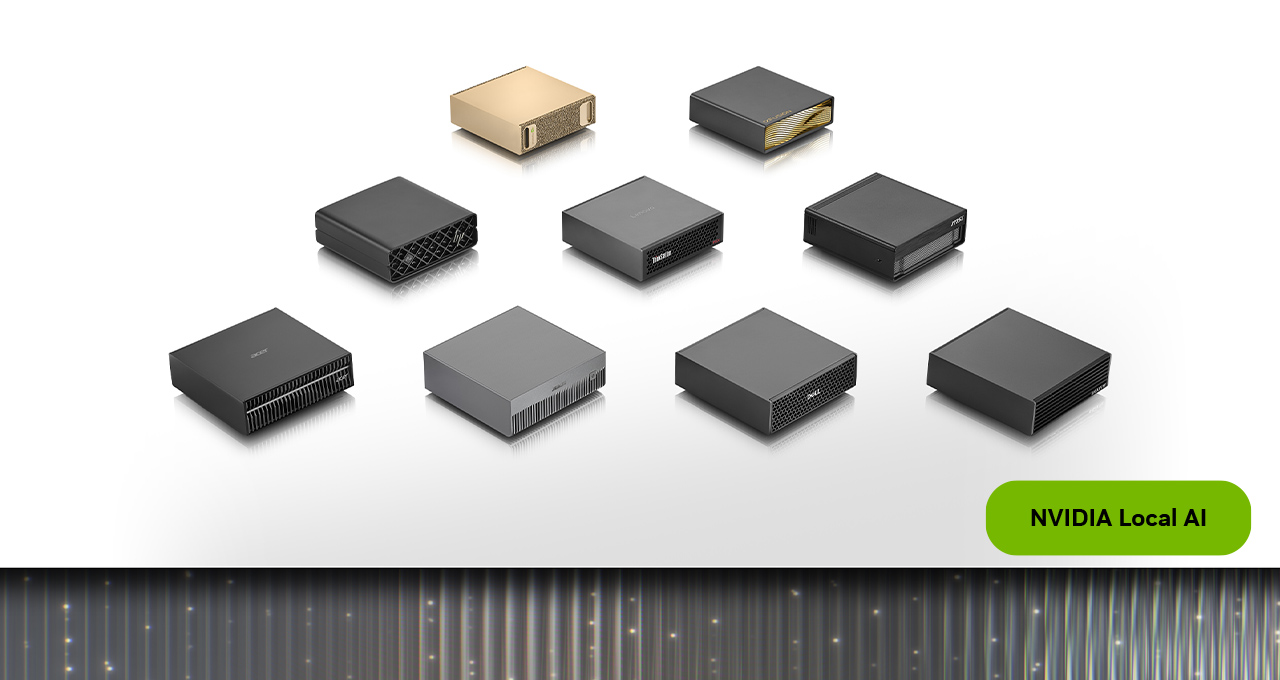
NVIDIA’s DGX Spark has always been a conspicuous answer to a specific question: how do you run unusually large AI models near your own data without building a rack? The new 64GB version makes that answer cheaper, but it also makes the compromises much easier to see.
Partner systems from Acer, ASUS, Dell, Gigabyte, HP and MSI are due to start at $4,999 on October 23. They retain the GB10 Grace Blackwell chip, NVIDIA’s DGX OS and ConnectX-7 networking, but halve the original configuration’s 128GB of unified memory. NVIDIA says a single 64GB system supports models up to 100 billion parameters; that figure is a ceiling, not a promise that every 100B model, context length and runtime will be pleasant to use.
That distinction is the entire story. For local AI, memory is not an ornament on a spec sheet. It decides which model formats fit, how much context can stay live, whether a second agent can run alongside the first, and how much room remains for the operating system and the work itself.
What buyers are actually getting
| Question | 64GB DGX Spark | Why it matters |
|---|---|---|
| Starting price | $4,999, according to NVIDIA | It creates a lower entry point, but it is still specialised workstation money. |
| Availability | October 23 from six named hardware partners | The price is a starting point, not a promise for every SSD, chassis or regional configuration. |
| Core platform | GB10 Grace Blackwell, DGX OS, CUDA software stack and ConnectX-7 | This is the same basic local-AI platform, not a stripped-down consumer GPU box. |
| Unified memory | 64GB in one system; 128GB when two are clustered | Memory determines viable models more directly than marketing parameter counts. |
| Two-system claim | Up to 1.7× performance in NVIDIA’s Qwen 3.8 27B test | It is a vendor result for one model and setup, not a universal doubling of speed. |
NVIDIA’s specification material establishes the architecture; its new announcement adds the 64GB configuration, partner list, price and launch date. Tom’s Hardware and Hardware Busters independently report the same practical shift: a lower-memory SKU at $4,999, arriving as 128GB systems become materially more expensive.
The value proposition gets narrower—and more honest
The 64GB version is not a miniature data centre. It is an expensive desktop aimed at developers, researchers and technically confident creators who have a real reason to keep inference close: private documents, intermittent connectivity, a persistent local agent or the desire to avoid metered cloud capacity for every experiment.
For that audience, 64GB can be the useful middle ground. A compact, quantized model can leave enough headroom for a sensible context window and supporting tools. NVIDIA also points to runtimes including Ollama, vLLM, PyTorch and LM Studio, which means the system is designed to join workflows people already use rather than impose a single NVIDIA-only interface.
But it changes how carefully a buyer must plan. A model’s parameter count does not state its full memory footprint. Quantization level, context length, the runtime’s cache, concurrent requests and even the prompt can move a workload from comfortable to constrained. “Up to 100B parameters” is therefore less valuable than a tested answer to a more mundane question: which exact model, at which precision and context size, will serve my actual job reliably?
The same caution applies to the tempting two-box answer. NVIDIA says two 64GB units can connect directly, pool to 128GB and deliver up to 1.7 times the performance in its Qwen test. That could be useful for a team that expects to grow, yet two $4,999 starting-price systems are not a bargain substitute for a single machine unless the software, network setup, workloads and support model all line up. Cluster capability is flexibility; it is not free simplicity.
Local remains a workflow decision, not a privacy spell
There is a genuine appeal to a machine that can keep source code, documents or media on premises while it runs a model. It can reduce uploads and reduce dependence on a cloud service’s availability or pricing. It does not make an output accurate, clear rights around the input, or replace the security work of patching the machine and controlling who can access it.
That is why the most interesting buyer is not someone chasing the largest number in an AI benchmark. It is the developer who already knows a local model suits a recurring task, or the studio with material it prefers not to send out for every iteration. We reached a similar conclusion when ASUS put RTX Spark into creator machines: large shared memory is enabling hardware, but application support and sustained real-world results decide whether it earns desk space.
The new Spark also invites comparison with conventional workstations, which can offer different balances of GPU speed, upgradeability and application compatibility. NVIDIA’s ecosystem—its software stack, direct networking and preconfigured operating environment—is part of what its price buys. Buyers should price the whole workflow, including storage, model licences if relevant, power, support and the time to maintain it, rather than reduce the choice to RAM alone.
Bottom line
NVIDIA’s 64GB DGX Spark is a more approachable way into its local-AI platform, not a general-purpose bargain. Its $4,999 starting price and October 23 arrival make the category less exclusive, while its halved memory makes workload discipline non-negotiable.
For a well-defined local model workflow, that can be a fair trade. For anyone shopping on the strength of a parameter-count headline, wait for independent tests and choose the model before choosing the machine. In local AI, the workload is the specification that matters most.