
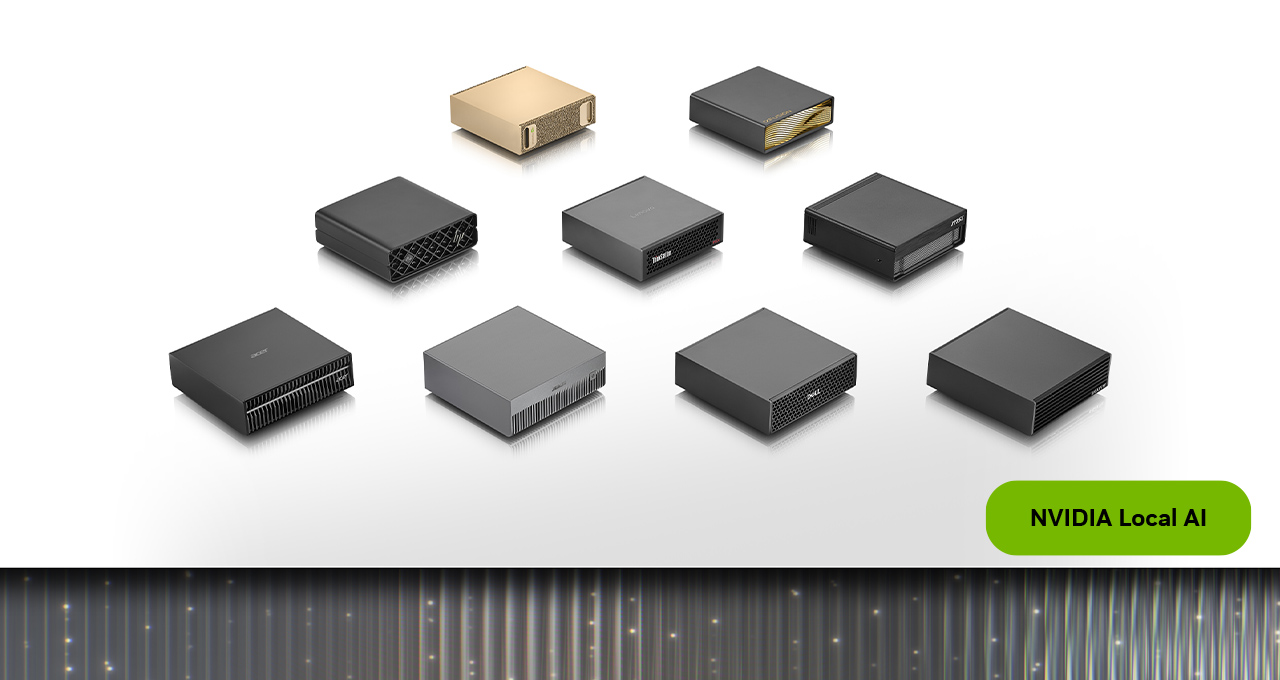
NVIDIA has found a way to make its compact DGX Spark line look more attainable without making it uncomplicated. The new 64GB version starts at $4,999 from Acer, ASUS, Dell, Gigabyte, HP and MSI on October 23. It keeps the GB10 Grace Blackwell superchip, 200GbE ConnectX-7 networking and the DGX software stack. What it gives up is the thing that made the original Spark unusually interesting: half of its 128GB unified-memory pool.
That does not make the new machine a bad local-AI computer. It makes it a machine that needs a sharper job description.
NVIDIA says the 64GB configuration can support models with up to 100 billion parameters, and MSI is positioning its EdgeXpert derivative for on-premises agents and edge deployments. Those claims describe a ceiling under favorable settings, not a promise that every 100B model will be useful with a long context, several users, or a busy tool-using agent. The Register and Tom’s Hardware both flag the same market reality: this is a lower-capacity option arriving during a period of much higher memory pricing, rather than a straightforward value reset.
The spec that matters is the shared pool
DGX Spark uses unified LPDDR5x memory: the CPU, GPU, operating system, model weights, context cache, and any local tools draw from the same 64GB. NVIDIA’s documentation lists 273GB/s of memory bandwidth for the platform; that bandwidth is retained here, but capacity is not.
| What stays the same | What changes |
|---|---|
| GB10 Grace Blackwell superchip | 64GB unified memory rather than 128GB |
| Up to 1 petaFLOP FP4 AI performance, an NVIDIA peak specification | Less room for model weights, KV cache, OS and concurrent work |
| ConnectX-7 networking and DGX OS | Partner-only configuration, starting at $4,999 |
| 273GB/s memory bandwidth | Different practical limits for long documents and multi-agent workloads |
The distinction is easy to miss because model parameter counts make for tidy headlines. A model that loads after aggressive quantization can still leave too little headroom for a useful context window or for another request. An agent that reads source code, searches files and retains a large working history can consume memory in places a model-size label does not describe.
For a single well-chosen local model, 64GB can be ample. NVIDIA specifically points to the current crop of capable open models and to always-on coding, research and document workflows. For someone who already knows the model, precision, context length and concurrency they need, that is a far more persuasive proposition than buying on a maximum-parameter claim.
The price is lower only compared with today’s expensive alternative
The $4,999 entry price needs context. NVIDIA says this is the starting price for manufacturer partners, so final specifications and retail availability can vary. The Register reports that the 128GB DGX Spark price moved to $6,950 at the same time. Against that current figure, the 64GB SKU creates a sizeable entry gap. Against the original 128GB Spark launch price of $3,999, it is a reminder that the market has moved in the wrong direction for buyers hoping memory would get cheap quickly.
That is why calling the 64GB machine “budget” would be misleading. It is a $5,000 desktop AI system whose virtue is focus. The sensible buyer is not trying to run every large model locally; they are avoiding recurring cloud use for a defined private workload, or putting a known agent stack near sensitive files, a factory process or a small development team.
Two boxes are capacity, not a loophole
NVIDIA’s cleanest answer to the 64GB limit is clustering. Two systems can connect over 200GbE through NVIDIA Sync Cluster Assistant, providing 128GB of pooled memory for workflows that support distributed execution. NVIDIA presents that as a way to scale a project without changing its software environment.
It is useful, but it is not a magic upgrade path. Two $4,999 starting-price systems cost at least $9,998 before accessories and do not turn every application into a single, frictionless 128GB machine. The workload needs software support for multi-node inference or training, and the resulting behavior depends on the model, runtime, networking and task shape.
That caveat matters because local AI hardware is increasingly sold as an escape from metered usage. The economics are real only when the workload is stable enough to justify the up-front cost—and when the owner is prepared to operate it. A local agent can keep sensitive material off an external service, but it also leaves updates, access controls, model selection and uptime with the owner.
Who should look twice
The 64GB Spark is most credible for builders who can name their workload before they buy: a local coding assistant with bounded repositories, a private document-analysis flow, a fixed vision task, or a single agent with a tested model and context budget. It is also relevant to teams that want an inference box beside their existing PCs rather than a cloud bill that rises with every iteration.
It is less convincing for exploratory work where the point is repeatedly swapping models, extending contexts, fine-tuning large systems or supporting several people at once. In those cases, memory headroom is not idle luxury; it is what keeps an experiment from becoming a sequence of compromises.
That is a different question from the one raised by NVIDIA PAIR, which routes independent tasks across compatible computers. PAIR can help distribute separate jobs around a network. It does not make a 64GB Spark hold a model, context and workload that need more than 64GB on one node.
Bottom line
NVIDIA’s 64GB DGX Spark is a rational response to a messy memory market, but buyers should judge it as a targeted local-inference appliance, not as a discounted 128GB machine. Its chip, software and networking remain serious; its memory ceiling is the point of the product.
GearPulse’s view: start with the model and the working set, not the petaFLOP badge. If your real task stays inside 64GB with enough context and concurrency to be useful, the new Spark can make local AI feel deliberate rather than extravagant. If it does not, adding a second box is an infrastructure decision—not a clever way to pretend capacity is free.