
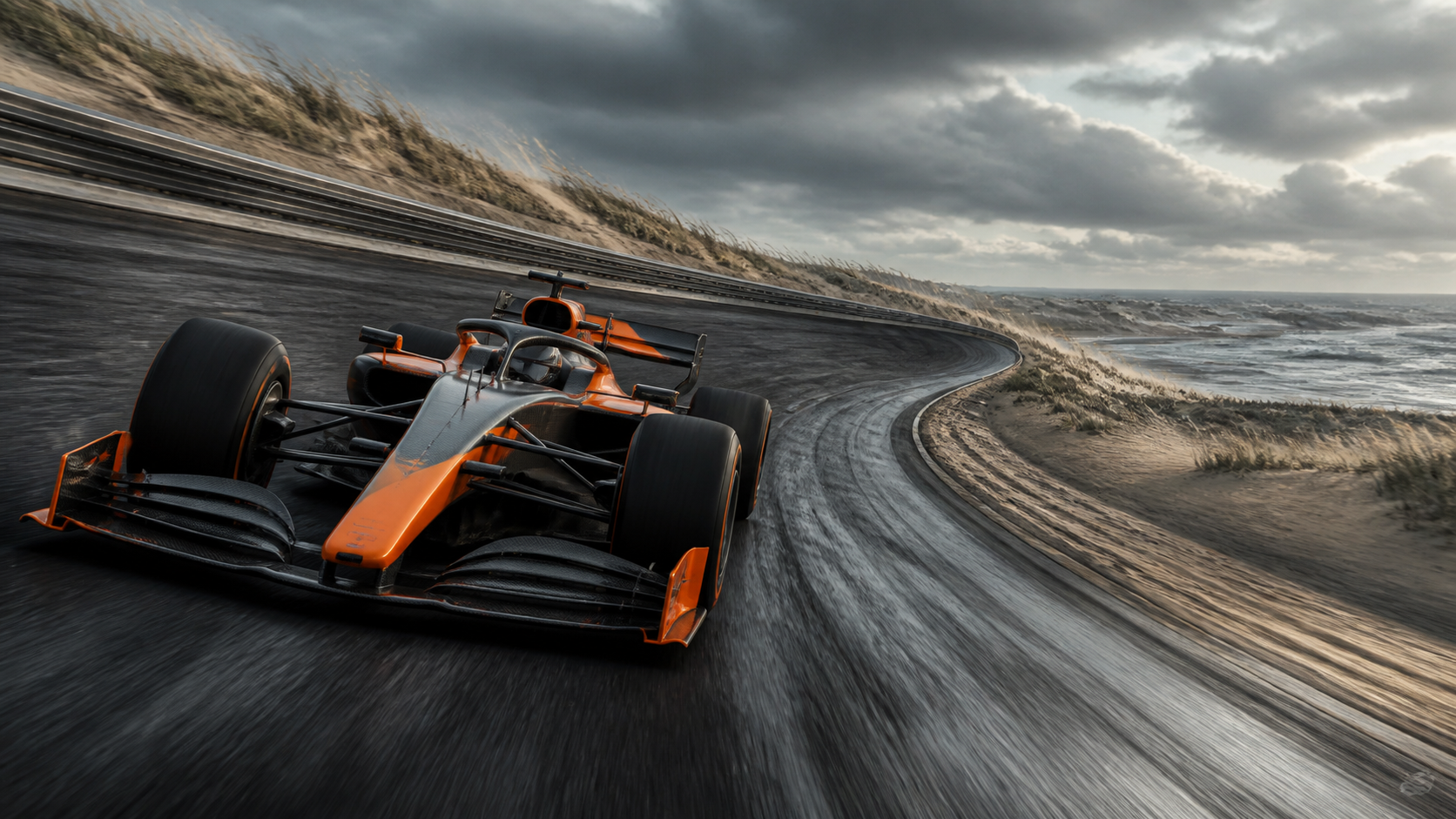
Spoiler note: this article discusses Saturday’s Dutch Grand Prix Sprint and Qualifying.
The telling line from Lando Norris after taking pole at Zandvoort was not the celebration. It was the admission that McLaren had to change something because its earlier configuration was not going to be enough.
That makes Saturday more interesting than a neat pole-position story. Norris put in a 1:11.163 to beat George Russell by 0.102 seconds, with Kimi Antonelli only another 0.031s back and Oscar Piastri a further 0.009s behind. Yet a few hours earlier Norris had finished third in the Sprint, passed by Charles Leclerc’s Ferrari and unconvinced by the McLaren’s pace. A minor change transformed the driver’s confidence for one lap; it did not automatically settle the more consequential 72-lap argument.
That distinction matters at a circuit where position is precious. McLaren has bought itself the best place to start. It has not bought itself a quiet Sunday.
A tiny change can be a large permission slip
Norris was refreshingly specific about the scale of the intervention: the team made small changes, not a magic tenth or two of raw performance. What they gave him was a car he could attack with through Zandvoort’s high-commitment sequence of bends.
That is a familiar F1 truth, but one worth dwelling on. At a circuit with banking, rapid direction changes and little room to tidy up an error, the stopwatch does not separate mechanical balance from driver confidence. A front axle that bites earlier, a rear that holds a fraction more reliably, or a platform that gives a driver a clearer reference can unlock commitment before the visible apex. The gain may look like a single lap-time number; its origin is often a car that has stopped asking the driver to negotiate with it.
Norris’s pole gives a useful counterpart to GearPulse’s recent look at McLaren’s architecture compromises. The MCL40 may still carry longer-term limitations in floor area, gearing and straight-line efficiency, but a weekend is not decided only by the parts that cannot be changed. Setup remains the bridge between an imperfect concept and a fast lap.
The Sprint was the caveat, not an inconvenience
The caution comes from what happened before qualifying. Russell controlled the 24-lap Sprint from pole. Leclerc, the only leading driver to start on soft tyres, took second from Norris late on, while Antonelli finished close enough behind the McLaren to make third look insecure rather than comfortable.
Norris’s own verdict was blunt: McLaren had not been quick enough. Piastri was similarly guarded after coming home fifth, saying the Sprint had not been strong for race pace. It would be too easy to dismiss that as a one-off tyre choice, because Leclerc’s softs did give Ferrari a different opening. But the underlying observation is stronger: in clean air, Russell could build control; in traffic, McLaren did not display the margin that pole position might imply.
There is also no contradiction here. Qualifying and race pace ask different questions of a car. A low-fuel lap rewards peak grip, rotation and a driver’s ability to lean on a fresh soft tyre. A Grand Prix asks for those things repeatedly while fuel burns off, tyres age, wind shifts and dirty air rewrites the balance. The small change that let Norris attack qualifying may still prove valuable on Sunday, but it should be judged across stints, not by one gloriously committed lap.
Why the front row is worth more at Zandvoort
Zandvoort is only 4.259km long, but it does not behave like an easy, short circuit. The narrow, fast layout and its limited overtaking opportunities turn a clean opening stint into a strategic asset. McLaren’s own circuit guide highlights the short pit lane, which encourages teams to consider multiple stops; that does not make passing simple, but it can create choices when a faster car is trapped in a slower one’s wake.
For Norris, pole changes the calculation in three useful ways:
- He can choose the first corner rather than react to it.
- Mercedes must spend more of its energy attacking a McLaren than controlling its own ideal race.
- McLaren can use Piastri, starting fourth, as a genuine strategic factor rather than merely a recovery story.
None of that is a prediction of team orders or a promise that McLaren has the best race car. It is the value of track position on a circuit that penalises hesitation. Russell’s Sprint win is the counterweight: Mercedes already showed it can convert a front-row starting spot into control. Norris will need to prevent the same pattern from forming behind him.
Ferrari is the awkward evidence
Leclerc’s Sprint second was not enough to declare Ferrari the Sunday favourite, especially given the soft-tyre choice and a qualifying result that left the two red cars fifth and sixth. It was, however, an important piece of evidence. Ferrari found a way to move forward when McLaren expected to be defending its own pace.
That makes the first stint a three-team problem. Russell begins alongside Norris, Antonelli lines up third, Piastri fourth, and Lewis Hamilton and Leclerc sit directly behind them. The front four were covered by 0.142s in qualifying. With that kind of spread, a tiny delay at the start, an undercut window, or a tyre phase that lasts a lap too long can alter the race’s rhythm.
The weather deserves a caveat as well. Rain threatened the end of qualifying without changing the order. A damp or changeable Sunday would amplify the value of a settled car and clear visibility; it would not erase the performance clues from Saturday, but it would make the small setup changes more important still.
Bottom line
Norris’s pole is a deserved answer to a bad Sprint feeling: McLaren and its driver diagnosed a problem, adjusted, and found enough confidence to beat two Mercedes by fractions.
But the sharper reading is not that McLaren suddenly owns Zandvoort. It is that the team has proved it can make its car easier to attack exactly when a weekend starts to slip away. Sunday will reveal whether that recovery is a qualifying weapon or the opening move in a race that McLaren can actually control.