
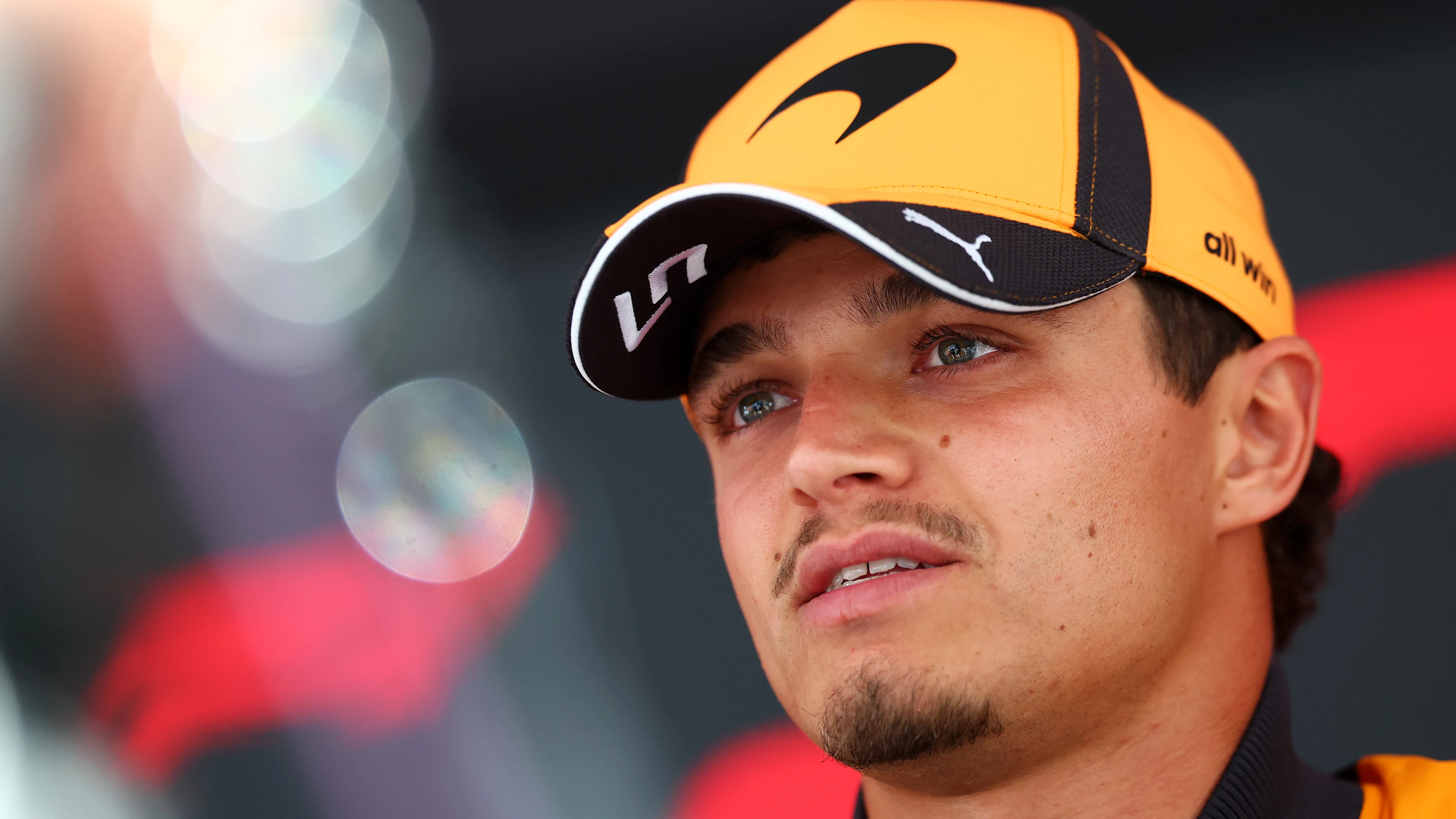
Lando Norris’s Belgian Grand Prix is already compromised, and McLaren is right to do it anyway.
That is the tension behind today’s Daily Dose of F1. McLaren confirmed on July 16 that Norris’s car will take a fourth power electronics unit at Spa-Francorchamps, exceeding the permitted allocation and triggering a 10-place grid penalty. Formula 1 published the penalty news in the morning, then followed with Norris’s own media-day explanation from Spa. Sky Sports F1, Motorsport.com, RACER and The Race all picked up the same core point: McLaren is paying a sporting price now so it can move the reigning champion onto Mercedes’ updated reliability specification.
On paper, it looks like another blow to a title defence that has never quite settled. Norris is fifth in the official drivers’ standings on 97 points, 82 behind Mercedes leader Kimi Antonelli, while team mate Oscar Piastri sits sixth on 82. In context, it is more interesting than a routine engine-penalty story. McLaren has chosen the venue, the timing and the damage profile.
GearPulse’s view: this is not McLaren giving up on Spa. It is McLaren admitting that the cost of another power electronics failure later in the season is probably higher than the cost of starting 10 places lower at the longest, most recoverable track on the calendar.
Why this story rose today
The story has the right mix for a Daily Dose piece: primary confirmation, official series context, broad same-day pickup and a real competitive consequence.
McLaren’s statement lays out the chain clearly. Norris lost his first power electronics unit to a terminal China problem that stopped him starting the race. His second unit, introduced in Japan, needed remedial work after practice issues and later suffered a terminal Monaco problem. The third unit has been reliable since Miami, but Mercedes-AMG High Performance Powertrains has introduced fixes to the newer system.
That leaves McLaren with a choice. Stay on the known unit and protect Spa track position, or take the updated part now and accept the penalty. The team chose Spa over Hungary and Zandvoort because overtaking is more realistic in Belgium.
The trend signal is obvious. Formula 1 ran two articles on it in one day, McLaren put out the primary explanation, and the same details were repeated across Sky, Motorsport.com, RACER and The Race. It also intersects with several bigger 2026 themes GearPulse has been tracking: customer power-unit complexity, Mercedes reliability, McLaren’s stalled recovery and the way the new rules make electrical hardware a championship variable rather than background plumbing.
Spa is the least bad place to pay
The obvious question is why McLaren would sacrifice a Belgian Grand Prix where Spa’s long straights might actually suit recovery racing.
The answer is exactly that: Spa gives Norris more paths back than the next two venues.
Formula 1’s official race hub lists Spa-Francorchamps at 7.004 km, with 44 laps and a 308.054 km race distance. It is the longest circuit on the current calendar, with long full-throttle sections, heavy braking into Les Combes and the Bus Stop, and weather that can split the track into different grip states. A penalty is still painful, but starting 10 places lower here is not the same as doing it at the Hungaroring or Zandvoort, where track position tends to harden quickly.
| Venue choice | Why McLaren chose Spa |
|---|---|
| Spa-Francorchamps | Long lap, slipstream potential, multiple recovery phases and higher overtaking probability. |
| Hungaroring | Shorter lap rhythm, more traffic sensitivity and fewer clean passing zones. |
| Zandvoort | Narrower, more position-led, with dirty air and qualifying position usually carrying extra weight. |
There is also a calendar logic. If McLaren genuinely believes this fourth unit can run for the rest of the year, the team is not only buying one race of reliability. It is buying the chance to stop managing every Friday, every deployment map and every cooling decision around a fragile allocation.
That is why the call feels rational even though it looks ugly on the grid sheet.
Norris’s title defence now has a reliability shape
The harsh part for Norris is that the penalty does not land in a vacuum.
He arrived in 2026 with the No. 1 on the car and the awkward weight of being the reigning champion in a McLaren that has not controlled the season. Mercedes has made the pace, Ferrari has rebuilt momentum, and Red Bull has become a threat again on some weekends. Norris has produced enough flashes to remain relevant, but the official standings show the real gap: Antonelli 179, George Russell 154, Lewis Hamilton 147, Charles Leclerc 108, Norris 97.
An 82-point deficit after nine rounds is not mathematically fatal. It is strategically severe.
That changes the likelihood framing for Belgium. A clean podium from a penalized grid slot would be a very strong outcome. A points finish with minimal damage would be acceptable if the car is fourth quickest. A non-score would make the title defence feel almost entirely dependent on chaos, upgrades and Mercedes/Ferrari missteps.
This is editorial analysis, not betting advice, but the probability shape is simple:
| Belgian GP outcome for Norris | GearPulse read |
|---|---|
| Podium | A statement recovery and evidence McLaren’s race pace is better than its recent narrative. |
| P5-P8 | Sensible damage limitation if the upgraded electronics are trouble-free. |
| Lower points or no score | The title defence moves from difficult to highly unlikely without a major McLaren step. |
The useful comparison is Piastri. RACER and The Race both noted that Piastri can move to the new Mercedes specification without the same penalty exposure because his earlier allocation was not damaged in the same way. That makes Belgium a clean intra-team read: if Piastri runs the updated package from a normal grid position and Norris spends Sunday recovering, McLaren will get a sharp picture of how much Norris’s season has been distorted by reliability rather than driver level.
The Mercedes customer question gets more practical
GearPulse covered McLaren’s wider customer-engine problem on July 8, but this is a narrower and more concrete version of the same 2026 headache.
The old customer-power-unit debate was usually about whether teams had equal hardware. This episode is about whether equal hardware arrives at the same sporting cost. Mercedes introduced reliability fixes on its new power electronics, but the path onto those fixes is not equal for every driver. Norris’s failed and withdrawn units force a penalty; Piastri’s allocation gives McLaren more room; the works Mercedes drivers already sit in the championship lead.
That does not mean Mercedes has done anything improper. The available reporting points to reliability fixes, normal allocation rules and McLaren’s own unlucky component history. But it does show how sensitive the 2026 rules are. Electrical hardware, control electronics, deployment confidence and calendar choice now shape a title campaign in ways fans cannot see from lap time alone.
McLaren’s rear-wing note adds a useful caveat. Norris said in Formula 1’s media-day piece that the Spa rear wing is a small step, not a magic correction, with larger development hopes pointed toward Budapest and Zandvoort. So Belgium should not be judged only by where he finishes. It should be judged by whether the upgraded electronics run cleanly, whether the MCL40 can race through traffic without burning its tyres, and whether McLaren looks less fragile by Sunday evening.
Fun Spa context
Spa is where you take a penalty if you have to take one, but it is not a free pass.
The circuit began life as a much longer public-road triangle between Francorchamps, Malmedy and Stavelot. Formula 1’s official race page notes that the modern layout is still 7.004 km, roughly half the original length and still the longest on the calendar. That creates more overtaking potential, but also more exposure. A slow exit out of La Source or a poor battery deployment phase can echo for a long time before the lap resets.
Spa also has a habit of making sensible plans look too tidy. A wet patch in one sector, a Safety Car at the wrong time or a qualifying session interrupted by weather can change the value of a 10-place penalty very quickly. That is the caveat around McLaren’s logic: it is correct on expected value, not guaranteed outcome.
Bottom line
McLaren has made the right uncomfortable call.
Taking Norris’s penalty at Spa is not painless, but it is better than protecting one grid slot today and carrying a fragile power electronics story into tighter tracks. The championship problem is that McLaren needed to make this call at all. Norris is not only chasing Mercedes and Ferrari on pace; he is also paying for early-season reliability damage with real starting positions.
If the new unit runs cleanly and Norris recovers into strong points, Spa can become a reset. If it turns into another messy weekend, the Belgian GP may be remembered as the moment McLaren’s 2026 title defence stopped being a pace problem and became a reliability bill.