
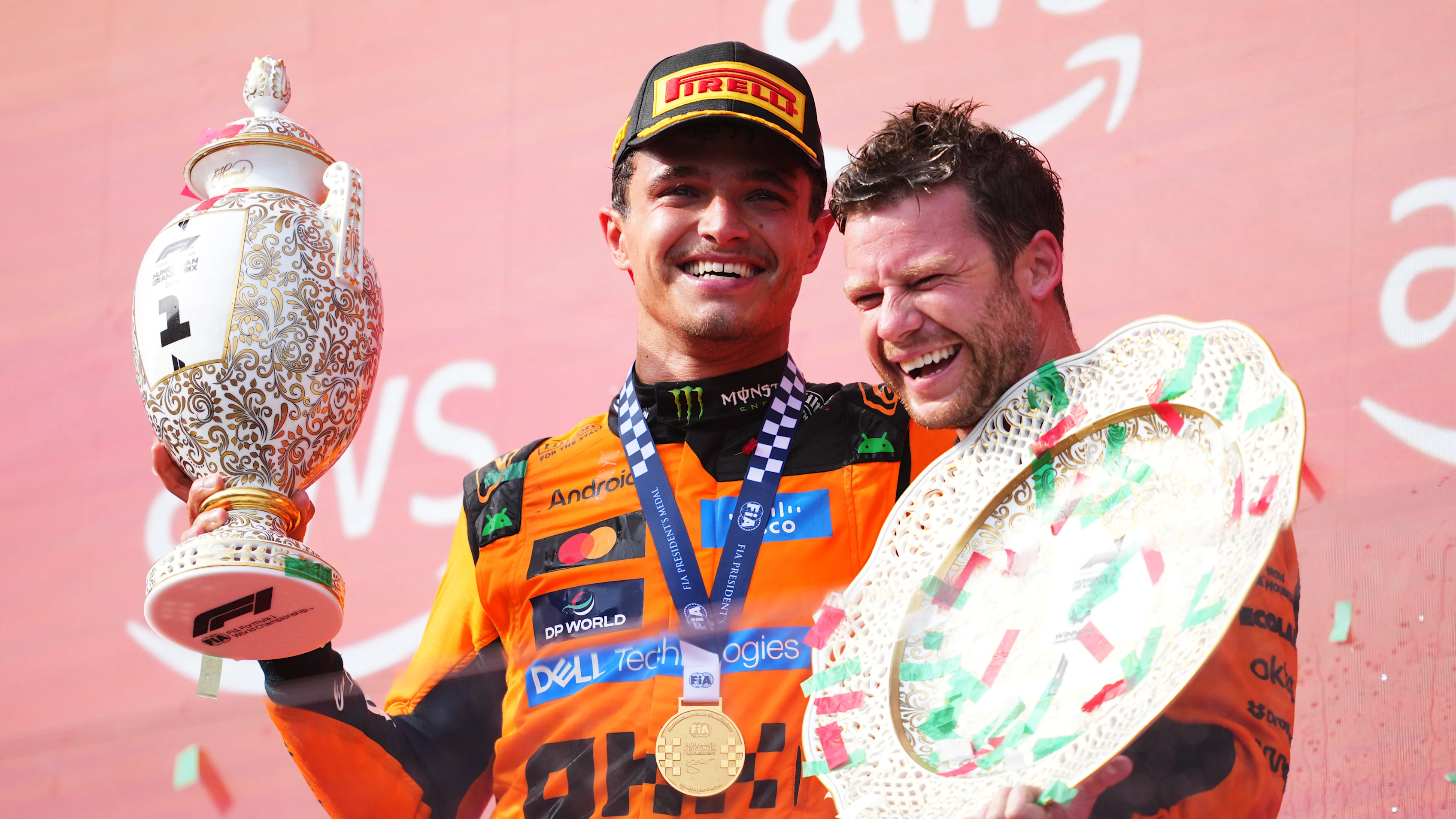
Lando Norris and McLaren did the important part in Hungary. They turned a pole position, an upgrade story and a tense pre-break weekend into a real Grand Prix win.
That should not be undersold. Formula 1’s official race report records Norris beating Max Verstappen by 15.080 seconds, with Kimi Antonelli third, Charles Leclerc fourth and Lewis Hamilton fifth after a pit-lane speeding penalty. McLaren’s own report calls it the team’s first win of the year, its 204th Formula 1 victory and its third straight Hungarian Grand Prix win.
GearPulse’s view: this was the most interesting F1 story of the day because it made yesterday’s McLaren qualifying proof matter, but it also exposed why McLaren’s season is still unstable. Norris looked like the cleanest winner of the current regulation cycle once he had air. Oscar Piastri looked quick enough to make it a McLaren control race. Then traffic, contact and a gearbox failure turned a likely team statement into a one-car rescue act.
Why this rose above the rest
The source stack is unusually clean for a race-day story. Formula 1 and the FIA published matching race accounts and official classification. McLaren supplied primary-team detail on both Norris’s win and Piastri’s gearbox retirement. Formula 1 also published a Piastri reaction piece that makes the losing side of McLaren’s day more than a footnote. AP, The Guardian and Motorsport.com all carried the same core shape of the race: Norris won, Piastri lost a strong position, Verstappen grabbed second, Antonelli protected the championship lead, and Hamilton’s latest penalty capped another messy Ferrari Sunday.
It is also materially new for GearPulse. Saturday’s article was about McLaren converting its Hungary upgrade into qualifying evidence. Today’s article is about what happens when that evidence meets a 70-lap race: one McLaren became the class of the field, the other became the caution label.
The other major candidate was the FIA and Formula 1 confirmation that Malaysia will host the 2026 Bahrain Grand Prix at Sepang in October. That is a big calendar story and it had official confirmation, Malaysian mainstream pickup and international coverage. It lost out here because the Hungarian GP produced the stronger immediate sporting angle, broader same-day race coverage and a direct continuation of the McLaren, Ferrari and Mercedes competitive thread.
Norris made the upgrade real
The cleanest reading of Hungary is that McLaren now has proof across every meaningful layer of a weekend.
On Friday, the team was still evaluating the new package. On Saturday, Norris put it on pole. On Sunday, he won by enough that the final margin cannot be dismissed as a traffic fluke. He did not lead every meaningful phase, and he did not have a frictionless afternoon, but once the race came back to him he turned it into a controlled run to the flag.
That matters because the Hungaroring is a useful car test in a different way from Spa or Silverstone. It rewards traction, rotation, tyre temperature control and confidence through linked medium-speed corners. If a package works only in clean high-speed air, Hungary can hide it behind traffic and rear-degradation pain. McLaren instead produced pole, race pace and enough strategic flexibility to win after losing the lead early.
The probability read has moved. Before Hungary, I would have put McLaren’s upgrade as a plausible but still unproven front-running step. After Norris’s win and Piastri’s early pace, it looks more like a 75-85% case that the MCL40 has gained genuine high-downforce performance. The caveat is reliability, not lap time.
Piastri is the part McLaren cannot ignore
Piastri’s race is the reason this does not read like a simple McLaren breakthrough.
Formula 1’s Piastri follow-up says he led the first half of the Grand Prix after moving past Leclerc at the start and then cutting back on Norris at Turn 2. The problem came after his second stop, when he had to clear traffic and made contact with Carlos Sainz between Turns 2 and 3. McLaren says the larger damage was ultimately a gearbox issue that forced him to retire.
That sequence matters for two reasons.
First, Piastri was not slow. If anything, the first half of the race strengthens the argument that McLaren had the car to dominate Hungary with both drivers. That is a better performance signal than a one-driver win.
Second, the failure converts performance into a management problem. McLaren can celebrate Norris, but it leaves Budapest with a sharper version of the question it had on Saturday: can it make two cars work at the same level, on the same weekend, under the same strategic pressure? Piastri missed FP1 for Leonardo Fornaroli’s rookie outing, then still became a win threat. That says a lot about the car and the driver. It also says McLaren left points behind.
Verstappen’s second was not random
Verstappen finishing second from a Red Bull weekend that never looked fully comfortable is the result rivals should take seriously.
Formula 1’s classification has him 15 seconds behind Norris, so this was not a disguised Red Bull win threat. But the fact he finished ahead of Antonelli, both Ferraris and Russell on a circuit where passing is difficult says Red Bull still has operational sharpness when races get untidy.
There is a danger in over-reading it. Hungary did not suddenly prove Red Bull has solved every weakness that has followed Verstappen through recent weeks. The more useful takeaway is narrower: when the front group leaves points loose, Verstappen still has a very high conversion rate.
That is relevant for the second half of the season. Red Bull does not need to be the fastest car every Sunday to influence the title fight. It only needs to sit close enough to punish McLaren reliability, Ferrari penalties or Mercedes execution gaps.
Antonelli lost little on a hard day
Antonelli’s third place may be the most quietly valuable result in the race.
He started seventh after a qualifying penalty, Mercedes was not the obvious fastest car in Hungary, and George Russell’s day went sideways almost immediately when an anti-stall issue dropped him down the order. Yet Antonelli still reached the podium and, according to AP and The Guardian’s updated standings, stretched his drivers’ championship lead to 219 points, 50 clear of Hamilton and 59 ahead of Russell.
That is classic damage limitation, and it is more important than it looks. Mercedes did not own this weekend in the way it had owned parts of the first half of the season. Ferrari had Friday pace. McLaren had the eventual winning car. Verstappen stole second. In that context, Antonelli leaving with third is exactly the kind of result that keeps a title bid calm.
The flip side is that his margin is now being protected by consistency rather than raw weekend dominance. If McLaren’s Hungary upgrade travels, and if Ferrari stops turning pace into penalties, Antonelli’s second half will require cleaner qualifying and fewer recovery drives.
Ferrari turned speed into stress again
Ferrari’s weekend had the ingredients for more than fourth and fifth.
Leclerc led FP1. Hamilton led FP2. Hamilton was close enough in qualifying to be a pole threat before his Saturday penalty. In the race, Ferrari had enough pace to stay in the conversation. But the final story is another mixture of speed, penalty and frustration.
Hamilton’s five-second pit-lane speeding penalty dropped him behind Leclerc in the classification. AP described it as another penalty on a weekend already shaped by his grid drop. Formula 1’s result makes the damage simple: Leclerc fourth, Hamilton fifth, no podium, no big title swing.
This is why Ferrari remains hard to price. The car can look like a real threat at the right circuit. The team can also give away the clean version of a weekend through traffic management, penalty exposure or timing. GearPulse’s read is that Ferrari’s raw competitiveness in Hungary was real, but the team is still only a 30-40% bet to turn that pace into sustained second-half pressure unless the execution improves.
The Hungary comparison board
| Team/driver | What Hungary proved | What still worries them |
|---|---|---|
| Lando Norris, McLaren | Pole-to-win conversion and strong clean-air pace. | Needs this to travel beyond McLaren-friendly circuits. |
| Oscar Piastri, McLaren | Had the speed to shape the race before retiring. | Traffic, reliability and lost points kept the team result incomplete. |
| Kimi Antonelli, Mercedes | Protected the championship lead from seventh on the grid. | Mercedes did not control the weekend on pace. |
| Max Verstappen, Red Bull | Still converts messy races into big points. | Red Bull was not close enough to beat Norris straight up. |
| Ferrari | Had enough pace for a podium challenge. | Penalties and execution kept turning pace into damage limitation. |
| George Russell, Mercedes | Recovered to seventh after a poor start sequence. | Another messy day versus Antonelli deepened the intra-team gap. |
Fun facts
McLaren now has three consecutive Hungarian Grand Prix wins, by three different competitive meanings: Piastri’s first F1 win in 2024, Norris holding off Piastri in 2025, and Norris winning again in 2026 with the number 1 on the car.
The Hungaroring remains a strange place for careers. It has produced first wins for Damon Hill’s near-miracle that got away in 1997, Fernando Alonso’s breakthrough in 2003, Jenson Button in 2006, Esteban Ocon in 2021 and Piastri in 2024. In 2026, it did something slightly different: it gave a reigning champion his first full Grand Prix win of the year.
Skipped candidates
Malaysia hosting the Bahrain Grand Prix at Sepang was the strongest non-race candidate. The FIA announced it on July 26, Malaysian outlets picked it up quickly, and Speedcafe/ESPN had the background trail. I skipped it because the race result had a bigger immediate F1 audience signal, more usable official sporting detail and a fresh continuation of GearPulse’s McLaren/Ferrari/Mercedes Hungary coverage.
Piastri’s traffic-contact and gearbox retirement could have been its own article because Formula 1 and McLaren both made it clear that his race was a major subplot. I folded it into the Norris article because the retirement is most meaningful as the warning inside McLaren’s winning day.
Hamilton’s latest Ferrari penalty was tempting after his recent unsafe-release protocol story and qualifying penalty. It was too narrow as a standalone Daily Dose angle, and it risks becoming repetitive unless Ferrari’s procedural pattern produces a materially new team response.
Antonelli’s podium and title lead could also stand alone, but GearPulse has published several Mercedes/Antonelli pieces since Spa. Hungary is better treated as a damage-limitation chapter inside the wider McLaren breakthrough story.
Bottom line
McLaren got the answer it needed from Hungary: the upgrade can win a Grand Prix, not just decorate a qualifying sheet.
The catch is that the same race showed why McLaren is not suddenly in control of the season. Piastri was fast enough to make it a two-car statement and still left with nothing. Verstappen salvaged second from a non-dominant Red Bull weekend. Antonelli stretched his lead on a day Mercedes did not own. Ferrari again showed pace without the clean result to match.
GearPulse’s bottom line: Norris’s win makes McLaren a much more serious second-half threat. Piastri’s retirement is the warning attached to it.