
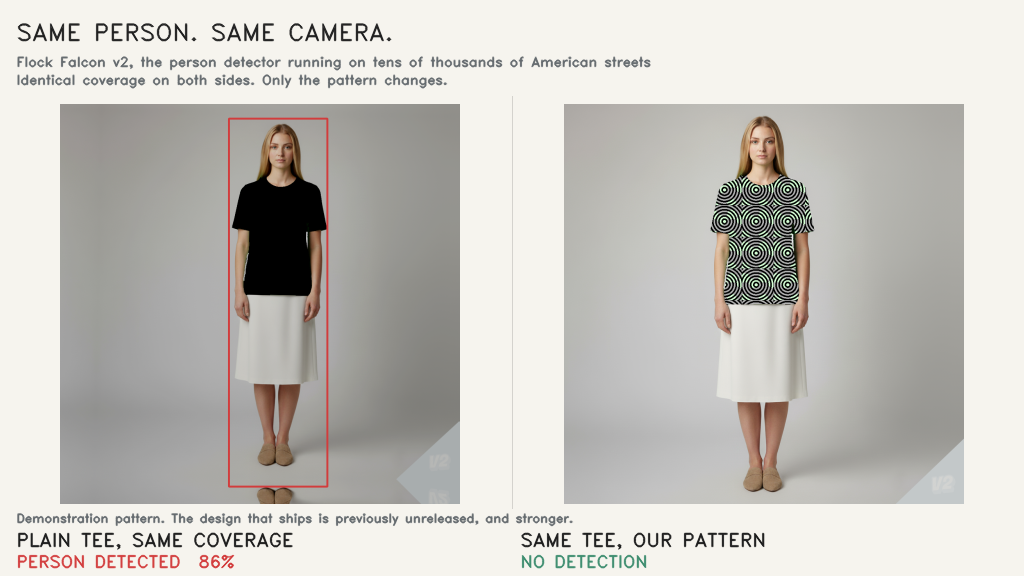
The most interesting privacy gadget of the week is not a phone, a browser or another dashboard full of toggles. It is a shirt that tries to make a camera’s AI look straight past you.
Bill Swearingen’s noRecognition project has been presented around Black Hat and DEF CON week as anti-surveillance clothing: shirts, hoodies, buffs and vehicle patterns designed to reduce automated detection by computer-vision systems. The official project page says the work has run more than 31 million tests against 11 production computer-vision models, with patterns scored before they ship. TechCrunch reports that Swearingen demonstrated one of the patterns on a vehicle at DEF CON, testing it against a Flock-style camera setup.
GearPulse’s view: this matters because surveillance has become boring infrastructure. Cameras are not just recording video anymore. They are feeding systems that identify plates, detect people, sort events and turn public movement into searchable data. noRecognition is relevant because it pushes privacy out of the app-settings menu and back onto the street, where ordinary people actually feel watched.
It also connects neatly with our recent piece on the WebKit Private Relay blind spot. Different technology, same lesson: privacy promises fail in the unglamorous details. With WebKit, the detail was which subsystem made a network request. With surveillance cameras, the detail is whether a detector confidently sees a person, face or vehicle in the first place.
What noRecognition claims
noRecognition is not claiming magic invisibility. The project page and interviews make a more precise claim: the camera can still record video, but the detection layer may fail to tag the person or object covered by the pattern.
| Claim | What it means for readers |
|---|---|
| 31.7 million tests run | The project is iterating patterns against detection models at scale, not simply printing a noisy graphic and hoping. |
| 11 production models | The target is practical surveillance AI, including person and vehicle detection, not only a toy academic demo. |
| Held-out test wearers | noRecognition says patterns are checked against people not used to make them, which matters for avoiding cherry-picked results. |
| Public method, private strongest patterns | The project wants proof without handing vendors a neat training set to patch against. |
That last point is the tension. A pattern that works because a model has not seen it can become less effective once the pattern is widely copied, photographed and added to training data. This is not a permanent invisibility cloak. It is closer to an ongoing contest between attackers, defenders and camera vendors.
Why clothing is the smart battleground
The obvious way to defeat a camera is to cover it. That is also illegal, suspicious or impractical in most places. Clothing is different. It is already the thing you put between your body and the world.
Academic work on adversarial patches has shown for years that computer-vision systems can be fooled by carefully designed physical patterns. The old problem was translation. A lab patch is not a consumer product. It has to survive fabric, distance, lighting, motion, body shape, camera angle and taste. Nobody wants to walk around in a shirt that screams “I am trying to break the surveillance stack.”
That is why noRecognition feels more personal than another research demo. The project is trying to make the countermeasure wearable enough to leave the lab. Swearingen told Startland News that the goal was not to disappear from video, but to make identity tracking harder. Dark Reading framed the approach around attacking the weaker, real-time detection step that often runs on limited camera hardware before heavier recognition or search systems take over.
My opinion: that is exactly where consumer privacy tools need to move. Not toward paranoia. Toward usable friction. If a city, store, building or private camera network wants to turn your body into a searchable event, there should be some practical way to say no without staying home.
The caveats are serious
This is early, adversarial technology, and readers should treat it like a promising prototype rather than a guarantee.
| Caveat | Why it matters |
|---|---|
| Cameras still record | A human reviewing footage may still see you clearly. |
| Models can adapt | Popular patterns could become training data for future detectors. |
| Real-world conditions vary | Lighting, distance, folds, motion and camera placement can change results. |
| Legal context matters | Some places restrict masks, plate covers or attempts to evade particular monitoring systems. |
| Privacy is not safety by itself | Anti-detection clothing can protect lawful protest and ordinary privacy, but any tool can be abused. |
The legal and ethical part should not be dodged. A technology that weakens surveillance will always make some people nervous. But that is not an argument for giving automated tracking a free pass. Cars have tinted windows. Phones have encryption. Homes have curtains. A free society normally allows some distance between being visible and being indexed.
The useful question is whether the tool is honest about its limits. noRecognition’s public messaging is stronger when it says “not invisible, harder to detect” than when the surrounding internet inevitably turns it into sci-fi armor.
Who should care
| Audience | Why this is relevant |
|---|---|
| Privacy-conscious consumers | It makes passive tracking feel less inevitable. |
| Security researchers | It is a physical-world test of model robustness, not just a benchmark score. |
| Camera vendors | It is a reminder that detection pipelines need adversarial testing before deployment. |
| Civil liberties groups | It creates a tangible way to discuss consent, protest and private surveillance networks. |
| Designers | It asks whether privacy clothing can look normal enough to be worn. |
I would not buy the first wave expecting perfect protection. I would pay attention because it changes the conversation. Once privacy becomes clothing, the debate is no longer only about policy PDFs and app permissions. It is about what people can carry into public space.
Bottom line
noRecognition is compelling because it treats automated surveillance as a system that can be tested, stressed and resisted.
The project does not make people vanish. It does something more believable and, frankly, more interesting: it tries to make camera AI less confident. That is enough to matter. In a world where detection confidence can decide whether footage is searchable, flagged or ignored, lowering that confidence can give people back a small but meaningful piece of control.
My take: anti-surveillance clothing will not replace privacy law, vendor accountability or better limits on camera networks. But it makes the power imbalance visible. And once people can wear that argument, the camera no longer gets to be the only machine in the room.
Support independent GearPulse articles at buymeacoffee.com/gearpulse.site.