
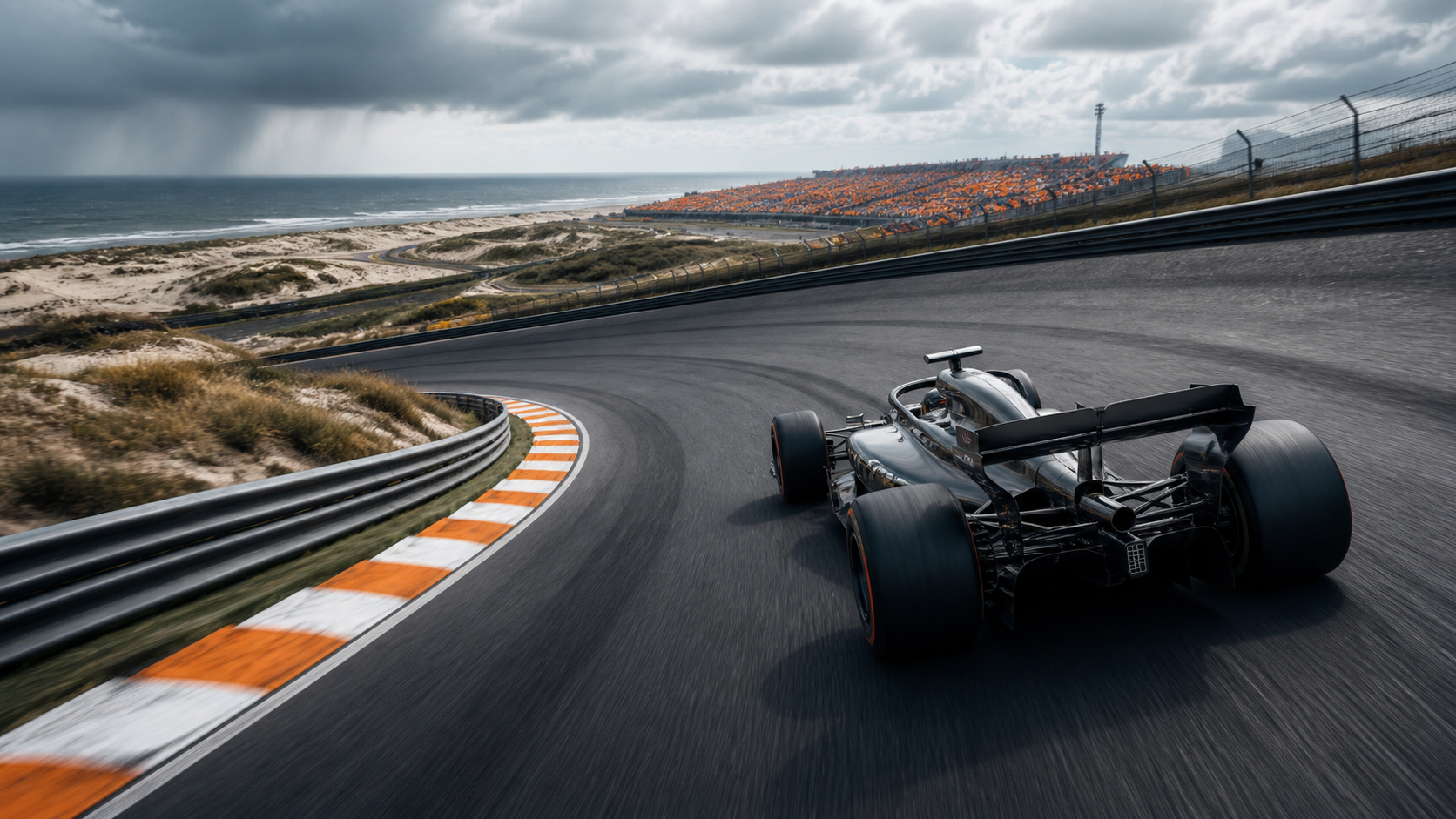
Formula 1’s Dutch Grand Prix Sprint starts at 10:00 UTC on Saturday, August 22 — 12:00 local time at Circuit Zandvoort. The short race is the middle of a compressed weekend, not a miniature version of Sunday’s 72-lap Grand Prix. That distinction matters at a 4.259-kilometre circuit where a small balance error can be repeated through banking, traffic and coastal wind before a driver gets a clean chance to reset.
This is a pre-session preview, not a results report. GearPulse is not trackside, does not have live telemetry and is not using live timing. It does not disclose or imply any completed Sprint Qualifying result, Sprint grid, Sprint outcome, qualifying result, pole position, race result, podium, fastest lap, classification-revealing penalty or championship outcome.
Why Zandvoort compresses the problem
The official timetable identifies the Netherlands as one of six 2026 Sprint weekends. That gives teams only one practice session before the Friday competitive session and makes every subsequent race lap a test of the setup direction they have already committed to.
Zandvoort’s Grand Prix is 72 laps and 306.587 km, but the Sprint’s shorter distance does not make it simple. The circuit is narrow, fast and unforgiving, with the steeply banked Hugenholtzbocht and Arie Luyendykbocht asking the car to hold a stable platform while the driver carries speed. Passing opportunities are limited enough that track position can be worth protecting even when a car has better peak pace behind it.
| Sprint variable | Why it matters at Zandvoort |
|---|---|
| Banking and ride control | A car that moves on the banked corners can overwork its tyres and leave the driver unable to use the exit cleanly. |
| Coastal wind | A breeze that changes direction can move the aero balance between the exposed fast corners and braking zones. |
| Short lap, dense traffic | A small gap-management mistake can spoil tyre preparation or put a driver into turbulent air quickly. |
| Track position | The narrow layout makes defending a sensible strategy, not merely a conservative one. |
The historical context is useful rather than decorative. Zandvoort returned to the championship in 2021 after a long absence, and 2026 is scheduled to be its final F1 weekend for now. That gives the event a local charge, especially for Max Verstappen, but it does not turn a home race into a setup advantage. The car still needs enough front-end precision to change direction without turning the rear tyres into a liability.
There are no DRS zones to count in 2026
For GearPulse readers used to judging a circuit by its DRS zones, the 2026 vocabulary matters. DRS has been replaced: active aero lets cars use low-drag Straight Mode at designated high-speed sections, while Overtake Mode supplies extra electrical energy to a following driver at activation points. The FIA says the new system is built around energy conservation as well as passing, unlike the old DRS-only logic.
At Zandvoort, that shifts the question from “where is the flap open?” to “who arrives at the useful point with energy left and a clean enough exit to spend it?” A driver who has had to correct the car through the banking may have less traction and less freedom to choose that moment. Equally, a team that trims the car too aggressively for straight-line efficiency can make the fast, loaded corners expensive.
That is the engineering argument for the Sprint: the useful car is not necessarily the one with the lowest-drag headline. It is the one that can preserve its tyres, keep enough battery deployment in reserve and still place itself well enough to avoid spending the whole race in disturbed air.
Weather can make the early laps decisive
Motorsport.com’s pre-weekend forecast called for cooler Saturday conditions and possible morning showers before the Sprint and qualifying. What Hi-Fi’s independent weekend guide likewise described rain as a meaningful risk across the event. Those are forecasts, not a claim about track conditions at the start, but they point to the same practical issue: Zandvoort’s seaside location can change grip and visibility faster than a static setup sheet expects.
If the surface is variable, tyre warm-up and the first few laps become more consequential. A driver who attacks immediately may gain track position; a driver who slides early can carry that damage through the short race. Teams also have to retain enough flexibility for later qualifying rather than treating the Sprint as an isolated experiment.
The team context: a setup referendum, not a verdict
Mercedes, Ferrari, McLaren and Red Bull enter the second half of the season with different ways to solve the same circuit. The most relevant pre-Sprint comparisons are inside the garages: whether each pair of drivers converges on a balance, whether the car holds the banking without nervous corrections, and whether its energy use remains controllable when it follows another car.
For Red Bull, Verstappen’s home event amplifies every signal without changing the technical task. For the leading teams, Zandvoort is a compact referendum on correlation: does the simulator’s expected low-speed traction and high-speed stability appear together on a real coastal circuit? The Sprint offers evidence, but not a final answer — its distance makes clean air, starts and tyre condition disproportionately important.
What to watch without chasing a result
Watch how close drivers can follow through the banked corners without overheating the tyres. Watch whether cars that look comfortable on entry also launch cleanly onto the straights. And watch the energy trade-off: active aero can lower drag, but a poor exit or empty battery can undo that gain before an overtaking attempt develops.
The official facts are straightforward: 10:00 UTC start, 12:00 local time, a 4.259-km lap, a 72-lap Grand Prix on Sunday, and a Sprint format that compresses setup learning. The interesting unknown is which team has created a car that can use Zandvoort’s banking as a tool rather than a warning light.