
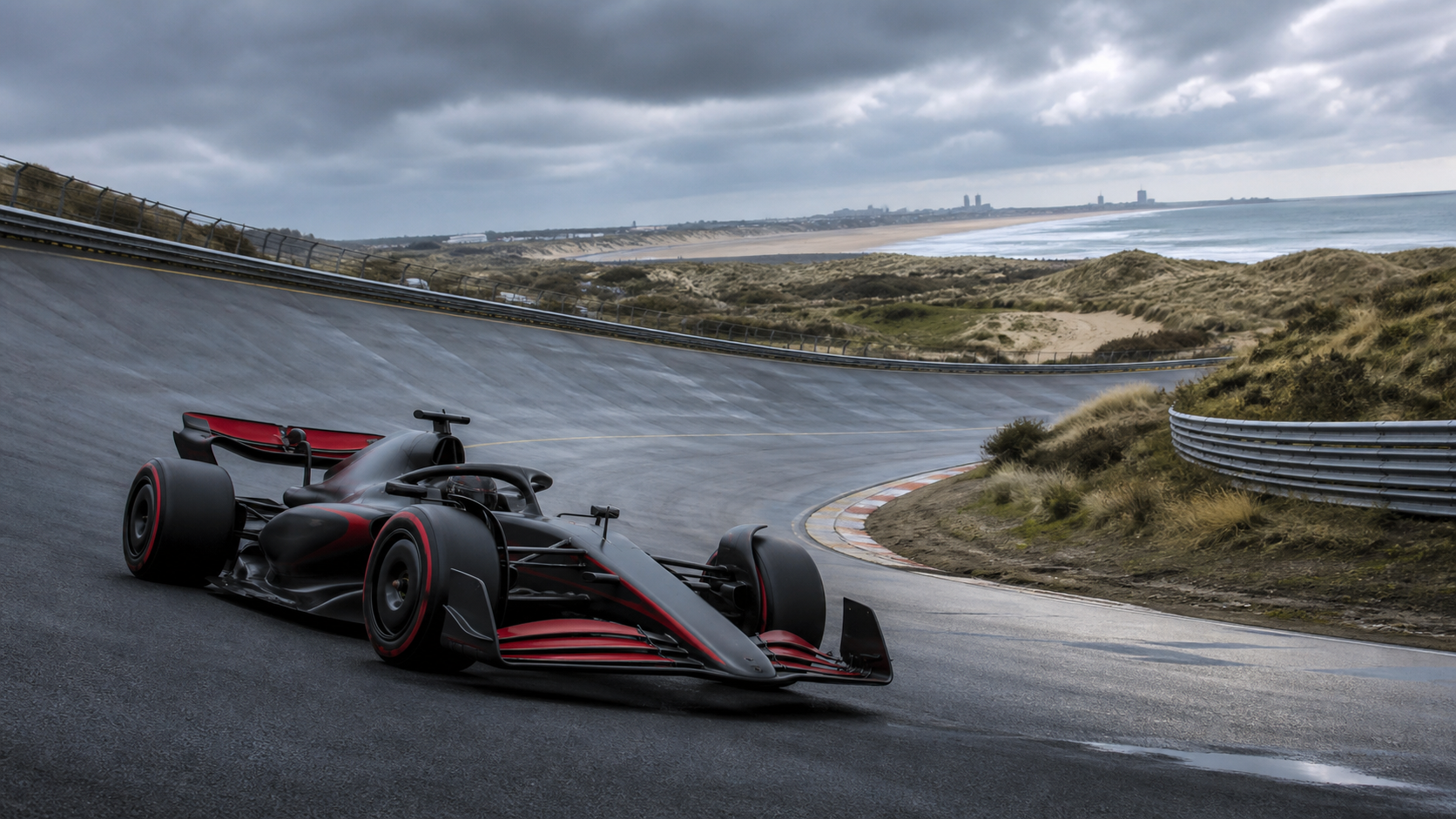
The 2026 Dutch Grand Prix begins at 13:00 UTC — 15:00 local time — at Circuit Zandvoort. This is a 72-lap, 306.587-km race on a 4.259-km circuit, but its real shape is set by the dunes: a narrow ribbon of asphalt, high-load banking and coastal wind that can move the car’s balance between one corner and the next.
This is a race-start preview, not a results report. GearPulse is not trackside, has no live telemetry and is not using live timing. Nothing here discloses or implies a completed qualifying, Sprint or race result, grid, pole sitter, winner, podium, fastest lap, classification-revealing penalty or championship outcome.
The fixed facts make a demanding 72 laps
Formula 1’s official race page puts the numbers in focus: 72 laps, 4.259 km per lap and 306.587 km in total. Its circuit guide describes Zandvoort as an undulating lap through the dunes, while the modernised Hugenholtzbocht and Arie Luyendykbocht banking create the distinctive high-load phases that make a calm car so valuable.
| Race-start checkpoint | Verified context |
|---|---|
| Session | Dutch Grand Prix race, 13:00 UTC / 15:00 local |
| Distance | 72 laps, 306.587 km |
| Circuit length | 4.259 km |
| Tyres | C2 hard, C3 medium, C4 soft |
| Track character | Narrow, flowing, banked and exposed to wind and sand |
| Weather forecast | 15-18C air, 20% rain chance, ENE wind forecast to gust to 32.4 km/h |
The last line is a forecast, not a claim about conditions at the start. Formula 1’s Sunday outlook called for a drier day than earlier in the weekend, but still forecast an east-northeast wind. Motorsport.com’s independent Sunday guide likewise identified track position and tyre behaviour as central at the seaside venue. That combination is the important GearPulse point: a stable forecast does not make a stable aerodynamic platform.
The tyre question is about usable pace, not just compound choice
Pirelli’s confirmed selection is C2 hard, C3 medium and C4 soft. It describes the hard as the likely Sunday reference, while making clear why Zandvoort can resist a one-line strategy: low baseline grip, sand that can be blown onto the surface, two steeply banked turns and high tyre energy density.
The strategic tension is simple. A longer hard-tyre phase can reduce stop count and protect track position, especially where overtaking is difficult. A softer option can create a pace advantage, but it has to pay for the pit-lane loss and then find clear air. With only one major straight and a narrow track, a quicker car caught in traffic can burn the very tyres that were meant to deliver the undercut or overcut.
| Strategy choice | Potential upside | Main risk |
|---|---|---|
| Longer hard stint | Fewer interruptions and greater control of track position | Giving up tyre temperature or early-stint pace |
| Medium-led flexibility | More ways to react to traffic, weather or degradation | Rejoining into a train after a stop |
| Soft-led attack | Immediate grip if track position is available | Thermal stress and an early second stop |
This is why lap-time headlines are less useful than stint shape. The car that can stay precise through the banking without sliding its rear tyres earns more strategic freedom than one that is merely fast for a handful of laps.
Active aero replaces the old DRS shorthand
There is no conventional DRS-zone count to lean on in 2026. The FIA’s rules explainer says the former DRS system has been replaced by active aerodynamics: front and rear wing elements change between higher-downforce corner running and lower-drag straight running, while the energy system adds an Overtake Mode under its defined activation conditions.
At Zandvoort, that is more than a terminology update. A low-drag straight mode helps only if the car exits the banked and flowing corners cleanly enough to use it. A car that needs a steering correction, loses rear grip or is unsettled by a gust can give away the exit speed and energy margin before the straight begins. The familiar question of who has the best DRS effect becomes a broader systems question: who can connect aero state, battery use and tyre load across the whole lap?
For GearPulse readers, it is a useful comparison with road-car engineering. Peak output is easy to advertise; repeatable performance when grip, temperature and load change is the harder product. Zandvoort is a compact version of that distinction.
Wind and banking make the setup visible
The official tyre preview says the two banked turns carry gradients of 19 and 18 degrees and generate high vertical and lateral tyre forces. It also flags gusts as a recurring local factor under the new aerodynamic rules. On a wide, stop-start circuit, a small balance shift can be recovered at the next braking zone. At Zandvoort, it can carry through several connected corners and into the tyres.
That puts the driver-and-team context in a sensible place without pretending a pre-race preview can know the order. Max Verstappen’s home setting makes every Zandvoort signal louder, but it does not change the physics of the banking. McLaren, Mercedes, Ferrari and Red Bull face the same base question: can their cars retain front response while keeping the rear calm as fuel burns away and the track changes? The better intra-team comparison is not a prediction; it is whether both drivers can converge on a repeatable balance rather than needing opposite compromises.
The Race’s independent weekend schedule confirms the 15:00 CEST start, while its wider Dutch Grand Prix coverage has emphasised the event’s distinctive farewell atmosphere. That is real human context, but the race remains a technical test first: local familiarity cannot substitute for tyre control or a clean aero platform.
What matters after the start
Watch the first stint for three things. First, whether the cars can follow through the banked corners without asking too much of the rear tyres. Second, whether the pit wall treats the hard as a control tyre or needs a softer compound to create an offset. Third, whether the wind turns what looks like a balanced setup into a compromise at the exposed parts of the lap.
The confirmed baseline is solid: 13:00 UTC start, 72 laps, 4.259 km, C2-C3-C4 tyres and no legacy DRS-zone calculation. The variable is execution. Zandvoort rewards a car that can make its mechanical grip, active aero and energy deployment agree with each other for a full race distance — not simply one that looks dramatic on a single clean lap.