
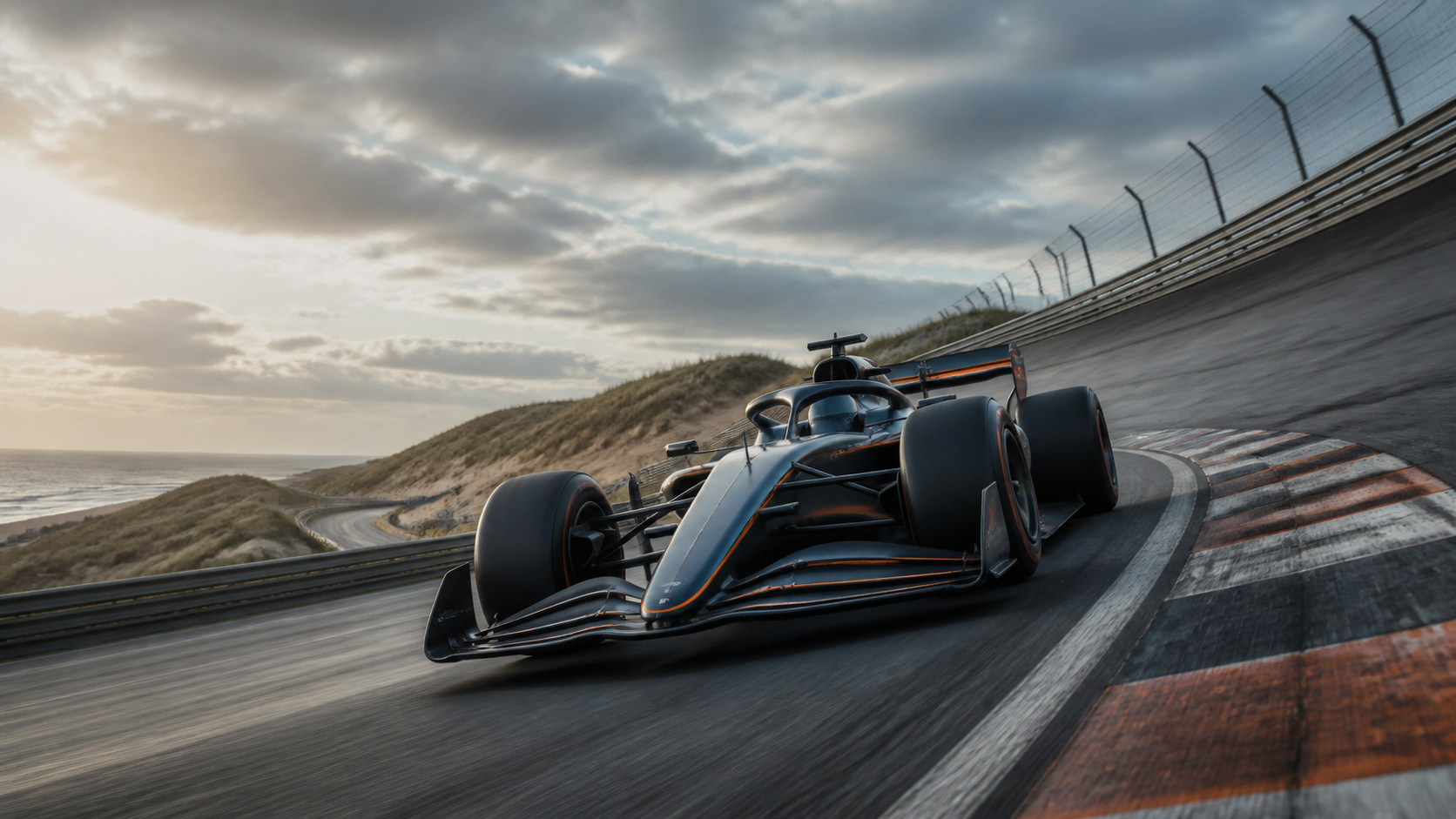
Dutch Grand Prix qualifying starts at 14:00 UTC on Saturday, August 22 — 16:00 local time at Circuit Zandvoort. Formula 1’s official race hub lists a one-hour session, but the job is more concentrated than that calendar slot suggests. At 4.259 km, Zandvoort is short enough for traffic and tyre preparation to crowd the margins, yet loaded enough to punish a car that is only efficient in a straight line.
This is a pre-session preview, not a results report. GearPulse is not trackside, does not have live telemetry and is not using live timing. Nothing here discloses or implies a qualifying, Sprint or race result, grid, pole sitter, winner, podium, fastest lap, classification-changing penalty or championship outcome.
A banking problem before it is a bravery problem
Zandvoort’s modern character comes from the banked Hugenholtzbocht and Arie Luyendykbocht, fast direction changes, and a narrow ribbon of asphalt cut through the dunes. Formula 1’s official timetable confirms that Sunday’s Grand Prix will run 72 laps for 306.587 km, a useful reminder that qualifying setup cannot be separated completely from the longer race compromise.
For one lap, though, the central question is simple: can the car stay low, composed and predictable as it loads up on the banking? A nervous rear axle turns the driver into a passenger at precisely the corners where a clean exit matters most. Chasing a little more top speed with less wing may look clever on a simulation sheet, but it is costly if it creates corrections through the corners that lead onto the circuit’s faster sections.
| Qualifying variable | Why it matters at Zandvoort |
|---|---|
| Banking stability | The car needs a dependable platform through the loaded corners so the driver can commit early. |
| Front-end response | Fast changes of direction reward a front axle that bites without making the rear slide. |
| Tyre preparation | A short lap gives little time to recover a tyre that begins the push lap too cool or too hot. |
| Traffic spacing | The tight layout makes a compromised out-lap or dirty air expensive even before the timed lap begins. |
That is why Zandvoort qualifying is relevant beyond a Saturday lap-time contest. It is a compact demonstration of how well a modern F1 car integrates suspension control, aero load and energy deployment when the driver needs all three at once.
DRS is no longer the shorthand
There are no conventional DRS zones to count in the 2026 rules. The FIA says the new active-aero package uses Straight Mode to reduce drag at designated high-speed sections, while Overtake Mode adds electrical energy for a following car at activation points. The systems make energy conservation part of performance rather than an invisible background calculation.
Qualifying uses that same hardware in a different way. The best lap is not automatically the one with the lowest-drag configuration; it is the one that can carry speed through the banking, arrive at the straight with a tidy exit, and deploy its available energy without leaving the car unsettled at the next braking point. That is the GearPulse engineering comparison to watch: a car that gains a little in peak speed but loses trust at the wheel may be slower over the whole lap than a slightly higher-downforce rival.
The weather is a setup variable, not scenery
Formula 1’s pre-weekend forecast puts Saturday air temperatures between 16C and 18C, with a 40% rain chance concentrated in the morning and early afternoon. It also forecasts moderate winds averaging 14.4 km/h, with gusts up to 28.8 km/h. Those are forecasts, not a claim about the conditions at the start of qualifying, but they describe exactly the kind of coastal variability that can move the balance of a car from one run to the next.
What Hi-Fi’s independent event guide also flags rain risk across the weekend. If qualifying is dry, the useful question is still how much the wind shifts the car in exposed corners; if the surface evolves, tyre warm-up and the order in which teams use their sets become more important than a fixed baseline. At Zandvoort, a small confidence deficit can turn into a large lap-time deficit because there are so few easy places to hide it.
The human context is unusually local
The Race notes that 2026 is scheduled to be Zandvoort’s final F1 weekend for now, giving this event a farewell atmosphere without changing the technical task. For Max Verstappen, the home setting naturally magnifies attention, but banking, wind and energy use do not grant anyone a free tenth of a second. The valuable signal is whether a driver can put the car on the limit without asking it to make a dramatic correction.
The broader team comparison is equally useful. The front-running organisations may arrive with different philosophies — a car that relies on peak aero load, one that protects rear stability, another that prioritises active-aero efficiency — but Zandvoort asks them to converge on the same answer. The package needs enough confidence in the corners to unlock its straight-line tools, not the other way around.
What to watch without chasing the result
Watch the out-laps. On a short circuit, leaving a small gap is not just etiquette; it decides whether the tyre reaches the first braking zone in the right state. Watch how sharply cars turn into the banked corners and whether they can release steering lock cleanly on exit. And watch the wind as a performance clue rather than a weather graphic: a gust that changes the aero platform can rewrite the driver’s comfort level without changing the setup sheet.
The confirmed facts are clear: qualifying begins at 14:00 UTC, the lap is 4.259 km, Sunday’s race is 72 laps, and 2026’s active-aero rules replace the old DRS shorthand with a more integrated energy question. The unknown worth watching is which team has built a car that treats Zandvoort’s banking as usable load instead of a liability.